The Coach-the-AI Protocol Explained: The Complete Guide from ZenithMind by Rich Schefren
Most people who use AI for self-improvement make the same foundational mistake.
They go in as students. They ask the AI to evaluate them, assess their weaknesses, tell them what to do. And the AI obliges — producing confident, well-structured, thoroughly generic advice. Advice that sounds correct. Advice that could apply to ten thousand different people. Advice that changes nothing because it reflects no actual understanding of who they are.
Rich Schefren has spent over two decades studying why intelligent, motivated people consistently underperform relative to their capabilities. His answer, developed across years of working with some of the highest-earning entrepreneurs in the world, is almost always the same: the bottleneck is not knowledge, strategy, or effort. It is invisible psychological patterning — automatic behaviors and beliefs operating below conscious awareness, sabotaging execution in ways the person cannot see from inside their own perspective.
The traditional solution to this problem is expensive, slow, and dependent on the quality of the practitioner: years of therapy, coaching relationships that cost tens of thousands of dollars, or luck in finding someone skilled enough to see what you cannot see about yourself.
ZenithMind — Schefren's $1,097 AI-assisted mindset course — is built on a different premise. AI does not replace great coaching. But when configured and used correctly, it surfaces invisible psychological patterns in hours, not years. And the framework that makes that possible is what he calls the Coach-the-AI Protocol.
The Problem With How Most People Use AI
Before unpacking the protocol itself, it is worth understanding the failure mode it corrects.
When you sit down with ChatGPT or any large language model and say "help me with my limiting beliefs" or "what's holding me back in business," the AI has no real information about you. It has training data — statistical patterns extracted from billions of documents written by millions of people. It produces statistically likely responses to your query, not personally calibrated insights about your specific psychological architecture.
The output feels insightful because language models are extraordinarily good at generating confident, articulate prose. But it is the same kind of insight a horoscope provides: broad enough to feel true, specific enough to feel relevant, and ultimately non-diagnostic because it reflects no real knowledge of you.
The second failure mode is the opposite: people dump their life story into the AI and expect it to synthesize something profound. Without structure, this produces a different kind of generic — an overwhelming mirror of everything you've said, reorganized slightly, with no analytical frame to make it actionable.
The Coach-the-AI Protocol solves both problems by restructuring the fundamental dynamic of the human-AI interaction.
What Is the Coach-the-AI Protocol?
The Coach-the-AI Protocol is a four-stage methodology for using AI as a diagnostic instrument for self-knowledge, rather than an answer machine. It inverts the conventional relationship: instead of positioning yourself as a student asking the AI to teach you, you position yourself as a domain expert who is briefing the AI with structured, highly specific inputs so that the AI can perform pattern recognition on your behalf.
The four stages are:
- Give domain ownership
- Force justification
- Switch models for brainstorming
- Never bring your own ideas first
Stage 1: Give Domain Ownership
The first stage establishes the AI's role before you introduce any personal content.
This is not the same as the popular technique of telling ChatGPT to "act as a world-class coach." That instruction makes the AI adopt a persona, but it does not actually change the quality of the information it has to work with. The AI is still operating without domain context, and no persona instruction changes that.
Giving domain ownership means something more specific: you prime the AI with a structured briefing about the specific domain in which you are operating. Not your life story. Not your goals. The precise context, terminology, and dynamics of the psychological or behavioral territory you are exploring.
In practice, this might look like spending the first part of your session establishing what patterns like procrastination, self-sabotage, or decision avoidance actually look like in entrepreneurial contexts specifically — not generally, not theoretically, but in the specific operating environment of someone running a business with real stakes. You are giving the AI the map of the terrain before you start discussing where you are on it.
This matters because AI pattern recognition is context-sensitive. The same behavioral description will produce radically different analysis depending on whether the AI's current session context is calibrated to general human psychology or to the specific domain of high-performing entrepreneurs who are stuck despite extensive knowledge and resources.
Schefren's insight here is structural: most people skip this step because it feels like overhead. It feels like setting up instead of doing. But the quality of everything downstream — every insight, every analysis, every pattern the AI identifies — depends on how precisely the domain context was established in this first stage.
Stage 2: Force Justification
The second stage introduces a discipline that most AI users never apply: you require the AI to show its reasoning, not just state its conclusions.
Language models are optimized to produce confident output. They do not naturally hedge, explain their inferential chains, or identify where their analysis is weakly supported versus strongly supported. When the AI says "this pattern suggests you may have a fear of visibility," it is stating a conclusion. The conclusion may be correct. It may also be a statistically common observation about entrepreneurs that has nothing specifically to do with you.
Forcing justification means requiring the AI to explain, for each insight it produces, what specific evidence in what you said supports that conclusion — and what alternative interpretations exist that were considered and discarded.
This produces two benefits. First, it surfaces the difference between genuine pattern recognition and generic output. If the AI cannot point to specific details from your inputs that generated a specific conclusion, the conclusion is generic. Second, and more importantly, the process of reading the AI's reasoning often triggers your own recognition of patterns you did not consciously register while you were describing them.
The psychological mechanism here is significant. When you tell your own story, you are inside it. The telling is automatic, shaped by the same cognitive filters that created the patterns in the first place. When you watch an external system trace the logical connections between the things you said, you are looking at your patterns from the outside — often for the first time. That shift in perspective is where the diagnostic value lives.
Schefren's instruction is simple: never accept a conclusion without asking the AI to justify it in specific terms. Make this a hard rule in every session, not an occasional practice when you feel skeptical.
Get Every Framework from ZenithMind
The course costs $1097. All frameworks extracted — $49/year.
Start free — 10 full summaries, no credit card
Stage 3: Switch Models for Brainstorming
The third stage is one of the most technically specific in the protocol and one of the most commonly misunderstood.
Not all AI models think alike. Different large language models — and different versions of the same model — have different training emphases, different tendencies in how they handle ambiguity, and different characteristic patterns in what they generate when asked to produce novel ideas or divergent options.
What this means practically: the same AI you use for analysis and pattern recognition is not necessarily the best AI to use when you want to brainstorm possible solutions, alternative interpretations, or new behavioral experiments to try.
Schefren's instruction is to use different tools for different cognitive tasks within the same session or process. Use one model to build your Zenith Signature Profile — the structured picture of your psychological patterns, defaults, and blind spots. Use a different model, or a deliberately different prompting configuration, when you want to generate ideas, options, or creative reframings.
The reason is that fresh sessions and different models bring no inherited assumptions from the analysis session. They approach the brainstorming task without the frame already established — which means they are more likely to surface genuinely novel possibilities rather than variations on what the analysis session already concluded.
For practitioners conditioned to use a single AI tool for everything, this is an unusual discipline. It requires deliberately switching tools when the cognitive task changes. But the output difference is real: analysis conducted in one frame and brainstorming conducted in a fresh frame produces a richer and more practically useful set of possible experiments than a single continuous session in the same model.
Stage 4: Never Bring Your Own Ideas First
The fourth stage is the most counterintuitive, and arguably the most important.
The natural impulse when working with an AI on personal development is to share your existing hypotheses. You already have theories about what's holding you back. You have ideas about why you procrastinate, why you avoid certain conversations, why a particular goal keeps stalling. And those ideas feel important, feel true — because you have been living with them.
Schefren's instruction is to withhold them.
Before the AI has produced its independent analysis based on the structured inputs you have provided, do not offer your own interpretations. Do not say "I think I might be afraid of success" or "I've always suspected I have imposter syndrome." These are not neutral observations. They are hypotheses — and the moment you introduce them, you shape the AI's subsequent output in the direction of confirming or engaging with them rather than generating an independent read.
Language models are highly responsive to the frame established by the person they are talking with. If you say "I wonder if I have fear of success," the AI will engage with that frame. It will explore it, find evidence for it, potentially validate it. The output will be intelligent and coherent — and it will reflect your hypothesis back to you with more articulation than you had originally, which will feel like insight but is actually confirmation.
The diagnostic value of AI is highest when it is generating its own patterns from the raw material you have provided — before your interpretive layer is introduced. Once the AI has produced an independent analysis, you can then share your own hypotheses and compare. The differences between what the AI noticed and what you assumed are often where the most useful information lives.
This is not about distrusting your own self-knowledge. It is about separating your existing narrative from the fresh pattern recognition the AI can provide — and then using both together.
How the Protocol Fits Inside ZenithMind
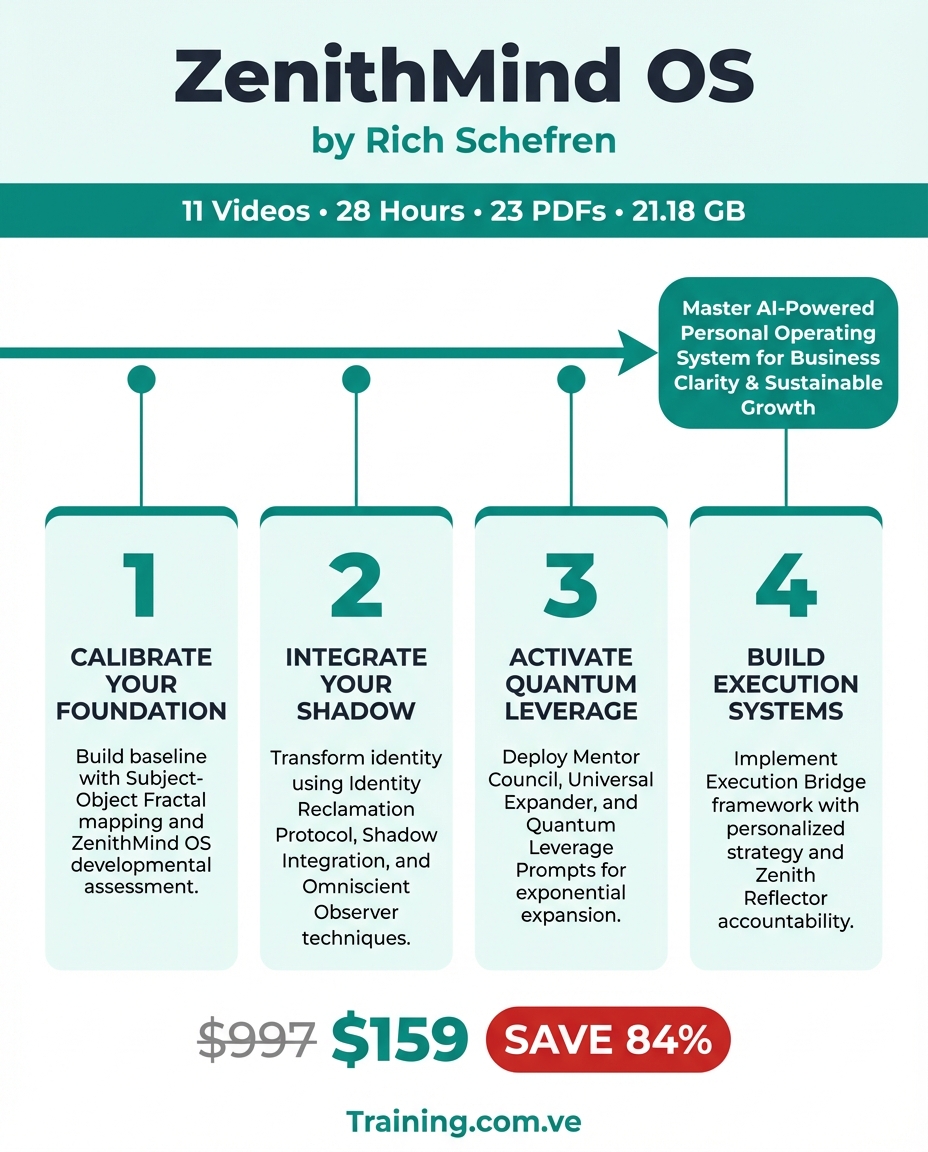
The Coach-the-AI Protocol does not operate in isolation. Inside ZenithMind's 5-module, 11-lesson structure, it serves as the operational methodology for building the Zenith Signature Profile — the AI-generated map of your psychological architecture that the rest of the course works from.
The Subject-Object Theory that Schefren teaches elsewhere in the course explains the core problem the protocol is solving: the psychological patterns that most constrain your behavior are the ones you are so identified with that you cannot see them. You are subject to them, not objective about them. The patterns feel like reality rather than like patterns.
The Coach-the-AI Protocol is designed to make you objective about what has been subjective. It uses a structured external instrument — configured and interrogated in a specific way — to generate a perspective on your patterns that you cannot generate from inside them.
The Business Neural Network Model provides the diagnostic categories the AI is looking for. The Zenith Mirror Score provides a way to measure the clarity of the picture being built session by session.
But none of those frameworks produce results without a correct relationship to the AI. The protocol is the operational foundation on which all of it depends.
Who Gets the Most Out of This Framework
The Coach-the-AI Protocol delivers the highest value to a specific kind of person: someone with enough self-awareness to know they have blind spots, and enough frustration with conventional solutions to try something structurally different.
If you have done coaching, therapy, journaling, or personality assessments and found them useful but insufficient — particularly if you have the experience of understanding your patterns intellectually while still being run by them behaviorally — this framework addresses exactly that gap.
The protocol's power is not that it gives you new information about yourself. It is that it surfaces existing patterns in a frame you can see for the first time. The AI does not know things about you that you do not know. But it processes what you tell it without the defensive filters, narrative assumptions, and habitual framings that you bring to your own self-examination — and that processing difference is where the value lives.
Schefren has spent decades coaching the people behind some of the most successful online businesses in the world. The Coach-the-AI Protocol is his attempt to make the diagnostic capability that was previously available only in an expensive one-on-one coaching relationship accessible through a $1,097 course and a ChatGPT subscription.
Whether it fully delivers on that promise depends significantly on how rigorously you apply the four stages. The framework is precise because it has to be: shortcuts at any of the four stages collapse the diagnostic value back toward the generic output most people get when they use AI without this kind of structure.
Used correctly, it is one of the most sophisticated applications of large language models to personal development currently available.
Read the Full Breakdown Before You Buy
The course costs $1,097. The full Course To Action breakdown deconstructs every framework across all 11 lessons — including the Coach-the-AI Protocol analyzed stage by stage alongside the God Prompt, Omniscient Observer, Business Neural Network Model, and Zenith Mirror Score. Every lesson has audio so you can read the summary or listen instead.
Course To Action covers 110+ premium courses. Free account gets you 10 summaries — no credit card required. Full access is $49 for 30 days. AI tools let you "Apply to My Business" (3 free credits) or "Generate Action Plan" (10 credits) so you can pressure-test whether the framework fits your situation before committing at this price.
Read the Full ZenithMind Breakdown on Course To ActionGet All Frameworks from ZenithMind
The course costs $1097. The complete breakdown is $49/year — every course on the platform.
This is one framework. Course To Action has every framework, every lesson, and AI that applies it to your specific business. Read or listen — every summary has audio.
Start free — 10 full summaries, no credit card required