The Ladder of Belief: Kathleen Cameron's Framework for Reprogramming Your Money Identity
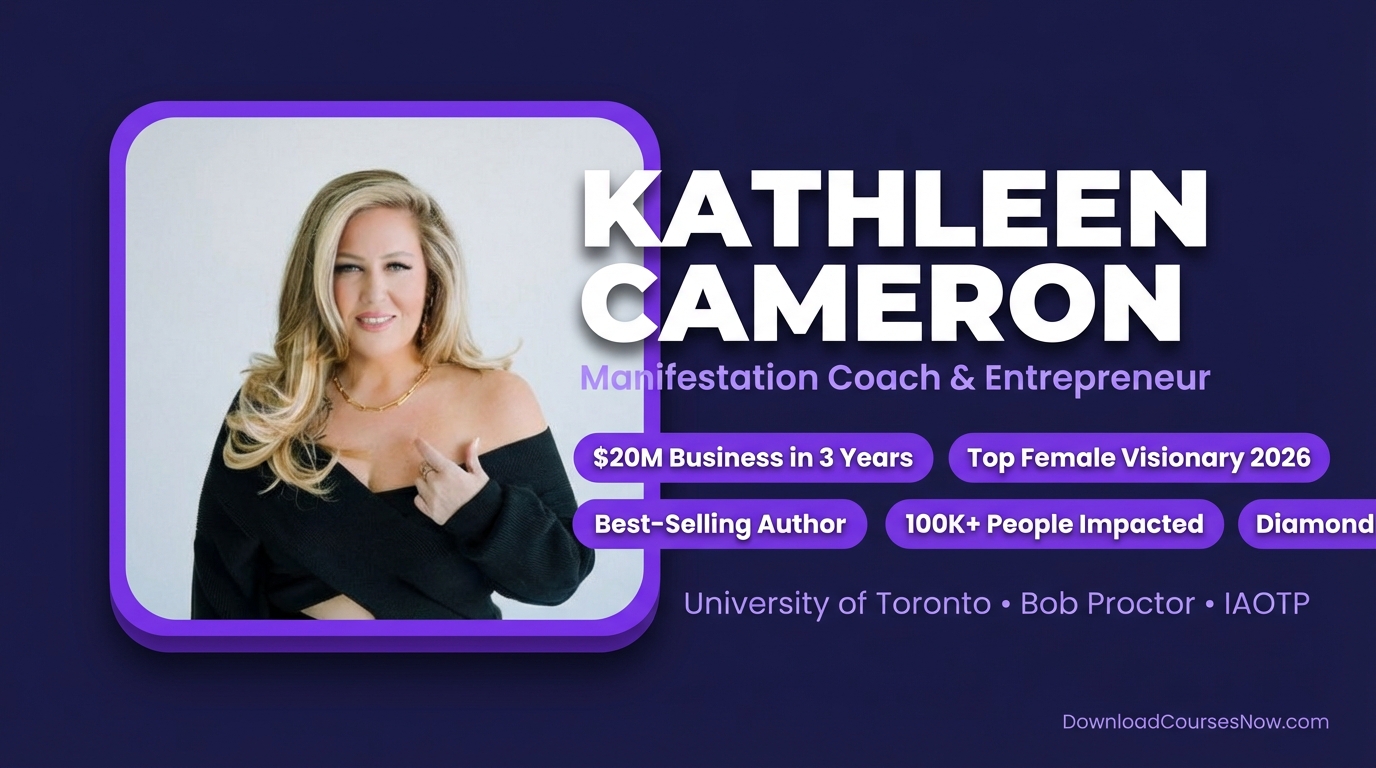
Most people spend their entire lives trying to change their financial situation by changing what they do. They budget harder, hustle longer, switch careers, and read every personal finance book they can find. But Kathleen Cameron — a former registered nurse who built a $20 million business in under three years — argues that all of that effort is pointed in the wrong direction.
The real lever, she says, is not behavior. It is belief. And not just any belief — belief held so deeply, so thoroughly, at such a fundamental level of identity, that it becomes indistinguishable from fact.
That is what the Ladder of Belief is designed to produce.
What Is the Ladder of Belief?
The Ladder of Belief is one of the cornerstone frameworks inside Cameron's Wealth from Within 2025 course. It maps a psychological and spiritual progression across four distinct rungs, each representing a different relationship a person can have with a desired reality — in this case, wealth.
The four rungs are:
- Need
- Want
- Believe
- Know
Cameron's core thesis is simple: your external financial reality is always a direct printout of whichever rung you are living from. If you are living in Need, your bank account will reflect scarcity. If you have climbed to Know, abundance becomes a matter of inevitability, not effort.
Rung One: Need
The lowest rung on the ladder is Need, and it is where the vast majority of people unconsciously live — not because they are broken or flawed, but because it is the default output of a culture that constantly reminds people what they lack.
Living from Need means that wealth feels like an emergency. It means that every financial decision is made from a place of desperation, fear, or urgency. When you are in Need, money is not something you attract — it is something you chase. And the act of chasing, Cameron argues, sends a signal to the subconscious mind that wealth is always just out of reach.
The energetic signature of Need is contraction. The nervous system is in low-grade survival mode. Creative thinking narrows. Opportunities that would be obvious from a higher rung become completely invisible.
What makes Need so difficult to escape is that it feels entirely justified by external circumstances. The bills are real. The debt is real. The scarcity is real. And so the mind keeps cycling evidence of shortage, reinforcing the identity of someone who does not have enough.
Cameron uses her own story here with particular power. As a burned-out nurse dealing with the mental and physical exhaustion of a demanding career, she was not just financially constrained — she was running on empty. Need was not just a financial state for her. It was a whole-body experience. Recognizing that state was the first step toward leaving it.
Rung Two: Want
Moving to Want is often mistaken for progress, and in some ways it is. Want at least implies a direction. There is desire. There is a vision. The person on this rung can picture a different financial life and feels a pull toward it.
But Want has a hidden trap. Want, by its very grammatical nature, implies absence. "I want to be wealthy" contains within it the embedded assumption that you are not wealthy yet. The subconscious mind — which operates on feeling and identity rather than logic — hears the dominant signal: not yet, not now, not me.
This is why people can spend years on vision boards, affirmations, and goal-setting practices and see little material change. They are practicing Want with enormous dedication. But the very act of wanting reinforces the gap between where they are and where they wish to be.
Cameron is careful not to dismiss desire entirely. She recognizes that Want is a necessary step in the journey — it is the rung that gets people searching, reading, investing in courses like hers. The problem is treating Want as the destination rather than a waypoint.
The shift from Want to Believe requires more than enthusiasm. It requires evidence — internal evidence that begins to override the old story.
Get Every Framework from Wealth from Within 2025
The course costs $$1,111. All frameworks extracted — $49/year.
Start free — 10 full summaries, no credit card
Rung Three: Believe
Believe is where the transformation genuinely begins to take root. On this rung, a person has gathered enough internal and external data points to hold a new proposition as possible. The wall of impossibility that existed at Need, and the frustrating gap that characterized Want, begins to soften.
Belief is the rung where affirmations and visualization start to do meaningful work — not as wishful thinking, but as mental rehearsal of a reality that feels genuinely accessible. A person at Believe may have their first real month of unexpected income, or may notice that their relationship with money conversations has shifted from anxiety to curiosity.
However, Belief is also the most unstable rung on the ladder. Cameron calls the experience of moving between Believe and lower rungs "The Wobble" — a concept she treats as its own distinct framework. The Wobble is the experience of holding a new belief and then getting hit by a piece of contradictory evidence (an unexpected bill, a launch that underperforms, a relationship that feels tight around money), and feeling the new belief partially collapse.
She is explicit that The Wobble is not a sign of failure. It is a sign of transition. The nervous system does not give up old identity constructs easily. What separates people who eventually reach Know from those who stay stuck at Believe is not that they never wobble — it is that they learn to wobble without fully returning to Need.
The practices Cameron teaches for stabilizing Believe include her Five Methods for Subconscious Reprogramming — tools drawn from a combination of neuroscience, somatic work, and spiritual principle. These practices are designed to stack internal evidence faster than external circumstances can tear it down.
Rung Four: Know
Know is the rung that most people in the personal development world talk about without fully understanding. It is often described in mystical terms — certainty, faith, unshakable conviction. But Cameron approaches it with more precision than that.
Living from Know does not mean you have no fears or doubts. It does not mean you walk around in a perpetual state of bliss. It means that at the identity level — at the level of who you fundamentally are — wealth is no longer a question. You do not need to affirm "I am wealthy" with effort. You simply are. The affirmation becomes redundant the same way you do not need to affirm "I have a body."
The linguistic marker Cameron uses for Know is the shift from "I AM wealthy" as an aspiration to "I AM wealthy" as a statement of current identity. This is not semantic wordplay. The subconscious mind responds to identity declarations with physical and behavioral reality. When wealth becomes part of identity rather than a goal, the entire system — decisions, attention, relationships, opportunities — begins to reorganize around it.
Cameron traces her own journey to this rung back to a specific moment, not of external success, but of internal collapse and reconstruction. It was not when she hit her first six-figure month that she felt she had arrived. It was when she stopped needing the number to validate who she was.
The Circulatory System of Money framework, another concept inside the course, builds directly on Know. Cameron teaches that money moves toward identity, not effort. When your identity is that of a wealthy person, money circulates toward you the way blood circulates toward healthy tissue — naturally, continuously, without force.
Why This Framework Matters
The Ladder of Belief is particularly powerful as a diagnostic tool because it removes blame from the equation. You are not poor because you are lazy. You are not financially stuck because you lack intelligence or drive. You are financially stuck because you are operating from a lower rung of internal belief — and rung-location is not a moral judgment. It is simply a starting point.
Cameron built this framework from her own experience and from watching the transformation patterns of the more than 100,000 people she has worked with across her programs. The pattern is consistent: when the internal rung shifts, the external reality shifts. Not always immediately. Not always linearly. But consistently.
This is what makes Wealth from Within 2025 a fundamentally different kind of financial education. It is not teaching you how to invest. It is not teaching you how to market. It is teaching you how to become the kind of person for whom wealth is a natural outcome — because that is who they are, not because of what they do.
Who Will Get the Most from This Framework
The Ladder of Belief will resonate most powerfully with people who have already tried the tactical approach and found it insufficient. If you have done the budgets, built the business plans, read the books, and still find yourself cycling back to the same financial ceiling — this framework offers a genuinely different explanation and a genuinely different path.
It will also resonate with people who have had brief moments of financial expansion but could not sustain them. The Wobble concept, in particular, will feel like a revelation to anyone who has wondered why they seem to "self-sabotage" just as things start to go well. The answer, Cameron would say, is that they had not yet climbed to Know. They were at Believe — and Believe wobbles until the identity fully solidifies.
The framework is less useful for someone seeking step-by-step financial tactics. Cameron is explicit that this course does not cover investment strategies, marketing systems, or business planning. The Ladder of Belief is a tool for internal architecture, not external strategy.
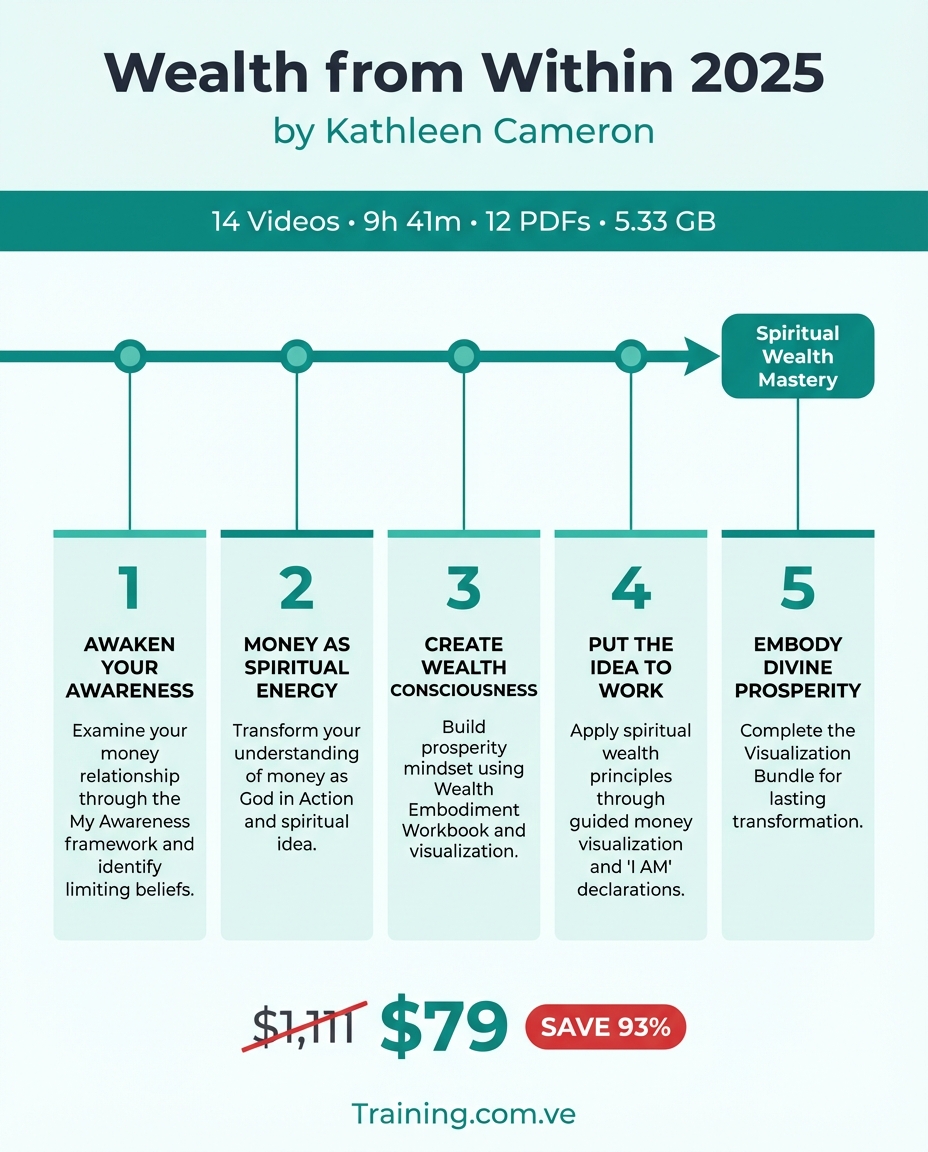
Wealth from Within 2025 is available at coursetoaction.com with our full breakdown, including who the course is best suited for and what to expect from the 14-lesson curriculum. The course costs $1,111. The full breakdown — plus 110+ other premium courses — is on coursetoaction.com. Start free: 10 summaries, no credit card required. Every summary has audio so you can read or listen. Use "Apply to My Business" (3 free AI credits) to see how the Ladder of Belief applies to your own situation right now. Start free at coursetoaction.com
Get All Frameworks from Wealth from Within 2025
The course costs $$1,111. The complete breakdown is $49/year — every course on the platform.
This is one framework. Course To Action has every framework, every lesson, and AI that applies it to your specific business. Read or listen — every summary has audio.
Start free — 10 full summaries, no credit card required