The Viral TEDx Formula Explained: Suzanne Adams' 3-Part Talk Architecture for Talks That Get Millions of Views
Most TEDx talks disappear into the void. They get polite applause in the room, a modest YouTube upload, and then nothing. No shares. No invitations. No ripple effect. The speaker walks off stage feeling like they said something meaningful, but the world moves on in about 48 hours.
Then there are the talks that hit a million views. Two million. Five. They get clipped, quoted, and embedded in newsletters years after they were recorded. People reference them in job interviews and therapy sessions and late-night conversations.
What separates these two outcomes is not credentials, charisma, or even the quality of the idea. It is structure. Specifically, it is the three-part architecture that speaking coach and TEDx mentor Suzanne Adams calls the Viral TEDx Formula, taught inside her course The TEDx Program.
This article breaks down each component of that formula, explains the reasoning behind it, and shows you how to begin applying it before you ever step foot on a TEDx stage.
What Is the Viral TEDx Formula?
The Viral TEDx Formula is a talk architecture built around three sequential components:
- The Magnetic Hook (15-20 seconds)
- The Quantum Moment (approximately 2 minutes)
- The Idea Worth Spreading Reveal (with evidence)
Component 1: The Magnetic Hook (15-20 Seconds)
The hook is the first thing out of your mouth. It has one job: stop the scroll.
In an era where the average viewer decides within the first few seconds whether to keep watching a video, the opening of your talk is a make-or-break moment. Suzanne Adams teaches that the hook must accomplish this in 15 to 20 seconds — not 60, not 90. Fifteen to twenty.
This constraint forces a kind of ruthless clarity that most speakers resist. The instinct is to warm up the audience, to establish credibility, to ease into the topic. That instinct is the enemy of virality.
An effective Magnetic Hook tends to do one of the following:
- Opens with a disorienting or counterintuitive statement. Something that makes the listener tilt their head and think, "Wait, what?" The cognitive friction creates an immediate need for resolution.
- Drops into a scene in medias res. No preamble. You are already inside a moment. The listener has to catch up, and catching up keeps them engaged.
- Makes a bold, falsifiable claim. Not a vague assertion, but a specific statement that either challenges conventional wisdom or promises a concrete outcome.
The test for a strong hook is simple: if someone read just those first two or three sentences cold, would they feel compelled to keep reading? If the answer is "maybe" or "I think so," the hook needs more work.
Component 2: The Quantum Moment (Approximately 2 Minutes)
After the hook creates curiosity, the Quantum Moment creates connection.
This is a short personal story — two minutes, roughly 300-350 words spoken aloud — that functions as the emotional anchor for everything that follows. Adams uses the word "quantum" deliberately. A quantum moment is a before-and-after moment. It is the specific point in time when something shifted: a belief cracked open, a perspective inverted, a decision got made that changed the trajectory of a life.
The Quantum Moment is not a biography. It is not a tour through your credentials or a summary of your career arc. It is one scene, rendered with sensory specificity, that shows the audience the exact moment you encountered the problem your talk is solving.
Why does this work? Because ideas are abstract. Stories are concrete. When you ask an audience to accept a new way of thinking, you are asking them to do something cognitively difficult. The story gives them an emotional handhold. They are not just hearing a proposition — they are feeling the experience that made the proposition necessary.
Several things tend to make a Quantum Moment land:
- Specificity of detail. The color of the room. The exact words someone said. The physical sensation in your body. Vague stories create vague connection.
- Vulnerability without performance. The moment needs to feel real, not curated for sympathy. Audiences can sense the difference.
- A clear hinge. The story needs to have a visible turning point — the moment before and the moment after. Without the hinge, the story is just anecdote.
Component 3: The Idea Worth Spreading Reveal (With Evidence)
This is where the talk earns its TEDx designation.
TEDx is built around a specific premise: ideas, not stories. The talk cannot be a testimonial or a keynote speech. It has to introduce and defend a distinct, transferable idea that the audience can take away and apply or share.
Adams teaches that the Idea Worth Spreading must be revealed — not buried, not implied, but stated clearly — and then supported with evidence. This evidence can take several forms: data, case studies, research, or additional illustrative stories. But the idea itself must be explicit. The audience should be able to write it down in one sentence.
What distinguishes a strong Idea Worth Spreading from a weak one:
- It is specific enough to be disagreeable. If no one could argue with it, it is not an idea — it is a platitude. "Connection matters" is not an idea. "Loneliness is a public health crisis that begins in middle management" is an idea.
- It is transferable. The audience can take it out of the room and use it. It gives them a new lens, a new vocabulary, or a new practice.
- It is framed as a mission, not a story. Adams is precise about this distinction. The idea is not "here is what happened to me." It is "here is what this means for you and why it matters now."
Get Every Framework from The TEDx Program
The course costs hundreds of dollars. All frameworks extracted — $49/year.
Start free — 10 full summaries, no credit card
How to Craft Each Component: A Starting Framework
If you want to begin working on your own Viral TEDx talk structure, start here:
For the Hook: Write ten possible opening sentences. Force yourself to make each one a cold open — no context, no introduction, no warm-up. Then read each one to someone unfamiliar with your topic and watch their face. The ones that make someone lean in are worth developing. For the Quantum Moment: Write the scene, not the lesson. Describe what happened without explaining what it meant. Include at least three specific sensory details. Once the scene is written, identify the exact hinge — the before and after. If you cannot find the hinge, the moment is not quantum enough. For the Idea Reveal: Write your idea in one sentence. Then ask yourself: could someone disagree with this? Could it appear in a headline? Could someone share it at a dinner table and spark a debate? If the answer to all three is yes, you have a real idea. Then list every piece of evidence you have for it.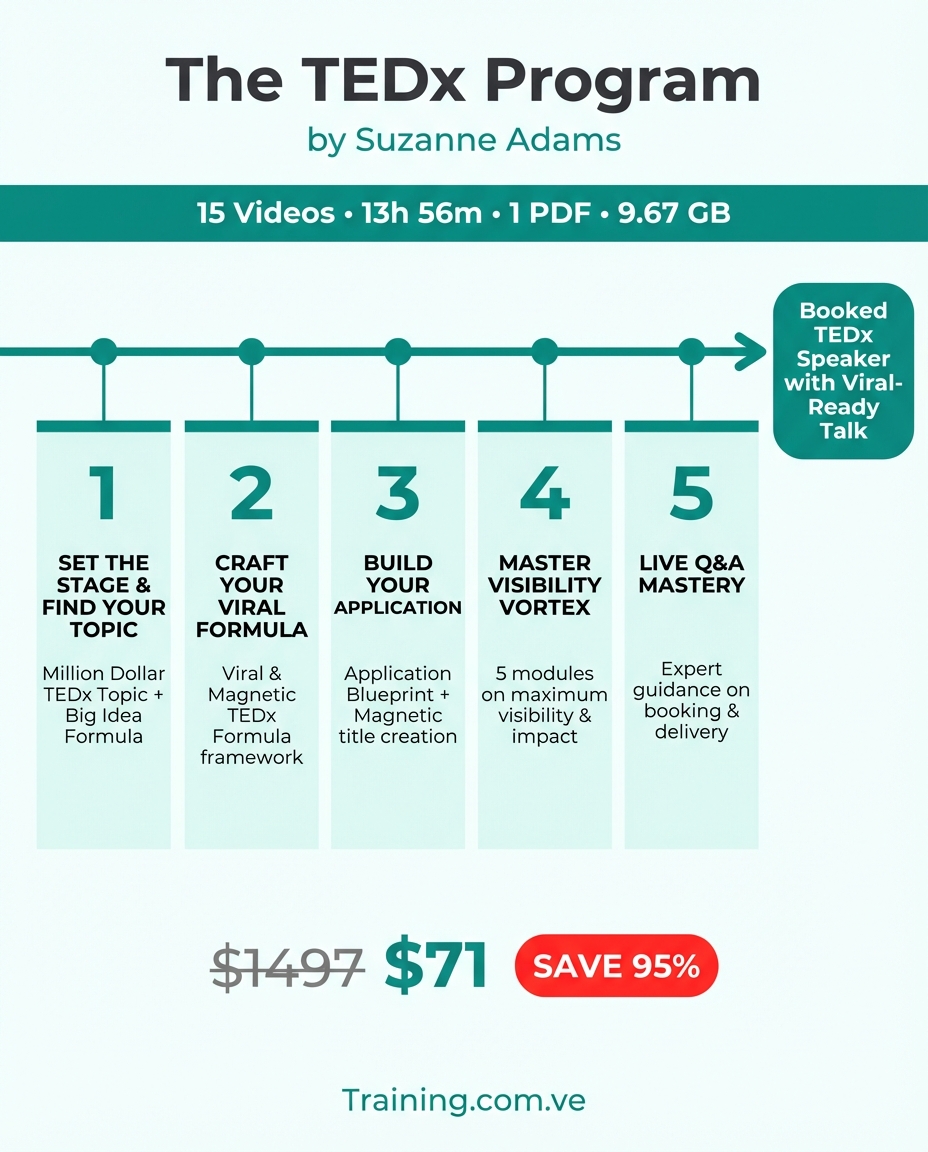
Apply This Week
- Draft your ten hook options. Do not edit. Just generate.
- Write your Quantum Moment in full. Aim for 300-350 words.
- Write one sentence that captures your Idea Worth Spreading. Test it for specificity and transferability.
Common Mistakes to Avoid
Starting with context instead of a hook. Context is for the middle of a talk, not the beginning. The audience does not need background to be hooked — they need disruption. Making the Quantum Moment too long. Two minutes is a constraint, not a suggestion. When the personal story runs long, the idea gets squeezed. The story is the setup, not the main event. Stating the idea too late or too softly. Some speakers are so attached to the dramatic build that they never fully declare the idea. If the audience cannot write your idea down in one sentence at the end of your talk, the reveal failed. Confusing inspiration with evidence. Emotional resonance is not evidence. A moving story can support an idea, but it cannot prove it. You need both.Final Thought
The Viral TEDx Formula works because it respects the audience's attention, earns their emotional investment, and then delivers a transferable idea worth their time. It is not a gimmick. It is a structure built around how human beings actually process and retain new information.
Suzanne Adams teaches this framework inside The TEDx Program alongside the application strategy, topic development, and positioning work that gets speakers booked in the first place. The formula itself is a starting point anyone can work with right now, before a single application is sent.
The talk that changes your life is probably already inside you. The formula is just the architecture that lets it out.
coursetoaction.com has the complete lesson-by-lesson breakdown of The TEDx Program — including audio for every summary — alongside 110+ other premium courses. Free to start, no credit card required. The AI tools ("Apply to My Business" and "Generate Action Plan") let you put Adams' frameworks to work for your specific speaking situation.
Read the full TEDx Program breakdown on Course To ActionGet All Frameworks from The TEDx Program
The course costs hundreds of dollars. The complete breakdown is $49/year — every course on the platform.
This is one framework. Course To Action has every framework, every lesson, and AI that applies it to your specific business. Read or listen — every summary has audio.
Start free — 10 full summaries, no credit card required