The Four Pillars of Story Explained: Muse Storyfirst's Diagnostic Framework for Why Your Content Isn't Landing
You spent three weeks on that video. The footage was clean. The edit was tight. You hit publish and waited.
Nothing.
A few polite comments from friends. A handful of views that tapered off by day two. No shares, no clients, no momentum. And the worst part is you cannot figure out why. The technical execution was fine. So what went wrong?
Emmy-winning filmmakers Patrick and Grant of Muse Storyfirst have a specific answer to that question, and it is not what most creators expect to hear. In their course, The Science of Storytelling, they argue that most video content fails not because of production quality but because it is missing one or more of what they call the Four Pillars of Story.
This framework is not a checklist you run through in post-production. It is a diagnostic tool you apply before you ever pick up a camera — a way of identifying exactly which structural element your story is lacking and why that absence is causing your audience to disengage.
What Are the Four Pillars of Story?
The Four Pillars framework is built on a foundational insight from Muse Storyfirst's research into narrative psychology: stories work because they transport audiences into a different mental state. When a viewer is fully absorbed in a story, their rational defenses drop. They stop evaluating and start experiencing. The beliefs and emotions they generate in that state feel self-created, which makes them far more durable than anything delivered through argument or statistics.
But transportation only happens when all four structural elements are present. Remove any one of them and the story stalls. The audience stays in their head. The message lands flat.
The Four Pillars are:
- People — the emotional engine
- Plot — the engagement mechanism
- Places — the trust builder
- Purpose — the memory anchor
Pillar One: People (The Emotional Engine)
The first pillar is the most foundational. Stories without compelling people are not stories — they are reports.
In The Science of Storytelling, Patrick and Grant point to a landmark piece of research to explain why this matters so much. In what is known as the Rokia study, researchers found that a single girl's story generated 2.4 times more donations than statistical data describing millions of people in need. More striking still, when researchers added statistics alongside Rokia's story, donations went down. The data diluted the emotional connection.
People connect with people. Not demographics, not case studies, not "clients like you." A specific human being with a specific face, a specific problem, and a specific interior life.
This is why Muse Storyfirst built what they call the Big Three Character Scoring system — a 20-point framework that evaluates potential story subjects across three dimensions: desire, motivation, and uniqueness. A subject who scores high on all three creates the emotional pull necessary to initiate narrative transportation. A subject who scores low on any dimension produces content that viewers describe as "fine" but do not share and do not remember.
When this pillar is missing or weak, the diagnostic symptom is simple: viewers watch but do not feel anything.

Pillar Two: Plot (The Engagement Mechanism)
Once you have a compelling person, you need something to happen. That something is plot — but not in the Hollywood sense of car chases and plot twists. In Muse Storyfirst's framework, plot is defined through what they call the Desire + Conflict + Growth Delta Formula.
Every story that holds attention contains a character with a clear desire, a genuine conflict standing between them and that desire, and a measurable delta — a visible change from who they were at the start to who they are at the end. The delta is what makes a story feel complete. Without it, even compelling characters produce content that feels like it goes nowhere.
The course maps this onto what Muse Storyfirst calls Six Essential Plot Points: Hook, Conflict, Initiation, Journey, Resolution, and Jab. These are not arbitrary narrative beats. Each one serves a specific function in maintaining viewer engagement across the arc of the story. The Hook establishes the desire. The Conflict introduces the obstacle. The Initiation marks the character's decision to act. The Journey is the struggle. The Resolution delivers the delta. The Jab is the closing emotional punch that ties the story's meaning to the audience's own life.
When this pillar is missing or weak, the symptom is viewer drop-off midway through. People start watching but lose interest before the message lands.
Pillar Three: Places (The Trust Builder)
This is the pillar most creators underestimate. Place is not set dressing. It is not visual interest for its own sake. In Muse Storyfirst's framework, place is the mechanism through which audiences grant a story permission to feel real.
The course breaks place down into Four Layers: Time, Environment, Objects, and Situations. Each layer contributes a different quality of specificity. A story set "in a kitchen" is forgettable. A story set in a grandmother's kitchen where the linoleum has been worn through in the exact spot where she stands to roll dough — that story is real. The specificity signals authenticity. And authenticity is the precondition for trust.
This pillar matters especially for documentary and brand filmmakers because the real-world settings they work in are a feature, not a limitation. A corporate testimonial filmed in a generic conference room with a logo wall backdrop is fighting against itself. The environment is signaling inauthenticity even as the person on screen tries to say something genuine.
When this pillar is missing or weak, the symptom is that viewers find the content "hard to believe" or describe it as feeling "staged" — even when every word is technically true.
Get Every Framework from This Course
The course costs hundreds of dollars. All frameworks extracted — $49/year.
Start free — 10 full summaries, no credit card
Pillar Four: Purpose (The Memory Anchor)
The fourth pillar is what transforms a story from entertainment into meaning. Purpose is what the story is ultimately about beneath the surface narrative. It is the reason a viewer should care not just in the moment, but tomorrow, and next week.
Muse Storyfirst maps purpose onto Seven Story Archetypes: Origin, Value, Why, Vision, Teaching, Impact, and Objection. Each archetype serves a different strategic function depending on what you need the audience to believe, feel, or do after the story ends. An Origin story builds founder credibility. A Value story demonstrates principles through behavior rather than assertion. An Objection story preemptively addresses skepticism by embedding the counterargument inside the narrative itself.
Without a clear purpose, stories entertain but do not convert. Viewers feel good while watching and forget the content within hours. The emotional experience does not attach to a durable belief because there was no belief being constructed beneath the surface.
When this pillar is missing or weak, the symptom is engagement without action — likes without inquiries, shares without sales.
How to Use the Four Pillars as a Diagnostic Tool
The practical power of this framework is that it gives you a language for diagnosing failure at the structural level rather than the execution level.
When a piece of content underperforms, run it through each pillar with these questions:
- People: Is there a specific, named individual at the center of this story? Have I established what they want and why it matters to them personally?
- Plot: Does something actually happen? Is there a before and after that a viewer can feel the difference between?
- Places: Have I grounded this story in specific, sensory-rich detail that signals authenticity? Does the environment support or undermine the credibility of what is being said?
- Purpose: What belief am I constructing beneath the surface of this story? Which archetype am I working in, and does my structure serve that archetype?
Apply This Week
Pick one piece of underperforming content — a video, a case study, a testimonial — and run it through the four-pillar diagnostic. Do not look at the production quality. Do not adjust the color grade. Ask only: which pillar is weak or missing?
Then rebuild from that pillar outward.
If it is People, go find a subject who scores high on desire, motivation, and uniqueness. If it is Plot, map the actual before-and-after delta of your subject's experience. If it is Places, add three specific sensory details that a viewer could not have invented themselves. If it is Purpose, choose one archetype and subordinate every other creative decision to it.
Common Mistakes
Treating all four pillars as equally optional. They are not. People is foundational — without it, the other three cannot function. Start there. Confusing "nice visuals" with "strong place." Cinematic footage of mountains is not place-building. Specific, story-relevant detail in a specific environment is. Defining purpose as theme. Purpose is not "this story is about resilience." Purpose is the specific belief you want a specific audience to hold after watching. Themes are vague. Purpose is operational. Scoring characters on likability instead of desire. A likable character who does not want something specific is not a story subject. Desire is what creates narrative pull.Ready to Go Deeper?
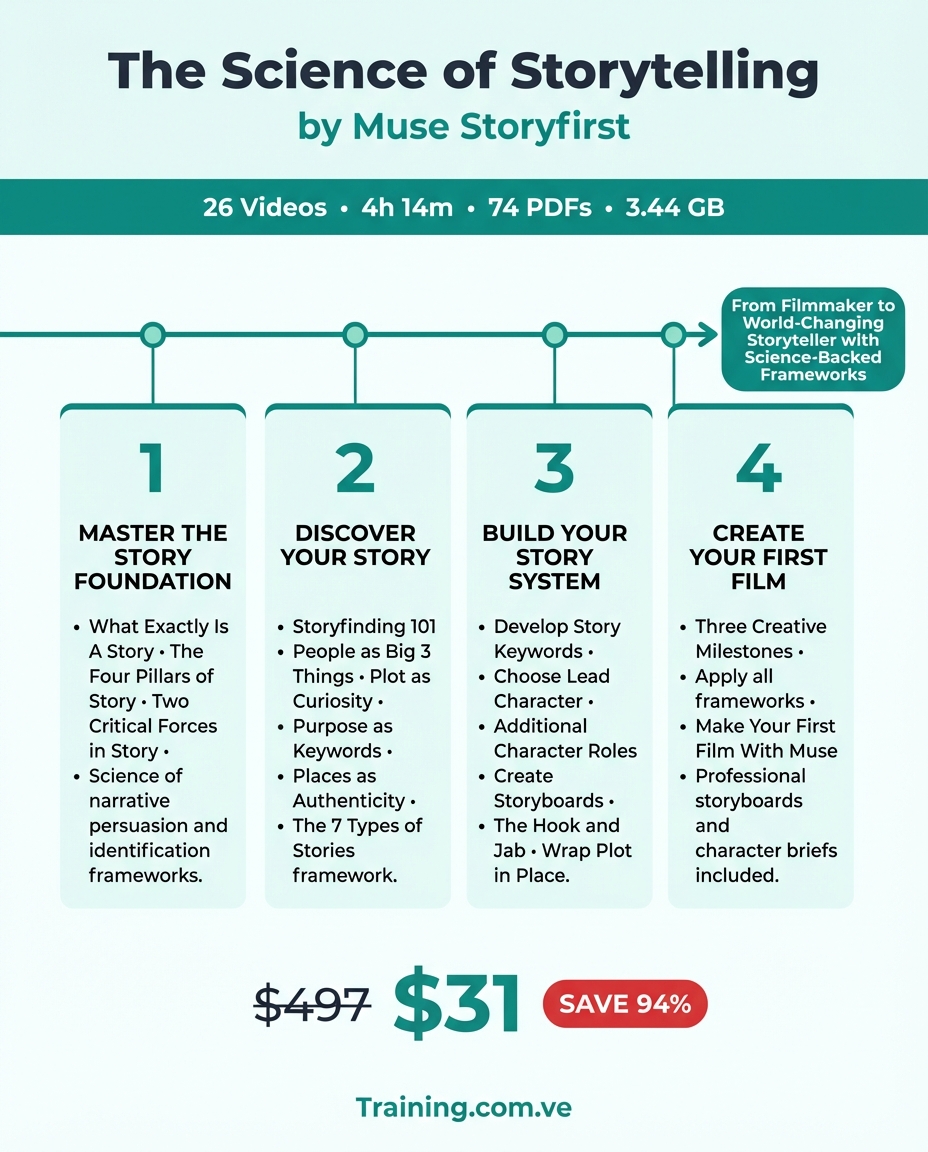
The Four Pillars framework is one component of The Science of Storytelling by Muse Storyfirst — a 26-lesson intermediate course built by Emmy-winning filmmakers who have helped creators scale from $4K to $40K+ per film. The full course covers the complete Storyfinding process, the Big Three Character Scoring system, Six Essential Plot Points, Seven Story Archetypes, and the Three Creative Milestones that take a story from raw conversation to final storyboard.
coursetoaction.com (110+ premium courses, from $49 for 30 days) publishes the complete lesson-by-lesson summary with audio at coursetoaction.com/. Use the "Apply to My Business" AI tool (3 credits) to run the Four Pillars diagnostic against your own content, or generate a full action plan (10 credits). Free tier available — no credit card required.
Get All Frameworks from This Course
The course costs hundreds of dollars. The complete breakdown is $49/year — every course on the platform.
This is one framework. Course To Action has every framework, every lesson, and AI that applies it to your specific business. Read or listen — every summary has audio.
Start free — 10 full summaries, no credit card required