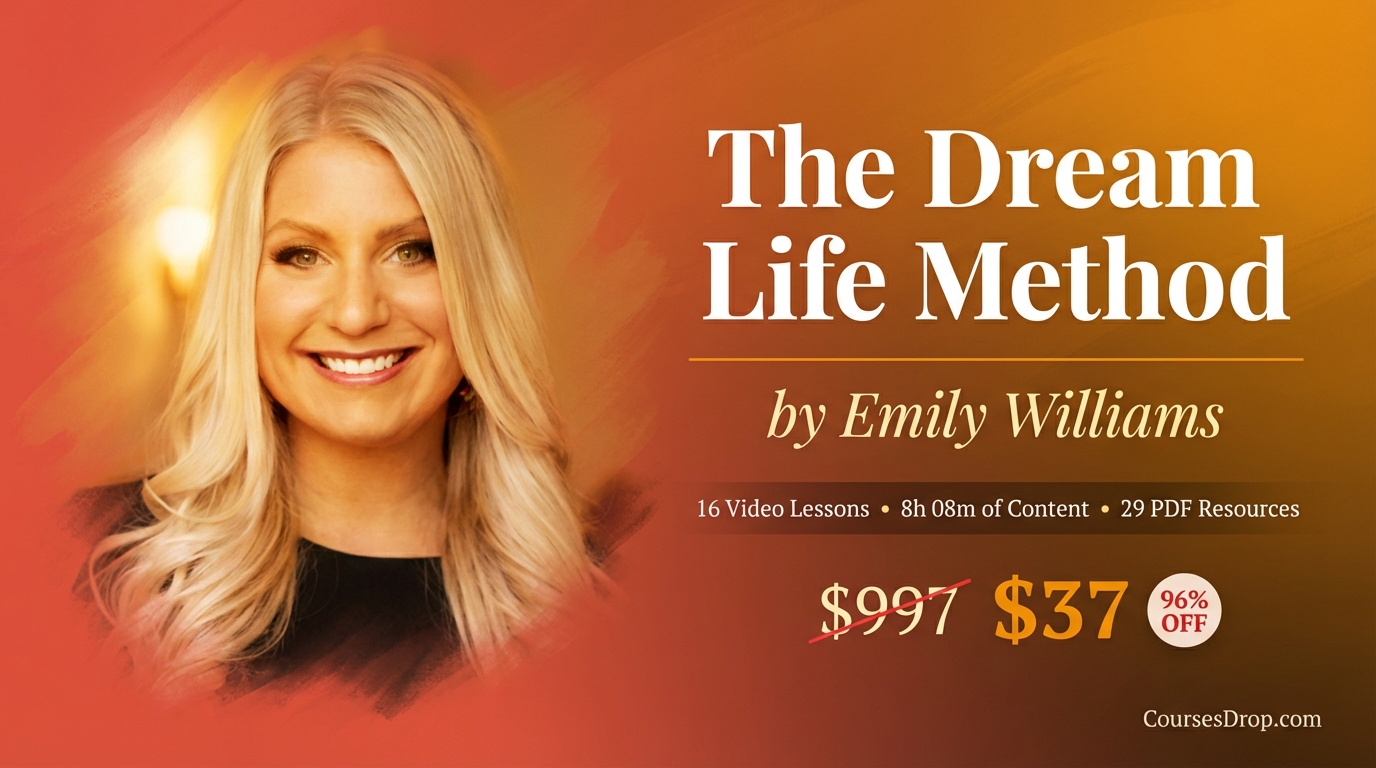
Stopping Strategies Explained: Emily Williams' Framework for Identifying the Subconscious Patterns That Kill Your Momentum
You have the goal. You have the plan. You have the motivation — at least on Sunday night when you're writing it all down in your journal. But by Wednesday, you're reorganizing your desk, re-reading the same book chapter you already highlighted, and convincing yourself that you just need a little more preparation before you start.
This isn't laziness. It isn't a lack of discipline. And it almost certainly isn't the missing productivity app.
According to Emily Williams, founder of I Heart My Life and creator of The Dream Life Method, what's happening is something far more specific — and far more treatable. She calls them Stopping Strategies: the subconscious patterns your mind runs to halt your progress the moment real momentum starts to build.
Understanding this framework might be the most important thing you do for your goals this year. Not because it's complicated, but because it's brutally accurate.
What Are Stopping Strategies?
The term sounds deceptively simple, but the concept cuts deep. Stopping Strategies are habitual behaviors — usually ones that look productive or reasonable from the outside — that your subconscious uses to keep you from moving toward something that feels risky, vulnerable, or unknown.
The key word here is subconscious. You're not consciously deciding to sabotage yourself. You genuinely believe you're being responsible when you spend three more weeks researching your business idea. You sincerely think you're being thorough when you redo your vision board before starting on the actual goal. You feel like you're being smart when you decide to "wait until the timing is better."
Emily Williams' insight is that these behaviors aren't random procrastination — they're patterned. They follow predictable forms. And once you learn to recognize the shape of your particular Stopping Strategy, you start to see it everywhere: in your past, in your present, and in the exact moment it kicks in to pull you back from the edge of real change.
This framework sits at the heart of The Dream Life Method because Williams believes that most stuck people don't lack information or strategy. They lack the self-awareness to catch themselves running the same stopping pattern over and over, dressed up in slightly different clothes each time.

The Most Common Stopping Strategies
While your specific pattern is personal to you, Williams identifies several recurring types that show up across her students with striking consistency.
Over-ResearchingThis is the most socially acceptable Stopping Strategy because it looks like diligence. Over-researchers buy every course on the topic, read every book, consume every podcast — and never quite reach the point where they feel ready to act. There's always one more resource that will finally give them the confidence to begin.
The tell: you've been "learning about" your goal for months or years. Your knowledge has grown significantly. Your action has not.
PerfectionismPerfectionists don't stop because they don't care — they stop because they care too much about how the output looks relative to the ideal in their mind. They'll rewrite the email seventeen times and never send it. They'll redesign the website until the launch date passes. They'll wait to feel "ready" for a conversation they needed to have six months ago.
The crucial distinction Williams draws is that perfectionism isn't actually about standards. It's about fear — specifically, the fear that if something imperfect goes out into the world and fails, that failure will mean something about your worth as a person.
Easy-Tasks-FirstThis one is particularly sneaky because it can look like productivity momentum. You start your day by clearing your inbox, updating your task list, responding to minor requests, and organizing your files. By the time you've finished the easy tasks, your best mental energy is gone and the hard, important work gets pushed to tomorrow.
Williams frames this pattern as a form of avoidance wrapped in the feeling of accomplishment. You end the day having done a lot — just not the thing that actually matters.
Preparation LoopsRelated to over-researching, preparation loops involve repeated cycles of getting ready to get ready. Making the plan for the plan. Outlining the outline. Creating the systems that will support the strategy that will drive the goal. Preparation loops feel proactive because something is always happening — but the actual goal never quite begins.
Sudden Priority ShiftsJust as you're building real traction on a meaningful goal, something new appears and demands your attention. A different opportunity. An urgent situation. A new idea that feels more exciting than the one you've been working on. Williams notes that these shifts often aren't random — they tend to appear at precisely the moment when your current goal starts to feel real and therefore scary.
How to Identify Your Stopping Strategy
Recognition is the first and most difficult step, because your Stopping Strategy will not feel like a Stopping Strategy when you're inside it. It will feel completely reasonable.
Step 1: Look at the pattern, not the event.One instance of over-researching is just research. Three years of over-researching the same goal is a Stopping Strategy. Pull back and look at your history with a specific goal or area of life. What has repeatedly gotten in the way? What form does "not yet" usually take for you?
Step 2: Notice what fires up right before you stop.Stopping Strategies are often triggered by a specific emotional state — usually some combination of excitement and fear that shows up when something is getting real. What happens in your body and your schedule in the days after you make a bold commitment or experience a genuine breakthrough? Do you suddenly get busy? Do you start doubting the plan? Do you find a new, more urgent priority?
Step 3: Ask the jealousy question.Williams uses jealousy as a diagnostic tool throughout The Dream Life Method, and it applies here too. When you see someone who has what you want — and they got there without the level of preparation you've been accumulating — what's your reaction? If it's irritation, that's useful data. It often points to a place where you're using preparation or perfectionism to feel safer than simply acting.
Step 4: Name it without judgment.The goal isn't to shame yourself for having a Stopping Strategy. Everyone has one. The goal is to name the pattern clearly enough that you can catch it in real time. "Oh — this is my over-researching pattern firing up. I don't need another resource. I need to take the next step."
Get Every Framework from This Course
The course costs hundreds of dollars. All frameworks extracted — $49/year.
Start free — 10 full summaries, no credit card
Apply This Week
Rather than a sweeping life audit, start with one goal — the one that's been on your list the longest without meaningful action.
Write down every reason you haven't started or progressed. Be honest and specific. Then look at the list and ask: do these reasons share a shape? Are they all about needing more information? More time? More readiness? More confidence?
That shape is your Stopping Strategy.
Once you've named it, choose the single smallest action that would represent genuine forward movement — not preparation for movement, but actual movement. Then do it before you do anything else on the list you just wrote.
Common Mistakes When Using This Framework
Turning the framework into another Stopping Strategy. It's entirely possible to spend so long analyzing your stopping patterns that the analysis itself becomes a way to avoid acting. Use the framework to identify and name the pattern quickly, then move. Expecting the pattern to disappear. Naming your Stopping Strategy doesn't eliminate it. It will still activate. The difference is that you'll recognize it faster and be able to choose a different response with more consistency over time. Treating all hesitation as a Stopping Strategy. Genuine discernment is not a Stopping Strategy. If you're pausing on a decision because something actually doesn't align with your values or goals, that's different from running a subconscious avoidance pattern. The distinction usually becomes clearer with practice and honest self-inquiry.The Bottom Line
Emily Williams built the Stopping Strategies framework around a core belief that runs through all of The Dream Life Method: the obstacle is rarely external. The gap between where you are and where you want to be is almost always maintained from the inside — by patterns that feel like wisdom, caution, or practicality, but are actually serving a different purpose entirely.
When you can see your Stopping Strategy clearly, you stop being its passenger. You start having a real choice about whether to run the pattern or take the next step anyway.
That's not a small thing. For many people, it's everything.
Want to go deeper into this framework and the full system Emily Williams built around it? coursetoaction.com covers 110+ premium courses — read the complete lesson-by-lesson summary of The Dream Life Method with audio at coursetoaction.com/. Use the "Apply to My Business" AI tool (3 credits) to map the Stopping Strategies framework to your specific situation, or generate a personalized action plan (10 credits). Access starts at $49 for 30 days — free tier available, no credit card required.
Get All Frameworks from This Course
The course costs hundreds of dollars. The complete breakdown is $49/year — every course on the platform.
This is one framework. Course To Action has every framework, every lesson, and AI that applies it to your specific business. Read or listen — every summary has audio.
Start free — 10 full summaries, no credit card required