Core Desired Feelings Explained: Danielle LaPorte's Method for Goal-Setting That Actually Leads Where You Want to Go
Most goal-setting advice starts with the goal. Write it down. Make it SMART. Break it into milestones. Track the metrics. The system works — until you hit the finish line, feel almost nothing, and start wondering what you actually wanted in the first place.
Danielle LaPorte built an entire methodology around that moment of emptiness after achievement. Her answer: you were chasing the wrong thing. Not the wrong goal — the wrong currency. The goal was never the point. The feeling the goal was supposed to create was the point. And if you don't know what feeling you're actually after, you'll keep building the wrong life with impressive precision.
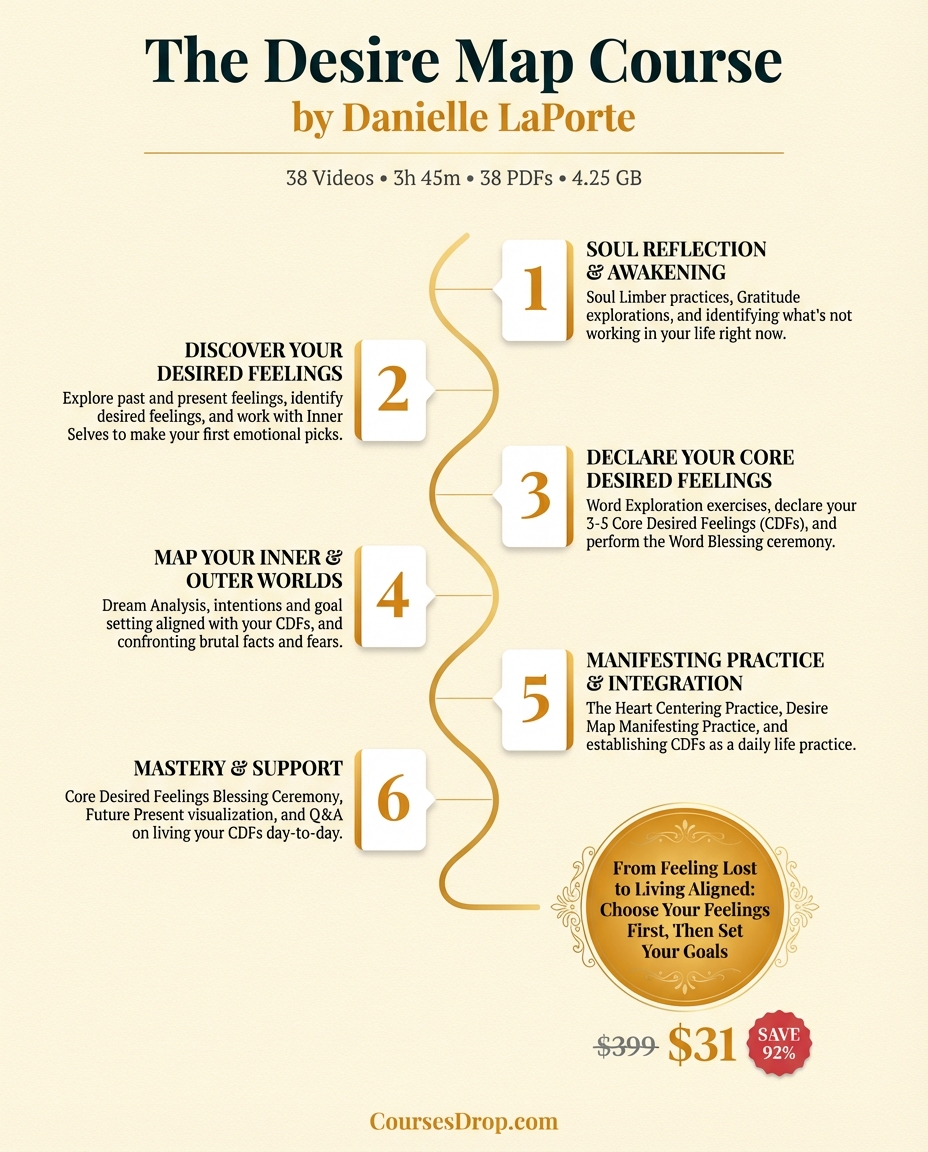
That insight is the foundation of the Core Desired Feelings framework, the heart of The Desire Map Course.
What Are Core Desired Feelings?
Core Desired Feelings — CDFs — are 4 to 5 words that describe how you most want to feel on a daily basis. Not how you want to feel at some distant finish line. How you want to feel while you are living your life right now.
They function as a compass. Every decision you make — a job offer, a relationship, how you spend a Tuesday afternoon — gets evaluated through one question: does this choice move me toward my CDFs or away from them?
The framework rests on a specific claim: feelings are not the reward you get after you achieve something. Feelings are the source of everything. Danielle LaPorte references the research on the heart's electromagnetic field — measured to be roughly 5,000 times stronger than the brain's — as evidence that emotional states are not passive byproducts of thought and action. They are generative. They shape what you think, what you pursue, and what you ultimately create.
This is the Feelings → Thoughts → Actions chain at the center of The Desire Map Course. Most productivity systems run it backward: take action, produce results, then feel something. LaPorte's framework reverses the sequence. Get clear on the feeling first. Let the feeling generate aligned thoughts. Let those thoughts produce actions that are actually congruent with what you want.
CDFs are not affirmations. They are not vague aspirations like "happy" or "successful." They are precise, personal, and usually arrived at through a process of elimination and excavation.
How to Find Your Core Desired Feelings
Step 1: The Reversal Method — Work Backward From What You Want
Start with a goal you already hold. Something you've written down, talked about, or quietly carried for years. It could be a revenue target, a relationship status, a physical transformation, a creative project.
Now ask: why do you want it?
Not the practical answer. The felt answer. If you had it right now — fully, completely — how would you feel?
Write that feeling down. Then ask the question again about that feeling. Why do you want to feel that way? What does that feeling give you access to?
Keep going until you hit bedrock — a feeling that doesn't seem to be a proxy for another feeling. A feeling that feels like an end in itself. That feeling is a candidate for your CDFs.
Most people discover quickly that two very different goals — say, launching a business and moving to a quieter city — are both trying to generate the same underlying feeling: freedom, or spaciousness, or being seen. When you identify the feeling beneath multiple goals, you start to see the pattern of what you're actually building toward.
Step 2: The Refinement Process
Once you have a list of candidate feelings, you need to narrow and sharpen it. LaPorte recommends working through the Five Life Areas — livelihood and lifestyle, body and wellness, creativity and learning, relationships and society, and essence and spirituality — and identifying the feelings you most want to generate in each area.
This produces a longer raw list. Your job then is to look for overlap, consolidation, and precision.
"Happy" is not a CDF. It's too broad to function as a compass. What kind of happy? Joyful? Playful? Content? Radiant? Each of those words points to a different way of being in the world and would generate different decisions.
The goal of refinement is to land on words specific enough that you could evaluate a decision against them. Could you walk into a meeting, an opportunity, or a relationship and ask "does this feel expansive?" and actually get a useful answer? If yes, "expansive" might be one of your CDFs.
Step 3: Vetting the Feelings Themselves
This is a step most people skip, and it matters enormously. Not all desired feelings are created equal.
LaPorte draws a distinction between desiring from wholeness and desiring from lack. A feeling you want because you believe it will fix something broken in you — that feeling, even if you achieve it, tends to dissolve quickly. It was never about the feeling. It was about trying to escape a wound.
Desire from wholeness is different. It comes from a sense of already being enough and choosing to expand further. The feelings that emerge from that place tend to be more stable as guides.
Ask yourself: do I want to feel this way because I believe I'm currently deficient without it? Or do I want this feeling because it represents who I genuinely am when I'm most alive?
The honest answer to that question will shape which words stay on your list.
Get Every Framework from This Course
The course costs hundreds of dollars. All frameworks extracted — $49/year.
Start free — 10 full summaries, no credit card
How to Apply Your CDFs This Week
Once you have your 4 to 5 Core Desired Feelings, the application is deceptively simple.
Use them as a filter before committing. Before saying yes to any significant request, opportunity, or plan, ask: will engaging with this generate my CDFs? Not "might it eventually lead there" — will the actual experience of doing it feel the way I want to feel? Use them as a diagnostic tool. When you feel flat, drained, or vaguely off, ask which of your CDFs has been absent. This turns a diffuse sense of wrongness into a specific diagnosis you can act on. Use them to build a Stop Doing List. LaPorte's framework includes a two-layer process for identifying what to eliminate. First layer: what activities are clearly draining? Second layer, harder — what commitments looked like they would generate your CDFs but consistently don't? This second layer often contains the most important cuts. Review them before goal-setting. This is what LaPorte calls "goal vetting before goal setting." Before you commit to a new goal, run it through your CDFs. If the goal — not just the hypothetical outcome, but the actual day-to-day experience of pursuing it — doesn't engage your CDFs, it may not belong on your list.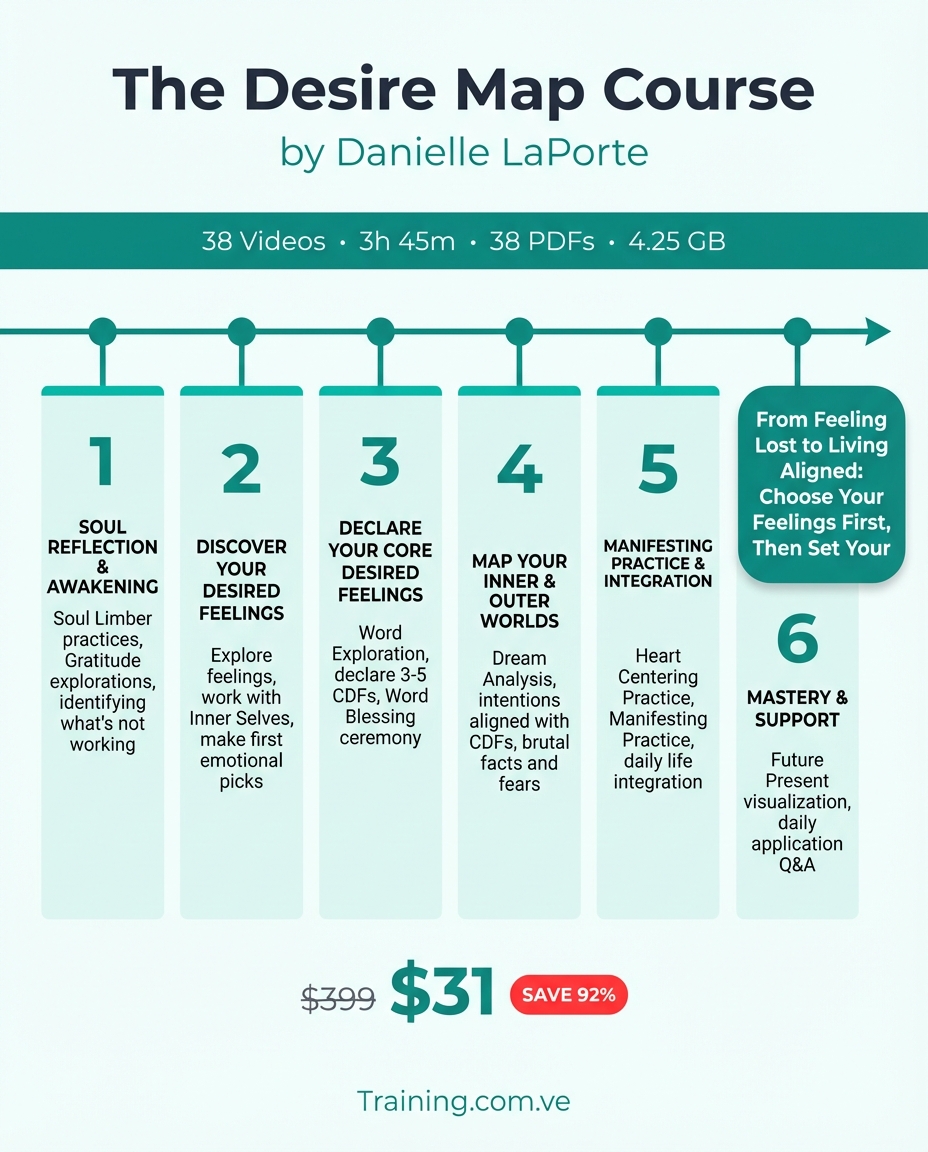
Common Mistakes With CDFs
Choosing aspirational feelings instead of authentic ones. There's a difference between a feeling you genuinely want and a feeling you think you should want. "Disciplined" sounds virtuous. But if discipline doesn't actually make you come alive, it won't function as a useful compass. Choose words that feel like recognition, not prescription. Treating CDFs as static. LaPorte is clear that your Core Desired Feelings can evolve. A word that was absolutely right for you at 28 might feel hollow at 35. Revisit them at least annually. Using them to justify avoidance. "This doesn't align with my CDFs" can become a sophisticated way to avoid discomfort. Some of the most generative experiences in life feel uncomfortable in the short term and expansive over time. CDFs are not a permission slip to avoid hard things. They are a filter for whether the hard thing is worth it. Picking too many. More than five CDFs and you have a mood board, not a compass. The constraint forces prioritization. If everything is equally important, nothing guides the decision.Why This Matters More Than Most Goal Frameworks
The conventional goal-setting conversation is almost entirely about the mechanics of achievement: systems, habits, accountability, milestones. That conversation is useful. But it assumes the goal is right. It has no mechanism for questioning whether the goal is actually connected to what you want.
The CDFs framework addresses the prior question. It gives you a way to audit your goals before you commit to chasing them — and to recognize when a goal is serving someone else's definition of success rather than your own felt sense of what your life is for.
That is not a soft or vague kind of work. It is clarifying in a way that most productivity tools cannot touch, because most productivity tools start one step too late.
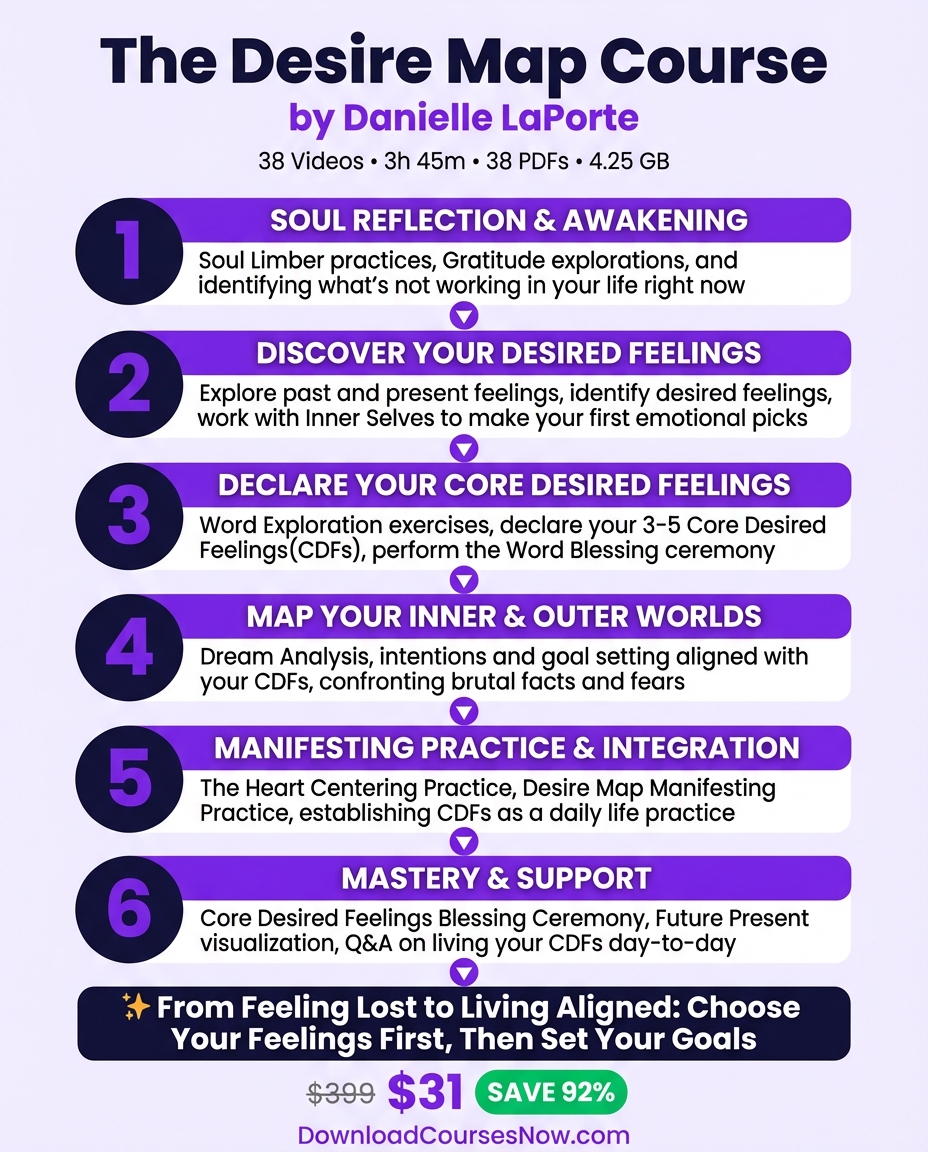
If you want to go deeper with the full four-part process, the Five Life Areas excavation, the Heart Centering Practice, and the complete goal-vetting system, Danielle LaPorte's course lays it out across 38 lessons designed for all experience levels.
Course To Action has summarized all 38 lessons with audio for every summary and lesson — part of a 110+ course library. Access 10 summaries free, no credit card required. The AI "Apply to My Business" tool lets you run the Core Desired Feelings process against your own goals and decisions right now. Paid access is $49 for 30 days or $399/year, one payment, no subscription, no auto-renewal.
Explore the full CDF breakdown and all 38 lessons at coursetoaction.com/.Get All Frameworks from This Course
The course costs hundreds of dollars. The complete breakdown is $49/year — every course on the platform.
This is one framework. Course To Action has every framework, every lesson, and AI that applies it to your specific business. Read or listen — every summary has audio.
Start free — 10 full summaries, no credit card required