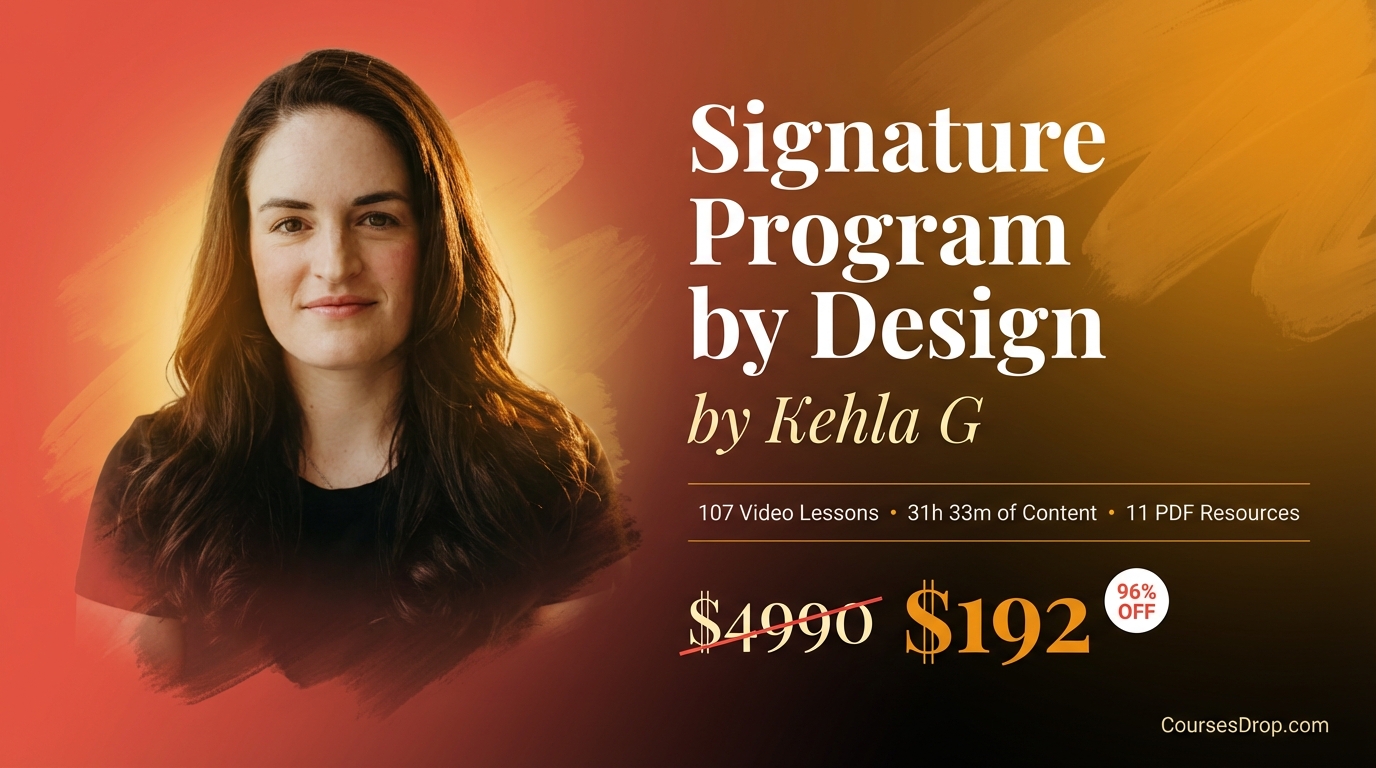
The Caption Framework: How Kehla G Turns Human Design Into Content That Converts (Signature Program by Design)
Most coaches are not struggling because their offer is wrong. They are struggling because their content never gets past the first sentence.
The average Instagram caption loses 80 percent of its readers within three lines. The rest of the post — the value, the offer, the call to action — lands in a void. Kehla G built the Caption Framework inside Signature Program by Design — a $1,800, 171-lesson course for coaches — specifically to solve this problem, and she did it by embedding energetic logic into the structure of written content. You can read the full course summary or listen to the audio version at coursetoaction.com, which covers 110+ premium courses.
This is not a copywriting formula borrowed from a marketing textbook. It is a five-layer system — Hook, Red, Orange, Yellow, Green — designed to mirror the psychological journey a potential client travels before they trust you enough to buy. Each layer corresponds to a frequency from Gene Keys and Human Design, and each one has a specific job to do.
Why Most Coaching Captions Fail
Before unpacking the framework, it helps to understand the failure mode it addresses.
Most coaches write captions in one of two broken patterns. The first is the value dump: a wall of tips, insights, or teaching that informs the reader but never connects to pain or desire. The reader learns something and moves on. No urgency, no emotional resonance, no reason to click.
The second is the premature pitch: leading with the offer before the reader understands why they need it. "Join my program — doors open Monday" posted to an audience that has not been warmed up produces silence.
The Caption Framework solves both problems by sequencing the reader's emotional experience before asking for any action.
Layer 1 — The Hook
The Hook is the first one to three lines of a caption. Its only job is to stop the scroll.
Kehla G teaches that effective hooks operate on problem-awareness, not solution-awareness. This is a critical distinction. A solution-aware hook ("Here's how to price your coaching offer") attracts people who already know they have a pricing problem. A problem-aware hook ("You're not undercharging because you lack confidence — you're undercharging because no one taught you the math") attracts a much wider pool of people who feel the symptom without having named the cause.
Problem-aware hooks work because they create a moment of recognition. The reader feels seen before they have said a word. That feeling of being understood is the single most powerful trust-builder in content marketing, and it costs nothing except the willingness to speak directly to the pain.
In Human Design terms, the Hook corresponds to the Shadow frequency — the lowest vibrational expression of a Gene Key. Kehla G reframes this counterintuitively: your Shadow frequencies are not weaknesses to hide. They are the exact experiences you have lived through that qualify you to serve your ideal client. The discomfort you have survived is the hook that pulls in the person still inside it.
Layer 2 — Red
Red is the agitation layer. Once the hook has stopped the scroll, Red deepens the pain.
This is where many coaches hesitate. Agitating pain feels manipulative if you think of it as poking a wound. Kehla G reframes it differently: Red is about helping the reader articulate what they already feel but have not yet put into words. You are not creating the problem. You are naming it clearly enough that the reader finally understands why their current situation is unsustainable.
Effective Red content asks "what does life look like if nothing changes?" It surfaces the cost of inaction — the launches that keep flopping, the clients who do not refer anyone, the exhaustion of building a business that runs against your energy type instead of with it.
The Red layer is also where specificity earns trust. Vague pain ("you feel stuck") produces mild agreement. Specific pain ("you built an offer you are secretly embarrassed to pitch because you priced it emotionally instead of strategically") produces the visceral "that is exactly me" response that moves people toward action.
Layer 3 — Orange
Orange is the bridge layer. It acknowledges the pain and begins to introduce possibility without yet naming the solution.
The Orange layer exists because there is a psychological gap between "I feel this problem" and "I believe a solution is possible for me specifically." Orange closes that gap by normalizing the struggle and reframing it as a signal rather than a character flaw.
In practice, Orange often sounds like: "Most coaches I know have been here. The problem is not your work ethic or your mindset. The problem is that you were handed a business model designed for someone with a completely different energetic makeup."
This is where Kehla G's Human Design lens becomes a structural advantage. Telling someone their burnout is the result of following a Generator's content strategy when they are a Projector is not a spiritual platitude. It is a concrete explanation that immediately makes their experience make sense. Orange creates what copywriters call a "belief shift" — the reader moves from "I am broken" to "I was using the wrong map."
Get Every Framework from Signature Program by Design
The course costs $1800. All frameworks extracted — $49/year.
Start free — 10 full summaries, no credit card
Layer 4 — Yellow
Yellow introduces the solution — specifically, your framework, method, or offer — but in conceptual terms rather than feature terms.
The mistake most coaches make here is listing deliverables: "Eight modules, weekly calls, a private Slack group." Deliverables answer the question "what do I get?" Yellow answers the question "what becomes possible?"
Yellow content sounds like: "When your program is built around your energetic design, and your content is structured to match how your ideal clients process information, the sales conversation stops feeling like persuasion and starts feeling like confirmation."
Notice that Yellow does not mention a specific product. It describes a state of being. This is intentional. At this stage, the reader is not ready to evaluate an offer. They are still deciding whether the transformation is real. Yellow plants that belief.
Layer 5 — Green
Green is the call to action. But unlike the standard "link in bio" prompt, Green in Kehla G's framework is specific, low-friction, and consent-based.
The consent-based approach matters here. Rather than directing readers to a sales page immediately, Green often invites them into a conversation: "If this is landing for you, drop a 'design' in the comments and I'll share what this looks like inside my program." This mirrors the DM Sales Script taught elsewhere in Signature Program by Design — a method that filters for genuine interest before the pitch happens, which protects both the coach's energy and the potential client's experience.
Green that is too aggressive loses the trust built in the previous four layers. Green that is too passive loses the opportunity. The framework teaches coaches to match the intensity of the call to action to the temperature of the audience — warmer audiences get direct offers, colder audiences get softer invitations.
How the Layers Work as a System
The Caption Framework is not a checklist to run through mechanically. Its power is in the pacing. Each layer should occupy roughly proportional real estate in the caption, with Hook and Red getting the most space because earning attention is harder than asking for it.
Kehla G also teaches coaches to vary which layer they emphasize by post type. Educational posts might spend more time in Orange and Yellow. Story posts might dwell in Red. Offer posts activate all five layers in sequence.
What makes the framework native to Signature Program by Design specifically is its integration with Human Design. Coaches learn not just how to write these layers but how to identify which Shadow frequencies from their own Gene Keys profile give them the most authentic material for the Hook and Red layers. This is what separates the Caption Framework from generic copywriting advice — it is anchored in the coach's actual lived experience, not a persona.
Who Benefits Most From This Framework
The Caption Framework is most immediately useful for coaches and healers who are already creating content consistently but are not converting that content into inquiries or sales. If you have built an audience that likes your posts but does not buy, the problem is almost always a structural gap in how your content moves readers through the emotional journey — and that is exactly what this framework addresses.
It is less useful for creators who have not yet established a consistent content practice, because the framework requires enough posting volume to test and iterate the layers against real audience feedback.
Bottom Line
The Caption Framework — Hook, Red, Orange, Yellow, Green — is one of the more practically teachable tools inside Signature Program by Design. It takes the abstract concept of "aligned content" and gives it a reproducible structure that coaches can apply immediately, regardless of niche.
The course costs $1,800. The full structured breakdown — including a summary of every framework Kehla G teaches — is available on Course To Action alongside 110+ other premium courses. Read it or listen to the audio version before you decide. The AI feature lets you ask how the Caption Framework and the Gene Keys Golden Path apply specifically to your coaching business.
Free account: 10 summaries, no credit card required. Full access starts at $49 for 30 days, one payment, no auto-renewal.
Explore the full course at coursetoaction.com/.
Get All Frameworks from Signature Program by Design
The course costs $1800. The complete breakdown is $49/year — every course on the platform.
This is one framework. Course To Action has every framework, every lesson, and AI that applies it to your specific business. Read or listen — every summary has audio.
Start free — 10 full summaries, no credit card required