
The Mirror Principle: How She Who Leads Herself Exposes What You're Actually Avoiding
There is a woman in your life — maybe a client, a colleague, an online personality — who drives you absolutely crazy. She is too loud. Too confident. Too unbothered by what people think. Or maybe she is too needy, too dramatic, too unwilling to take responsibility.
You have a story about her. And that story, according to Melanie Ann Layer's She Who Leads Herself, is one of the most precise diagnostic tools you will ever encounter.
This is the Mirror Principle. And it is not a soft, feel-good reframe. It is a confrontation.
What Is the Mirror Principle?
The Mirror Principle is one of the central frameworks inside She Who Leads Herself, Melanie Ann Layer's 9-lesson, 8.5-hour identity and leadership course for women entrepreneurs.
The premise is direct: what you attempt to change, correct, or distance yourself from in other people is a mirror of what you are actively avoiding within yourself.
This is not the same as saying "you attract what you are." That framing puts the focus on outcome and energy matching. The Mirror Principle is more surgical. It is pointing at a specific mechanism: the emotional charge you feel toward another person's behavior is generated by your own unresolved relationship with that same behavior — either the suppression of it or the fear of it.
If someone's audacity bothers you, you are likely suppressing your own. If someone's emotional expression makes you uncomfortable, you are likely containing yours at a cost. If someone's boundary-setting feels aggressive to you, you are likely in a pattern of not holding your own.
The mirror does not lie. Your reaction tells you exactly where you have gone quiet inside yourself.
The Core Components
1. The Charge Is the Clue
A neutral observer sees behavior and categorizes it without emotional electricity. When you have a strong reaction — irritation, contempt, envy, anxiety — that charge is data. It signals that something in what you are witnessing is activating an internal conflict.
Layer distinguishes between reaction and response throughout the course. A response comes from a grounded, evaluated place. A reaction is automatic and emotionally sourced. When you are reacting to someone else's behavior with consistent intensity, the Mirror Principle says: do not analyze them. Analyze the reaction.
2. The Two Flavors of Mirroring
The framework operates in two directions:
Suppression mirroring — You are bothered by someone doing something you want to do but have deemed unsafe, unacceptable, or too risky. Their freedom exposes your cage. This is often disguised as moral judgment: "She is too much." Translation: you have decided you are not allowed to be that. Projection mirroring — You are bothered by someone doing something you do but have not acknowledged in yourself. Their behavior is a version of yours you have not owned. This is often disguised as superiority: "She is so needy." Translation: you have unmet needs you are not willing to voice.3. The Rewrite Is Internal, Not External
Here is where the Mirror Principle diverges from most frameworks that tell you to "set boundaries" or "limit your exposure" to difficult people: it does not ask you to change your environment first. It asks you to change your relationship with the behavior in yourself first.
This is a crucial distinction. If you manage the mirror by removing the person, you still carry the same internal conflict into your next relationship, your next team, your next client roster. The charge travels with you. The Mirror Principle says: resolve it at the source.

A Real Example
Say you are a coach or service provider. A peer in your industry starts charging prices that feel aggressive to you. She does not apologize for them. She speaks about her offers with total certainty. You find yourself thinking she is arrogant, that she has not earned that confidence, that her pricing is not justified.
The Mirror Principle would not have you fact-check her pricing. It would have you look at the charge.
What if the irritation is actually about your own pricing — the ceiling you have imposed on yourself, the apology that lives in how you present your offers, the story you carry that says you have not yet done enough to deserve more?
Her visibility is not the problem. Her certainty is the mirror. And your reaction is the invitation to look at where you have decided you are not allowed to be that certain.
This does not mean she is right and you are wrong. It means your emotional reaction is not really about her.
Get Every Framework from She Who Leads Herself
The course costs $$1,111. All frameworks extracted — $49/year.
Start free — 10 full summaries, no credit card
How to Apply the Mirror Principle
Step 1: Identify the charge. Pick one person whose behavior consistently irritates, unsettles, or provokes you. Do not choose the most extreme example. Choose the one that comes up most often in your thoughts or conversations. Step 2: Name the behavior precisely. Not "she is a lot." Something specific: "She speaks about herself without being asked." "She raises her prices without explanation." "She cries openly in professional spaces." Step 3: Ask the suppression question. "Is there any version of this behavior that I want to do but have decided is not allowed for me?" Sit with this. The answer often comes with discomfort, which is confirmation that it is real. Step 4: Ask the projection question. "Is there any version of this behavior that I do but have not acknowledged?" This one requires more honesty. It is easier to see the behavior in someone else when you have labeled yours differently. Step 5: Locate the origin. Where did you decide this behavior was dangerous, unacceptable, or not for you? This connects to the Origin Story Rewrite framework also taught in She Who Leads Herself, which addresses how early-life decisions calcify into identity constraints. Step 6: Make one internal decision. Not a grand proclamation. One small internal permission. "I am allowed to speak about my work without apologizing." "I am allowed to feel and express disappointment." Start there.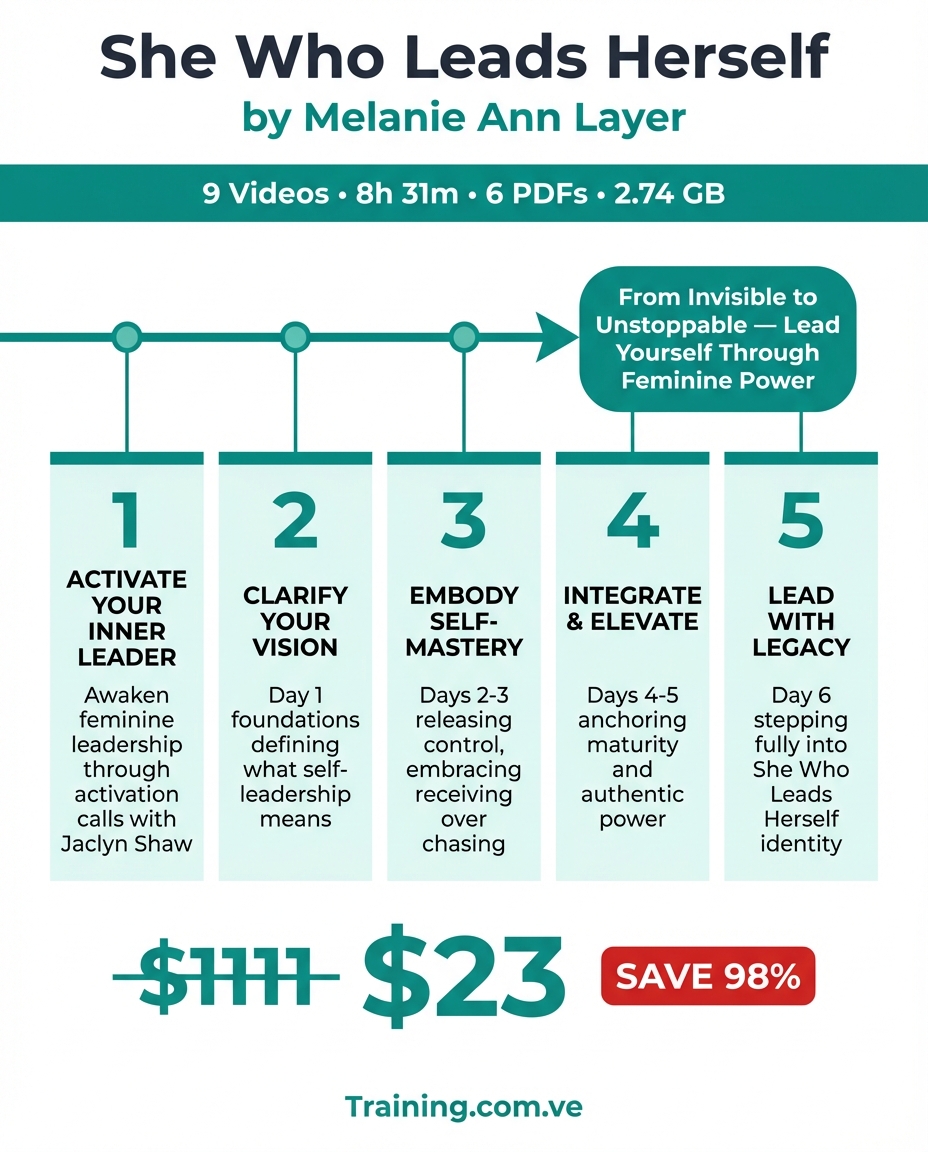
Common Mistakes When Working with This Framework
Mistake 1: Using it to spiritually bypass accountability. The Mirror Principle is not saying other people's harmful behavior is your fault. It is not a framework for excusing bad conduct. It is specifically about the emotional charge in you and what that reveals. These are separate conversations. Mistake 2: Applying it intellectually without sitting in the discomfort. The Mirror Principle does not work as a concept exercise. It works when you are willing to feel the thing that comes up when you ask the suppression and projection questions honestly. If you get to "oh interesting" and move on, you have not actually done the work. Mistake 3: Expecting the charge to disappear immediately. The charge may soften once you name it. Full resolution usually requires time, repeated internal decision-making, and — as Layer's course makes explicit — building your pain tolerance capacity. This is the connecting thread throughout She Who Leads Herself: avoidance of discomfort is always the mechanism. The Mirror Principle is simply one more place that mechanism shows up. Mistake 4: Only applying it to people you dislike. The framework works equally with people you idealize to the point of feeling inferior. Envy and admiration that destabilize you carry the same mirroring function. "I could never be that" is suppression in a quieter register.Why This Framework Matters for Women Entrepreneurs
Most business coaching addresses tactics. Very little of it addresses the internal architecture that determines which tactics a woman will actually execute — and at what level.
The Mirror Principle matters in a business context because your client relationships, your team dynamics, your peer comparisons, and your market positioning are all surfaces where your internal conflicts will appear. If you have not resolved your relationship with authority, your client calls will be expensive therapy sessions you do not get paid for. If you have not resolved your relationship with visibility, your content will be perpetually "almost ready."
The Mirror Principle does not tell you what marketing strategy to use. It tells you why you keep stopping yourself from using the one you already know works.
That is a different, more foundational kind of help. And it is what She Who Leads Herself was built to deliver.
The Bottom Line
The Mirror Principle is not comfortable. It is designed to be precise and confronting in equal measure. It asks you to take seriously the possibility that the most frustrating people in your life are pointing at the most important work you have left to do on yourself.
Melanie Ann Layer built this course from a life that required her to find genuine capacity — not performance, not optimism, genuine capacity — under real pressure. The frameworks inside She Who Leads Herself reflect that. They are not theoretical. They are operational.
If you are a woman entrepreneur who has been doing the mindset work and still finding yourself stuck in the same patterns with clients, pricing, visibility, or relationships, the Mirror Principle is worth your full attention. Not because it will be easy — because it will be accurate.
She Who Leads Herself is priced at $1,111. Before you decide, you can access a full summary of the course — with audio — for free at Course To Action, which covers 110+ premium courses. The free tier includes 10 summaries and AI credits, with no credit card required. The AI feature "Apply to My Business" (3 free credits) lets you ask specifically how the Mirror Principle and the other frameworks apply to your business before you commit. Full platform access is $49 for 30 days or $399 for a year, with no auto-renewal.
Get All Frameworks from She Who Leads Herself
The course costs $$1,111. The complete breakdown is $49/year — every course on the platform.
This is one framework. Course To Action has every framework, every lesson, and AI that applies it to your specific business. Read or listen — every summary has audio.
Start free — 10 full summaries, no credit card required