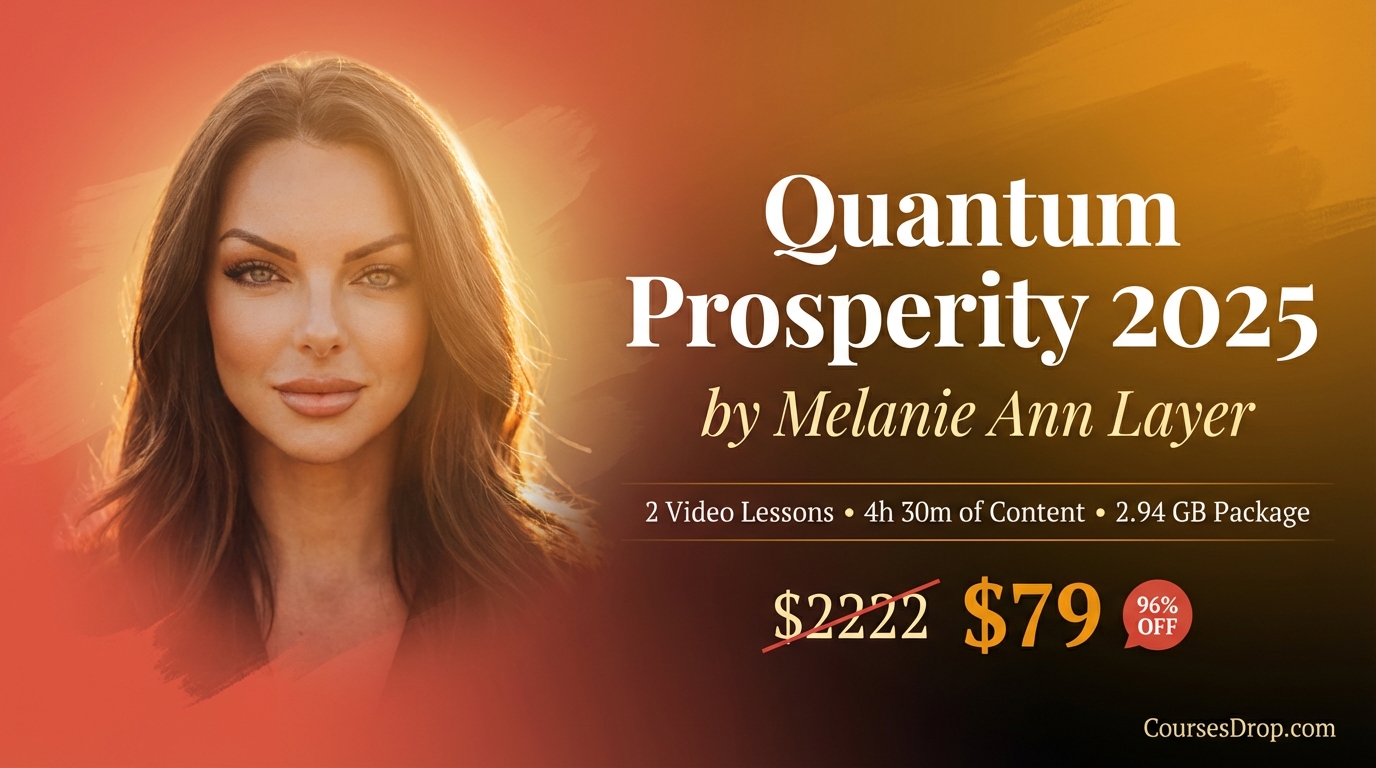
The Costco of the Quantum: Melanie Ann Layer's Framework for Energetic Abundance
There is a particular kind of spiritual teaching that tries too hard to make itself respectable. It borrows the language of physics, gestures vaguely at quantum mechanics, and hopes you will not look too closely. Melanie Ann Layer does something more interesting in Quantum Prosperity 2025. She leans into the metaphor fully and then uses it to make a genuinely useful point about how people block themselves from receiving what they claim to want.
The "Costco of the Quantum" is one of the course's most memorable frameworks. It is worth unpacking carefully — both what it says and what it actually means for someone trying to change their relationship with money, opportunity, and self-worth.
What the Framework Claims
The central image is straightforward. At Costco, everything is already available. The shelves are stocked. You do not negotiate with a manager to unlock the olive oil. You do not have to prove you deserve the cereal. The abundance pre-exists your arrival. Your only job is to show up with membership and pick things up.
Layer applies this logic to what she calls the quantum field — a term she uses metaphorically rather than scientifically. Her argument is that abundance, in the form of money, relationships, opportunities, and experiences, already exists. It is not scarce. The universe is not rationing it. The question is never whether it is available. The question is whether you are positioned to receive it.
The "membership," in her framework, is not money. It is energetic match. You access the quantum Costco by aligning your internal state — your beliefs, your nervous system's baseline, your sense of what is normal — with the frequency of what you want to receive.
This is where the framework stops being a cute metaphor and starts being a working model.
The Asymmetry That Makes It Useful
Layer's sharpest observation in Quantum Prosperity 2025 is not about abundance. It is about suffering. She points out that most people are already extraordinarily skilled manifestors — they just apply that skill almost exclusively to negative outcomes.
Think about how convincingly you can make yourself feel the emotions of a catastrophe that has not happened. You get an ambiguous email from your boss and within seconds you have mentally walked through the firing, the financial collapse, and the embarrassment of telling your family. Your body responds to this imagined sequence as though it were real. Your cortisol spikes. Your chest tightens. You are, in Layer's language, fully entangled with an outcome that does not yet exist.
That is powerful manifestation work. It is just pointed in the wrong direction.
The Costco of the Quantum framework asks a simple question: if you can generate that quality of emotional and physical response for an imagined failure, why can you not generate the same quality of response for an imagined success? The mechanics are identical. The asymmetry is a habit, not a law.
Most people, when they try to "visualize abundance," produce a pale, unconvincing mental image accompanied by a quiet internal voice saying "but this probably won't happen." They do not match the vividness, the physical embodiment, or the emotional conviction they bring to their worst-case scenarios. The Costco framework reframes this not as a failure of imagination but as a mismatch in practice.
What "Energetic Match" Actually Means
Layer is careful — to her credit — not to reduce this to positive thinking. She does not tell you to pretend bad things cannot happen or to plaster affirmations over genuine concerns. The energetic match she describes is closer to what psychologists might call schema — the deep, largely unconscious assumptions about what is normal, what you deserve, and what the world typically offers you.
If your baseline schema says that money is scarce, that people like you do not earn more than a certain amount, and that prosperity is something that happens to other people, then no amount of surface-level visualization changes that. You can repeat "I am abundant" every morning and spend every evening reinforcing the schema with anxious thoughts about bills. The schema wins because it is the structural layer underneath the affirmation.
What Layer calls raising your "energetic frequency" is essentially schema revision. It is the slow work of making a different internal reality feel normal — not aspirational, not performed, but genuinely unremarkable. You stop experiencing wealth as an exception or a stroke of luck and start experiencing it as the expected baseline. That shift changes the decisions you make, the risks you take, the rooms you walk into, and the opportunities you recognize as relevant to you.
This is less mystical than it sounds. Cognitive behavioral therapy, schema therapy, and Internal Family Systems work all operate on similar assumptions — that changing surface behavior without changing the underlying belief structure produces limited and unstable results.
Get Every Framework from Quantum Prosperity 2025
The course costs $2222. All frameworks extracted — $49/year.
Start free — 10 full summaries, no credit card
The Shelf-Stocking Problem
One subtlety the Costco metaphor handles well is the question of action. A common criticism of manifestation frameworks is that they encourage passivity — just believe hard enough and things will arrive. Layer's version of this framework does not endorse that reading.
Costco is stocked by suppliers. Abundance, in her model, flows through channels — clients, opportunities, collaborations, ideas. You do not manifest money from nothing; you become someone who naturally attracts and acts on the flows that produce money. The energetic match is not a substitute for action. It is the internal condition that makes effective action feel natural rather than forced.
When your baseline schema says you are someone who earns well, you return calls differently. You price your services differently. You enter negotiations differently. You recognize opportunities you would have previously dismissed as "not for someone like me." The framework is not claiming that belief replaces effort. It is claiming that misaligned belief makes effort far less productive than it should be.
Honest Limitations
The Costco of the Quantum is a useful metaphor, not a peer-reviewed model. Quantum field theory, the actual physics, does not support the claim that human consciousness interacts with a quantum substrate to produce material outcomes. Layer is not making a scientific argument and should not be evaluated as though she is. She is using the language of quantum mechanics as an evocative frame for a psychological and spiritual teaching.
Within that frame, the framework holds up. It gives people a concrete, sensory-rich way to think about why they block abundance, what matching it would actually feel like, and how the same mental machinery that produces anxiety can be redirected toward aspiration.
Whether you find that useful depends on whether the metaphor lands for you. For some people, the Costco image makes an abstract concept viscerally clear. For others, it might feel overly casual about serious financial and psychological work. That is worth knowing before you invest $2,222 in the course.
Who This Is For
The Costco of the Quantum framework is most useful for people who already understand that mindset influences outcomes but cannot seem to move their baseline. If you have done the vision boards, the affirmations, and the journaling exercises and still find yourself operating from a scarcity script, this framework offers a different angle. It targets the asymmetry — the gap between how vividly you feel failure and how tentatively you feel success — and names that gap as the specific thing to address.
It is not for people looking for business strategy, tactical advice, or a system for generating income. There is none of that in Quantum Prosperity 2025. What is there is a coherent, if unconventional, model for why the usual personal development tools feel hollow for some people, and what a different starting point might look like.
Before you spend $2,222, read the full breakdown on Course To Action — every framework extracted, audio on every summary, and an AI "Apply to My Business" tool to test the ideas against your situation. Course To Action covers 110+ premium courses. Start free with 10 summaries and no credit card required.
Read the Full Quantum Prosperity 2025 Breakdown — Start FreeGet All Frameworks from Quantum Prosperity 2025
The course costs $2222. The complete breakdown is $49/year — every course on the platform.
This is one framework. Course To Action has every framework, every lesson, and AI that applies it to your specific business. Read or listen — every summary has audio.
Start free — 10 full summaries, no credit card required