SERP Domination Strategy: How Parasite SEO Claims Multiple Rankings Without a Domain
Most SEO advice starts with the same premise: build a strong domain, earn authority over time, and eventually rank. The SERP Domination Strategy, as taught in Parasite SEO Mastery by Jesper Nissen (SEO Jesus), starts from the opposite direction. Instead of competing with high-authority domains, you publish on them — and then you publish on several of them at once.
The goal is not just to rank. It is to own multiple positions on a single search results page, pushing competitors down and maximizing the probability that a searcher clicks through to something you control.
The Structural Logic Behind the Strategy
To understand why this framework works, you need to understand how PageRank actually functions in 2026. Google's algorithm still weights domain-level authority heavily. A page on Medium, HubPages, LinkedIn, or a major news site enters the index with a trust signal that a two-year-old niche blog cannot replicate regardless of how good the content is.
Parasite SEO accepts this as a fixed constraint rather than a problem to solve. If domain authority determines ranking position, then the fastest path to the top of a SERP is publishing on domains that already have that authority. The SERP Domination Strategy takes this one step further: if you can rank one parasite placement, there is no technical reason you cannot rank three or five on the same keyword, provided you use different platforms.
This is the core mechanical insight of the framework. Google's diversity filters limit how many results from a single domain appear for a given query, but they do not limit results from different domains. A placement on Medium, a placement on a high-DA forum, and a placement on a press release aggregator can all appear simultaneously for the same target keyword — each one owned by the same operator.
How the Framework Is Structured
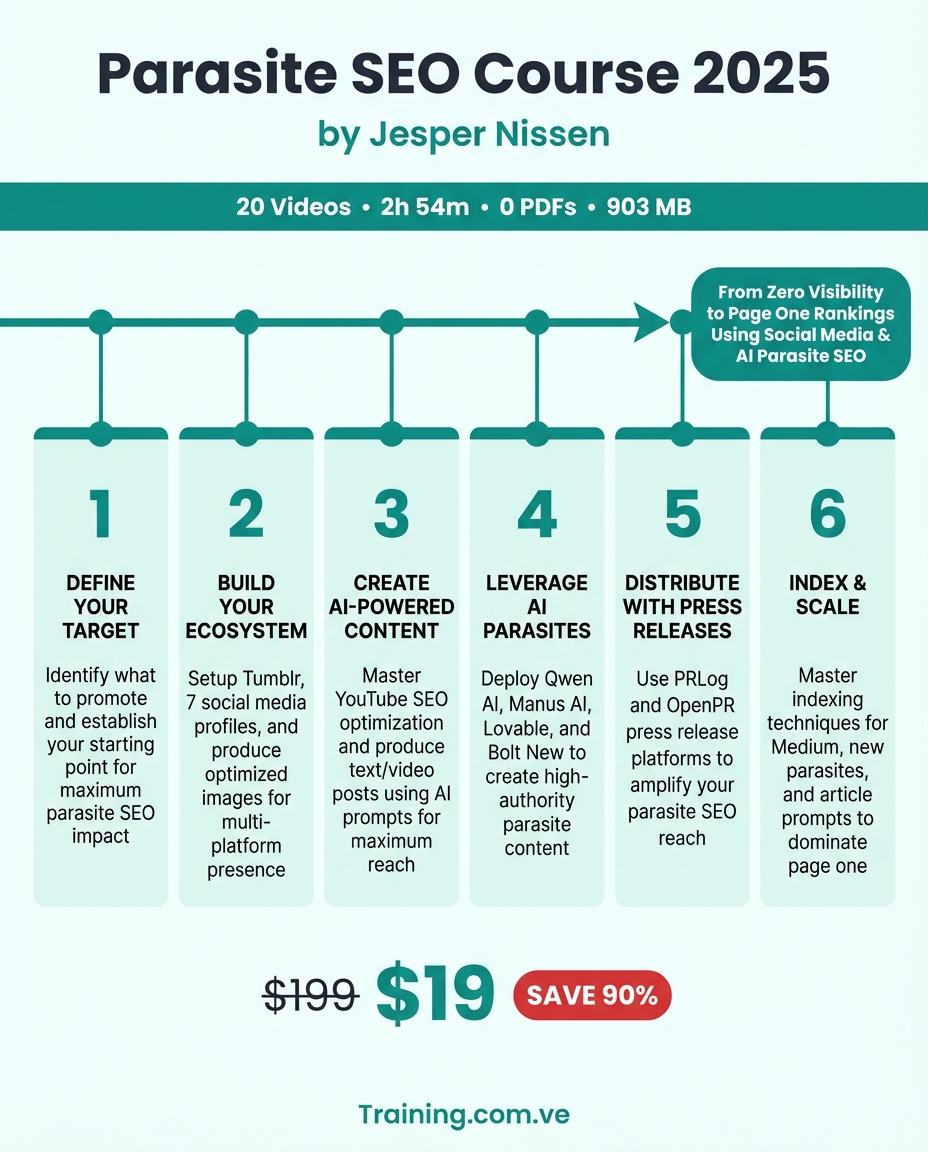
Jesper Nissen presents the SERP Domination Strategy as a sequenced process rather than a collection of tactics. The phases work as follows:
1. Keyword Selection With SERP AnalysisBefore publishing anything, you audit the target SERP to identify which types of content are already ranking. The framework pays particular attention to how many results on the first page already come from high-DA platforms. A SERP populated by Reddit threads, Medium articles, and listicle directories is a strong signal that Google is receptive to third-party platform content for that query. SERPs dominated by aged, established niche sites are treated as more resistant.
Keyword difficulty scores from tools like Ahrefs or SEMrush are used as a rough filter, but Nissen emphasizes that SERP composition matters more than any single difficulty number.
2. Platform Stack SelectionOnce a keyword is confirmed as viable, you select a set of platforms — the course covers specific tiers based on DA, content type, and moderation strictness. Not all platforms accept affiliate links or commercial content openly, so platform selection involves matching the content type to what a given platform allows without triggering removal.
The strategy calls for publishing to multiple platforms within a close time window, not sequentially over weeks. The reasoning is that coordinated publication creates multiple indexing events simultaneously, which accelerates the competitive pressure on organic results already sitting on page one.
3. Content Differentiation Across PlacementsEach placement needs to read as a distinct piece of content. The course is explicit that duplicating the same article across platforms creates deindexation risk and signals low quality. The Multi-Layered AI Content Workflow (another framework in the course) is used here to produce variants that share a keyword focus but differ in angle, structure, and depth.
This is where the grey-hat dimension becomes visible. The content differentiation process uses AI tools and spinning techniques to produce volume efficiently. The course does not present this as a content quality exercise — it is openly framed as a production workflow optimized for ranking speed rather than reader experience.
4. Tier 2 Link BuildingRaw parasite placements on high-DA platforms often rank without any additional link building. But for competitive keywords, Nissen recommends what the course calls Tier 2 link building: pointing external links at your parasite pages rather than at a domain you own. The goal is to pass additional authority into pages that are already sitting on strong platforms, amplifying their ranking signal.
The link sources discussed in this section are grey-hat by nature — link networks, private blog networks, and purchased placements. The course is transparent about this. If that approach conflicts with how you want to operate, this part of the framework is not compatible with a white-hat workflow.
5. CTR ReinforcementOnce placements are live and indexed, Nissen discusses using CTR manipulation tools and upvote mechanisms on platforms that factor engagement signals into visibility. This is the most explicitly black-hat component of the SERP Domination Strategy. The course frames it as a standard part of competitive parasite SEO, not an edge case.
Get Every Framework from Parasite SEO Mastery
The course costs $199. All frameworks extracted — $49/year.
Start free — 10 full summaries, no credit card
What the Framework Delivers in Practice
When all phases are executed correctly against a viable keyword, the outcome is a cluster of results on a single SERP page that all route through content you control. For affiliate marketers, this means the query triggers multiple exposure points rather than one. For lead generation, it increases the probability that a searcher finds your offer regardless of which result they click.
The strategy is most effective on informational keywords in commercial niches — product comparisons, reviews, "best X" queries — where affiliate monetization is natural and where high-DA platform content is already common in search results.
It performs less reliably on branded queries, local search, or transactional keywords with strong e-commerce competition. The course does not claim universal applicability.
What to Factor In Before Adopting This Framework
The SERP Domination Strategy has a meaningful cost structure. Executing it at scale requires keyword research tools, content production tools, and access to link networks — the course estimates $200 to $400 per month in tool costs. That number is realistic for anyone running this as a legitimate operation rather than experimenting on a single keyword.
Platform policies also change. Platforms that are receptive to commercial content today may tighten moderation tomorrow. A placement that ranks in March 2026 may not survive a platform-wide policy update in Q3 2026. The course addresses this as an expected part of parasite SEO operations, not an anomaly, and treats platform diversification as the primary hedge.
The absence of analytics depth is worth noting. Parasite SEO Mastery does not cover conversion rate optimization, funnel analysis, or what happens after a click lands on your affiliate offer. The course stops at ranking and traffic generation. If your operation has gaps in those downstream areas, this course does not fill them.
Who This Framework Is Designed For
The SERP Domination Strategy is a competitive ranking framework built for affiliate marketers, lead generators, and digital product promoters who need fast placements on commercial keywords and are willing to operate in grey and black-hat territory to get them. It is not designed for brand-building, long-term organic growth, or compliance-sensitive industries.
If you are evaluating Parasite SEO Mastery specifically for this framework, the course delivers a structured and technically coherent approach to multi-placement ranking. The tactics are practical rather than theoretical, and Nissen's background as a practitioner shows in the specificity of the platform guidance and content workflow.
The full course is $199. Before you buy, Course To Action has the complete written breakdown with audio, plus an AI tool ("Apply to My Business") that connects these frameworks to your specific business situation. 110+ premium courses covered. Start free — no credit card required — or access everything for $49/month.
Get All Frameworks from Parasite SEO Mastery
The course costs $199. The complete breakdown is $49/year — every course on the platform.
This is one framework. Course To Action has every framework, every lesson, and AI that applies it to your specific business. Read or listen — every summary has audio.
Start free — 10 full summaries, no credit card required