The Achievement Roadmap System Explained: Make Goals Inevitable Through Daily Standards — from Mindset Program by Martell Coaching by Dan Martell
The Achievement Roadmap System is Dan Martell's 5-step process for closing the execution gap between knowing what you want and consistently doing what it takes. The steps are: Permission to Dream, Standards Over Goals, Unlock Resources, Celebrate the Journey, and Connect to Triggers and Anchors. It is the foundational backbone of the $600 Mindset Program by Martell Coaching, a 75-lesson course covering goal-achievement systems, identity transformation, and mental reprogramming — according to the full breakdown on Course To Action, it is the single most important framework Martell has ever developed.
Most goal-setting systems ask you to write down what you want and then motivate yourself hard enough to get there. They fail at the same point: somewhere between the goal and the execution, willpower runs out. The key takeaway is that Martell's system treats this as an architecture problem, not a motivation problem.
Dan Martell built and sold multiple companies, grew SaaS Academy into the premier coaching program for software founders, invested in over 60 startups including Intercom and Udemy, and ran Ironman triathlons while raising a family. He is not someone who relies on motivation. His conclusion — arrived at through years of building systems inside his own life — is that motivation is not a strategy. A daily standard is.
What Is the Achievement Roadmap System?
The Achievement Roadmap is a 5-step goal-achievement framework that treats the execution gap — the space between knowing what you want and consistently doing what it takes — as a systems problem rather than a motivation problem. It does not ask you to want your goals more intensely. It asks you to architect your environment, your behaviors, and your accountability so that achieving the goal becomes the path of least resistance.
The system runs from lessons 1 through 10 of the Mindset Program and represents, by Martell's own account, the single most important framework he has ever developed and applied in his own life.
The 5 Steps
Step 1: Permission to Dream
The first step is deceptively simple and almost always skipped. Write a 25-year vision — not a business plan, not a 90-day sprint, but an honest description of what your life looks like in 25 years if you let yourself want it fully.
From that 25-year vision, identify the 1-year milestone that would represent meaningful movement toward it. The connection matters. When your annual goal is anchored to a 25-year vision, it stops being a target and becomes a waypoint. The scale of the long view gives permission for goals that would otherwise feel embarrassingly ambitious.
Martell calls this "Permission to Dream" for a reason: most entrepreneurs systematically suppress their actual aspirations to stay within the range that feels socially safe. This step asks you to stop doing that.
Step 2: Standards Over Goals
This is the hinge point of the entire system — and the most counterintuitive idea in it.
You do not track your progress toward the goal. You track your compliance with the daily standard.
The core insight is this: a goal is what you want to achieve. A standard is the specific, repeatable behavior that makes achieving the goal inevitable if done every day. The distinction is not semantic. It is operational.
"Add $500K in revenue this year" is a goal. "Have one new sales conversation every day" is the standard that makes the goal achievable. "Get to 180 pounds" is a goal. "Stay at 2,000 calories daily" is the standard. "Launch a podcast" is a goal. "Record for 30 minutes every weekday morning" is the standard.
Martell says he barely looks at his annual goals list. He tracks his daily standards obsessively. The goal tells him where he is going. The standard is what he actually controls.
When the standard is met consistently, the goal becomes a byproduct rather than a target. This shift eliminates the anxiety of goal-tracking — the obsessive checking of metrics and milestones that depletes creative energy — and replaces it with a single, manageable question: did I do the thing today?
Step 3: Unlock Resources
Once the goal and the daily standard are defined, the next step is to list every resource that could support achievement — people, tools, programs, communities, mentors, information.
Then — and this is the step most people skip — tell those people about your goal. Not to recruit them into a formal accountability structure, but because the act of speaking your goal aloud to someone else creates social accountability that private goal-setting cannot replicate. Thoughts remain negotiable until they are spoken. Once spoken to another person, they carry social weight.
Martell teaches public declaration across multiple lessons in the Mindset Program: tell your team, tell your family, post it on social media. The discomfort of being publicly held to a goal is not a side effect of this step. It is the mechanism.
Step 4: Celebrate the Journey
Most goal-setters think about the finish line and ignore everything in between. This step structures the middle.
Break the annual goal into milestone checkpoints — quarterly, monthly, or however frequently the goal requires. Assign a conditional reward to each milestone: something you want, something meaningful, that you receive only if the milestone is actually hit. Not a consolation prize for effort. A reward contingent on results.
Martell pairs this with Sensory Acuity — a 4D visualization practice that goes far beyond standard vision boarding. In Sensory Acuity, you are fully inside the experience: first-person immersion with all senses engaged, sounds and smells layered in, multiple angle shifts from your own eyes to an external observer. You run the visualization forward to completion, then rewind it entirely. The multi-sensory repetition wires new neural pathways. The future state starts to feel familiar before it arrives. That familiarity reduces the friction of pursuing it.
Step 5: Connect to Triggers and Anchors
The final step is the one that makes the system self-sustaining rather than dependent on daily willpower.
Identify three to five environmental triggers in your existing daily routine — moments that happen automatically regardless of your motivation level. Getting in your car. Sitting down at your desk. Getting into bed at night. Attach your goal review to each of those triggers.
The result is three to five daily exposures to your goals without adding any new habits to your routine. You are not building a new behavior from scratch. You are anchoring a two-minute review to existing behaviors that already run on autopilot.
What makes this different is that the goal becomes part of your operating environment rather than something you have to remember to do.
This is one of 8 frameworks in the Mindset Program by Martell Coaching. The complete breakdown — every framework, every limitation — is available on Course To Action. Start free.

A Concrete Example
Here is how the framework runs for a founder trying to break $1M in annual revenue:
Step 1: 25-year vision includes financial independence, a specific lifestyle, and a company with 30+ employees. 1-year milestone: $1M in revenue. Step 2: Daily standard: one qualified outreach to a warm prospect before noon, every weekday. Not "more sales activity." One specific, countable, time-bounded behavior. Step 3: Resources list includes a specific CRM, a mentor who has hit $1M, a peer accountability partner. Declares the goal to team and spouse. Posts it publicly. Step 4: Quarterly milestones at $250K, $500K, $750K, each with a defined reward. Runs a Sensory Acuity visualization every morning: inside the moment of crossing $1M, hearing the number, feeling the physical sensation, seeing the faces of the team. Step 5: Goal review anchored to three daily triggers: sitting at desk at 8am, getting in car after lunch, getting into bed. Each review takes 90 seconds.This is the whole architecture. There is no motivational content holding it together. The standard runs the execution. The anchors run the review. The milestones run the celebration. The system sustains itself.
Get Every Framework from Mindset Program by Martell Coaching
The course costs $$600. All frameworks extracted — $49/year.
Start free — 10 full summaries, no credit card
How to Apply This Week
Action 1: Write your 25-year vision. Give yourself 20 minutes, no editing, no filtering. Then identify the single 1-year milestone most directly connected to it. Write it on a card. Action 2: For that 1-year goal, define the daily standard — the one specific, repeatable behavior that would make hitting the goal inevitable if done every day. Start tracking compliance to the standard immediately. Ignore the goal number for 30 days. Action 3: Tell three people about your goal today. One member of your team, one family member, one peer. Speak it out loud. Include the deadline. Feel the discomfort. That discomfort is the accountability mechanism activating.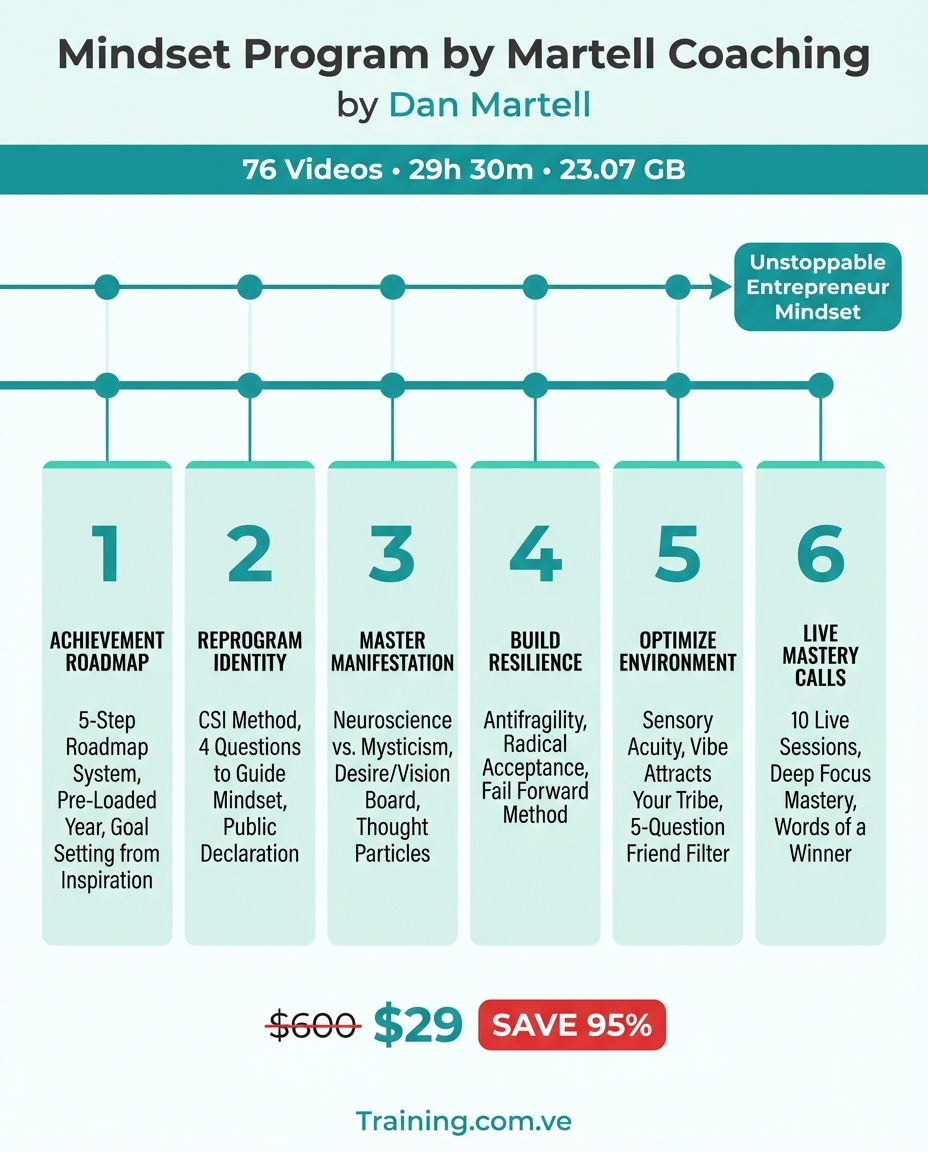
Common Mistakes
Mistake 1: Setting standards that are too vague. "Work on sales more" is not a standard. "Send three outreach emails before 10am" is. The standard must be specific enough that you can answer yes or no to whether you did it. Vague standards become negotiable under pressure. Mistake 2: Tracking the goal instead of the standard. When you miss a revenue milestone, checking your goal number tells you that you are behind. It does not tell you what to fix. When you miss a daily standard, you know exactly what broke down and you can correct it tomorrow. Track the thing you control. Mistake 3: Skipping the trigger anchors. Most people set up Step 2 (the daily standard) and then rely on willpower and reminder apps to maintain it. The trigger anchors are what make the system sustainable long-term. Take 10 minutes to write down three daily triggers and explicitly assign the goal review to each one. Do not leave this optional.The Leverage Point
In summary, the Achievement Roadmap's core insight is that you do not rise to the level of your goals — you fall to the level of your systems. The goal is the North Star. The daily standard is the road. The triggers are the guardrails that keep you on it.
Dan Martell has built five companies using this system, run Ironman races on it, and now teaches it as the entry point to his complete mindset library because, in his words, it is the single framework that makes everything else possible.
Frequently Asked Questions
Is the Achievement Roadmap System worth learning on its own? Yes. The Achievement Roadmap is the foundational framework of the Mindset Program by Martell Coaching. Martell identifies Standards Over Goals (Step 2) as the most important concept in the entire 75-lesson program. Fully implemented, it produces measurable results within a quarter for most entrepreneurs. What does the full Mindset Program teach beyond the Achievement Roadmap? The $600 Mindset Program covers 8 named frameworks across 75 lessons: the Achievement Roadmap, the Dualities Exercise, the Drama Triangle, Sensory Acuity, the Friendventory, the CSI Method, the Comma Yet Technique, and the Primary Question. All frameworks treat the mind as a programmable operating system. What does the Mindset Program NOT cover? Zero business strategy. No marketing, sales, funnels, or operations content. The course is pure inner game. It also has no sequential curriculum, includes near-duplicate lessons, and the faith-based language is inseparable from the content. Who is the Achievement Roadmap best for? Entrepreneurs who know what to do but cannot consistently execute. Founders earning $100K–$10M who have hit identity-based ceilings. Anyone who has tried goal-setting systems that failed at the execution stage.The course costs ~$600. The full breakdown of all 8 frameworks in the Mindset Program by Martell Coaching — plus 110+ other courses — is available at Course To Action for $49. Every summary includes audio. The "Apply to My Business" AI tool applies any framework directly to your situation — 3 free credits included.
Free account, 10 summaries, no credit card required. Full breakdown at Course To Action — start free. Course To Action publishes independent framework-level breakdowns of online courses — the 20% that delivers 80% of the value, so you can make an informed decision before you spend a dollar.Get All Frameworks from Mindset Program by Martell Coaching
The course costs $$600. The complete breakdown is $49/year — every course on the platform.
This is one framework. Course To Action has every framework, every lesson, and AI that applies it to your specific business. Read or listen — every summary has audio.
Start free — 10 full summaries, no credit card required