The Three Pillars of Self-Mastery Explained: Build a Life and Brand That Work Together — from MasteryOS 2.0 by Ross Harkness
The Three Pillars of Self-Mastery is the foundational framework inside MasteryOS 2.0, a $495 course by Ross Harkness that covers 8 modules and 132 lessons on self-mastery and personal brand building. The framework identifies the three domains — Mind, Actions, and Craft — that every high-performer must develop simultaneously or hit an invisible ceiling. According to the full breakdown on Course To Action, this model is the foundation on which all other MasteryOS frameworks are built.
Most people who try to build a personal brand start in the wrong place. They study content strategy. They learn hook formulas. They obsess over posting frequency and engagement tactics. And for a month, maybe two, it works — the numbers inch upward, the output is consistent, there's momentum. Then life gets in the way, the sleep goes bad, a hard week at work arrives, and the posting dies. The account goes quiet. They start again in three months with a different niche and the same result.
Ross Harkness went from zero to 500,000+ followers and a multi-six-figure online business in three years. His conclusion, built into every module of MasteryOS 2.0, is that this cycle has nothing to do with strategy. It is a self-mastery problem. What makes this different is that content advice starts at step four of a seven-step process — and the Three Pillars framework addresses the first three.
What Is the Three Pillars Framework?
The Three Pillars of Self-Mastery is Ross Harkness's structural model for diagnosing why high-effort creators produce inconsistent results. The model identifies the three domains every high-performer must develop simultaneously. Neglecting any single pillar creates a ceiling that limits the other two — no matter how developed those two are.
The three pillars are: Mind, Actions, and Craft.
The core insight is that your personal brand is not a marketing problem. It is a self-mastery problem. Your content quality, your posting consistency, your engagement rates, and your monetization results are all downstream reflections of how developed these three pillars are. Build the pillars, and the brand results follow as a natural byproduct. Skip the pillars and bolt on tactics, and you get the stop-start cycle most creators know too well.
The Three Core Components
Pillar One: Mind
Mind is the first and most foundational pillar. It covers two things: removing the limiting beliefs that are currently functioning as a ceiling on your behavior, and building the empowering mindsets that expand what you believe is possible and available to you.
Harkness teaches a three-step mindset rewiring process for this: identify a limiting belief through your self-talk patterns, behavioral tendencies, or recurring fears. Then gather counter-evidence from the world that directly disproves the belief. Then take a real-world action that contradicts the belief — and document the result.
The documentation step is critical. Most mindset work stays in the realm of internal narrative. Harkness insists on real-world action because the evidence stack you build through documented results is what actually dismantles impostor syndrome. You cannot talk your way out of a belief your lived experience is still confirming. You have to build new lived experience that contradicts it.
For personal brand builders specifically, the most important framework application is addressing what Harkness identifies as the expert fallacy: the assumption that you need to be fully credentialed before you can teach. The counter-argument he makes throughout the course is precise: you only need to be one step ahead of your audience. Not ten steps. One. And that one step is enough to deliver genuine value.
Pillar Two: Actions
Actions covers three areas: goal setting, habits, and consistency. This is where MasteryOS gets most tactical, and where the Conscious Alignment Hub — a Notion-based operating system that ties together your vision, your goals, your daily schedule, and your weekly reviews — becomes the central tool.
The key takeaway in the Actions pillar is about the relationship between goals and identity. Most goal-setting frameworks treat your goals as external targets to hit. Harkness treats your goals as identity statements that define who you are becoming. The question is not "what do I want to achieve?" It is "who does the person need to be who achieves this?" And then: what habits does that person run every day?
The Build, Sweat, Learn framework lives inside this pillar. Build, Sweat, Learn is Ross Harkness's daily structure framework: productive deep work in the morning (Build), physical training in the afternoon (Sweat), and learning in the evening (Learn). The framework is flexible enough to adapt to any schedule. Its function is to ensure that all three domains — production, physical health, and ongoing education — get daily attention rather than competing for whatever time is left over after the day has happened to you.
Pillar Three: Craft
Craft is the most nuanced pillar because it is the one most people misidentify. Craft is not your current skill set. It is the skill set you are deliberately building, through deep work, over a long time horizon.
Harkness draws heavily from Cal Newport's deep work research here, but applies it specifically to creators and entrepreneurs. The argument is not that you should work deeply in general. It is that you need to choose a craft — your specific niche and the skills required to dominate that niche — and then protect daily time for deliberate, focused development of that craft.
The deep work protocol in MasteryOS is built around 90-minute ultradian-aligned focus blocks, with a hard cap of four hours of deep work per day. The argument against the popular Pomodoro method is specific: it takes fifteen to twenty minutes just to enter flow state. A twenty-five-minute timer gives you five to ten minutes of actual focused work before the clock interrupts the state you just spent twenty minutes building. The ultradian rhythm — the natural ninety-to-one-hundred-twenty-minute cycle of human cognitive capacity — is the biological basis for the 90-minute block structure.
This is one of 7 frameworks in MasteryOS 2.0. The complete breakdown — every framework, every limitation — is available on Course To Action. Start free.
How the Pillars Interact: A Real Example
Here is what the Three Pillars failure mode looks like in practice.
A creator has strong Actions systems — they plan their content calendar, they show up consistently for six weeks, they batch record videos. But their Mind pillar is underdeveloped. They have an unexamined belief that people like them don't build large audiences. When they hit their first significant piece of public criticism — a dismissive comment, a mocking reply — the belief activates. They interpret the feedback through the lens of "I don't belong here." They post less. The consistency the Actions pillar built dissolves in response to what the Mind pillar is telling them about what the criticism means.
Or: they have strong Mind and Actions but weak Craft. They show up every day, they believe in themselves, but the content is thin because they have not done the deliberate skill-building that makes content genuinely valuable. The growth stalls not because of mindset or consistency but because the expertise that would make the content worth sharing has not been developed.
In summary, the Three Pillars framework is a diagnostic tool. When something in your brand or business is not working, it tells you which pillar to look at first.
Get Every Framework from MasteryOS 2.0
The course costs $495. All frameworks extracted — $49/year.
Start free — 10 full summaries, no credit card
How to Apply This Week
Step 1: Run a pillar audit. For each pillar — Mind, Actions, Craft — give yourself a score from one to ten. Not based on where you want to be, but based on honest current reality. Where is the biggest gap? That is the constraint limiting the other two. Step 2: Identify one belief in the Mind pillar that is functioning as a ceiling. Write it down as a specific sentence. "I believe that ___." Then write three pieces of counter-evidence that prove the belief is not objectively true. What one action could you take today that directly contradicts it? Step 3: Design tomorrow around Build, Sweat, Learn. Look at tomorrow's schedule. Block 90 minutes in the morning for your highest-leverage creative or business task. Block time in the afternoon for physical training. Block 30 minutes in the evening for learning that is directly relevant to your craft. Every block that gets protected is evidence that you are the person your goals require.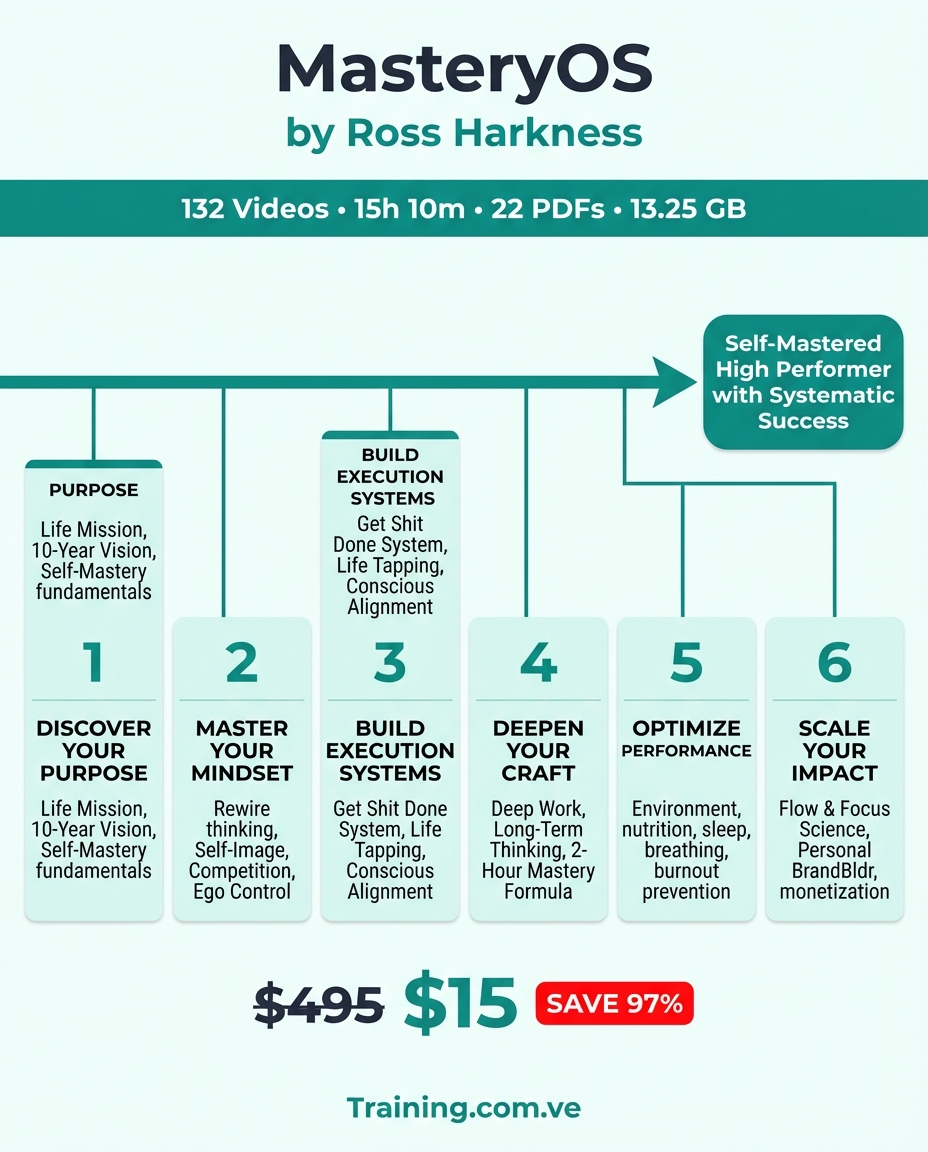
Common Mistakes
Mistake 1: Starting with tactics instead of pillars. Content strategy, engagement formulas, and distribution tactics are all real. They also all depend on the pillars for their effectiveness. If your Mind pillar is running limiting beliefs that tell you your content doesn't deserve to be seen, you will unconsciously undermine every tactical advantage you build. Fix the pillar first. Mistake 2: Treating Craft as passive. Many creators assume that posting content is the same as developing their craft. It is not. Posting is output. Craft development is the deliberate, protected work of becoming better at your specific skills — writing, speaking, thinking, teaching. The main limitation of most creators' schedules is that they have no time blocked for deep skill development separate from content production. Mistake 3: Ignoring the weakest pillar. The natural human tendency is to invest in the pillar you are already strongest at. It feels productive. It generates results. But the Three Pillars model is explicit: the weakest pillar is the constraint. Doubling down on your strongest pillar while the weakest one creates a ceiling is the highest-effort, lowest-return approach available to you.The Framework's Unifying Claim
The most important thing Ross Harkness says across MasteryOS 2.0 is not a tactic. It is a claim about causality: your personal brand is a reflection of your self-mastery. Not the other way around.
This inverts how most people think about brand-building. Most creators think the brand produces the income, the audience, the results — and then the results allow them to build a better life. Harkness argues that it runs in the opposite direction. The person you become through developing the three pillars produces the brand. The brand is the byproduct. Fix the person, and the brand fixes itself.
This is either the most useful or the most inconvenient thing you will hear depending on where you are in the process. But it explains something that tactics alone cannot: why some people with mediocre strategies build large audiences, and why people with excellent strategies keep producing mediocre results.
The Three Pillars framework is one of seven frameworks inside MasteryOS 2.0. The others — including the Conscious Alignment Hub, the Five-Part Thread Structure, the Content Pyramid, and the Distribution Methods playbook — are all built on top of this foundation.
The course costs $495. The complete breakdown of all 7 frameworks — plus 110+ other premium courses — is available on Course To Action for $49/30 days. Free account, 10 summaries, no credit card. Every summary includes audio. The AI advisor applies these frameworks to YOUR situation — 3 credits free.
Frequently Asked Questions
Is MasteryOS 2.0 worth $495? MasteryOS 2.0 is worth $495 if you are an aspiring personal brand builder who needs both the internal operating system (mindset, habits, deep work) and the external growth tactics (content strategy, distribution, monetization) in one course. The Three Pillars framework is the diagnostic foundation; the personal brand half delivers the tactical specifics. Skip it if you already have strong self-mastery foundations. What does the Three Pillars of Self-Mastery framework actually teach? The Three Pillars of Self-Mastery is Ross Harkness's model for diagnosing why personal brand builders stall. It identifies three interdependent domains — Mind (limiting beliefs and mindset), Actions (habits, goals, consistency), and Craft (deep work and deliberate skill development) — and argues that the weakest pillar creates a ceiling on the other two. What does MasteryOS 2.0 NOT cover? MasteryOS does not cover YouTube, TikTok, or podcasting. The monetization section is introductory. The self-mastery half draws from Cal Newport, James Clear, and Stoic philosophy. Team building, hiring, and advanced business scaling are not addressed. Who is MasteryOS 2.0 best for? This is best suited for aspiring creators at 0–10K followers, young entrepreneurs aged 18–30 who feel they are underperforming, and anyone who consumes more content about building than they actually build. It provides a complete system from mindset to monetization for Twitter and Instagram. Where can I read a full breakdown of MasteryOS 2.0? The complete independent breakdown — every framework, every limitation, and what the course does not cover — is available free at Course To Action.Get All Frameworks from MasteryOS 2.0
The course costs $495. The complete breakdown is $49/year — every course on the platform.
This is one framework. Course To Action has every framework, every lesson, and AI that applies it to your specific business. Read or listen — every summary has audio.
Start free — 10 full summaries, no credit card required