
The Will vs. Skill Framework Explained: Diagnose Why High-Ticket Buyers Don't Convert — from Market Like a CEO by Jereshia Hawk
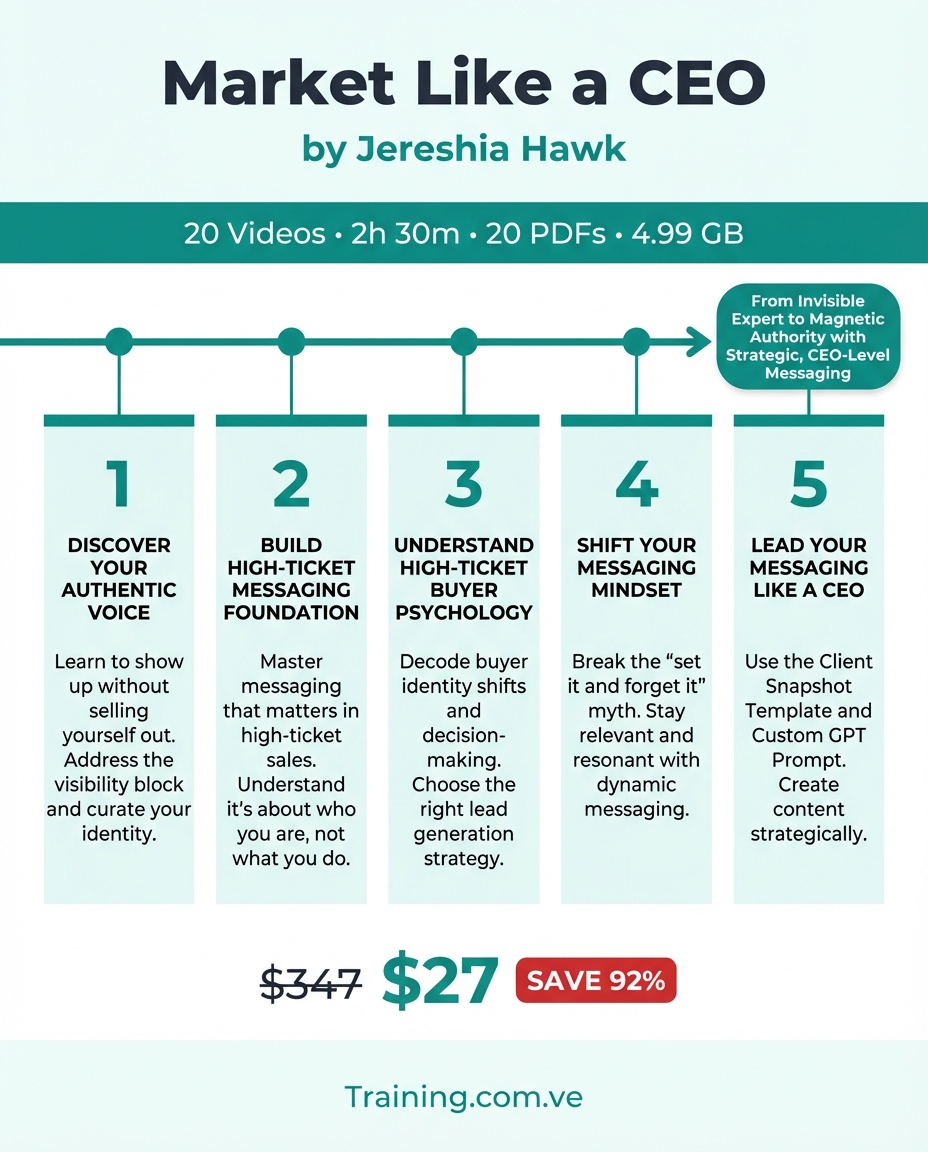
The Will vs. Skill Framework is Jereshia Hawk's 2x2 diagnostic matrix for identifying why high-ticket prospects are not buying. It is the foundational model inside Market Like a CEO, a $347 course with 20 text-and-audio lessons built for coaches and consultants selling $5K–$50K+ offers. The framework separates buyer objections into four quadrants — Principle, Process, Desire, and Belief — and reveals that most coaches are producing almost exclusively educational content while the quadrant that actually closes high-ticket sales sits nearly empty. The full course breakdown is available on Course To Action.
What Is the Will vs. Skill Framework?
The Will vs. Skill Framework is a 2x2 matrix for diagnosing why prospects are not buying. It was developed by Jereshia Hawk inside Market Like a CEO as the foundational model for understanding what messaging a high-ticket buyer actually needs at each stage of their decision.
The premise is this: every objection a prospect has to buying your high-ticket offer falls into one of two categories — Skill objections or Will objections. And those two categories split further into two types each, giving you four distinct reasons a prospect might not say yes.
What makes this different is the question it forces you to ask — a question that most coaches never explicitly ask: is this person not buying because they don't understand something, or because they don't believe something?
Those require entirely different content.
The Four Quadrants
Skill Objections
Skill objections are about comprehension. The prospect does not have enough information or understanding to move forward.
Principle (Skill — Concept Level)The prospect does not understand the core concept behind what you do. They cannot see how your framework, methodology, or approach works. This is the most common type of content being created in the online coaching space — educational content that explains ideas, breaks down frameworks, and teaches concepts.
If someone does not understand why your approach to sales works, a Principle-level piece explains the mechanism. Webinars, how-to blog posts, explainer videos, and methodology breakdowns are all Principle content.
Process (Skill — Delivery Level)The prospect understands the concept but does not understand what working with you actually looks like. They are confused about the structure, the deliverables, or the day-to-day experience inside your program.
Process objections show up as questions like: "What exactly would we be doing?" or "How does the program actually work?" A walkthrough of your offer, a day-in-the-life piece, or a behind-the-scenes look at your method addresses this quadrant.
Will Objections
Will objections are about motivation and belief — not understanding. The prospect may fully understand what you do, may even believe it works. But something inside them is not ready to commit.
Desire (Will — Motivation Level)The prospect does not want the transformation enough to invest at this price point. The core insight is this: Hawk's explicit position is that you cannot manufacture Desire through marketing. If someone does not already want the outcome you offer, no amount of content will change that. Desire objections are filter problems, not marketing problems. The right response is not to try harder — it is to evaluate whether these prospects are actually your buyers.
This is where many coaches waste enormous marketing energy: creating content designed to convince people they should want something. That energy is better spent qualifying the people who already want it.
Belief (Will — Trust Level)This is where the conversion actually lives for high-ticket offers, and this is the quadrant most coaches' content almost never enters.
Belief objections split into two sub-categories:
Self-trust: Does the prospect believe in themselves enough to succeed at this level? They may fully want the outcome and fully believe your methodology works. But they do not trust themselves to follow through, to do the work, or to be the kind of person who succeeds at this price point. Guide-trust: Does the prospect believe in you specifically? Not your credentials — your credentials are already assumed at the high-ticket level. Do they believe you understand their specific context, their specific life, their specific set of constraints? Do they feel seen by you, or do they feel like they are watching someone talk about other people's problems?The key takeaway is that Belief-level messaging is what actually closes high-ticket sales. And according to the Will vs. Skill Framework, most coaches produce almost none of it.
The Diagnostic: Where Is Your Content Actually Landing?
Hawk's instruction in the course is to run a 90-day content audit. Pull your last 10-15 pieces of published content and assign each one to a quadrant:
- Principle: explaining concepts and how things work
- Process: showing how your delivery is structured
- Desire: qualifying or filtering for motivation
- Belief: speaking directly to self-trust or trust in you as the guide
In summary, this is the messaging gap. Not a volume gap. Not a consistency gap. A quadrant gap.
This is one of 6 frameworks in Market Like a CEO. The complete breakdown — every framework, every limitation — is available on Course To Action. Start free.
Real Example: The Six-Figure Coach Who Cannot Break Through
Here is how this plays out in practice.
A business coach has been selling a $12,000 six-month program. She has been posting educational content five times a week for two years — frameworks, client results, behind-the-scenes of her methodology. She has a warm audience. She gets discovery calls. And yet her conversion rate has been flat for 18 months.
Without the Will vs. Skill lens:Every piece of content explains the concept better. More case studies. More methodology breakdowns. More demonstrations of expertise. The implicit belief driving this: if I can just help people understand well enough, they will buy. But they already understand. That is why they are on discovery calls.
With the Will vs. Skill lens:She audits her last three months of content. She finds 47 Principle posts, 6 Process posts, 2 Desire posts, and 1 Belief post — an Instagram caption about her own imposter syndrome that she almost did not publish.
That one post got 12 DMs. Three of those DMs became discovery calls. Two of those calls closed.
She starts writing Belief-level content: what she privately says on sales calls about the internal reasons clients hesitate. What the identity shift looks like six months into her program. What it means to trust yourself enough to invest $12,000 in yourself when you have not yet proven to yourself that you are worth it.
Her messaging stops sounding like a course and starts sounding like a mirror. And the people who recognize themselves in the mirror are already 80 percent of the way to yes before they ever get on a call.
Get Every Framework from Market Like a CEO
The course costs $347. All frameworks extracted — $49/year.
Start free — 10 full summaries, no credit card
How to Apply This This Week
Step 1: Run the content audit.Open a document. List your last 10-15 pieces of content. Assign each one to a quadrant: Principle, Process, Desire, or Belief. Be honest about where each piece actually lives — not where you intended it to live. Count the distribution.
Step 2: Identify your Belief gap.If your Belief quadrant is nearly empty, that is your assignment. Not more Principle content. One Belief-level piece this week. Pick one thing: what does your buyer need to believe about themselves — not about you — to say yes? Write directly to that.
Step 3: Answer the three pre-content questions.Before writing any content going forward, Hawk recommends three questions: Who specifically am I writing this for? What quadrant of their objection is this addressing? What do I want them to feel after reading this — not just know?
The most important framework is these three questions applied consistently — they will reorganize your content strategy in under five minutes.
Common Mistakes
Mistake 1: Treating Belief content like Principle content.The instinct is to explain the identity shift the way you explain a framework. Bullet points. Linear logic. Step-by-step. Belief-level messaging does not work that way. It works through recognition — through saying something specific enough that the reader feels seen rather than taught. The shift is from "here is how this works" to "here is what this is like inside your experience."
Mistake 2: Confusing Belief content with vulnerability content.Hawk is explicit: Belief-level messaging is not oversharing or performing emotional transparency. It is strategic curation. You are sharing the truths that your audience needs to hear to trust themselves and trust you — not every private thought you have ever had about your business. The filter is simple: does this piece of content address a Belief objection my buyer is actually holding? If yes, it belongs. If it is just personal, it does not.
Mistake 3: Giving up after two or three Belief-level posts.The main limitation of Belief content is that the response is often slower and quieter than the response to Principle content. Principle posts get likes and shares. Belief posts get DMs. The metrics look different, which tempts coaches to conclude the Belief content is not working. But a DM is worth a thousand likes when you are selling a $10,000 offer. The measurement standard has to match the buying behavior.
The Leverage Point Most Coaches Walk Right Past
Jereshia Hawk's argument in Market Like a CEO is not that educational content is wrong. Principle and Process content are necessary — they are part of the full messaging ecosystem. Her argument is specifically about proportion. Most coaches are producing 90 percent Principle content and 10 percent Belief content when the conversion gap for high-ticket offers lives almost entirely in the Belief quadrant.
The Will vs. Skill Framework makes that invisible proportion visible.
If your content is comprehensive and your audience is engaged but your high-ticket sales are plateauing, the audit will almost certainly reveal the same imbalance. More expertise demonstrated, not enough identity addressed. More how-it-works, not enough how-it-feels-to-be-the-person-who-is-ready.
That is not an algorithm problem. That is a quadrant problem. And the Will vs. Skill Framework is the map that shows you exactly where the gap is.
This framework is one of six original models inside Market Like a CEO. The others — including the Three Levels of Buyer Identity Shifts, the Lifetime Value vs. Lead Generation Focus model, and the Messaging Rhythm Framework — are all built on top of this foundation.
The course costs $347. The complete breakdown of all 5 frameworks — plus 110+ other premium courses — is available on Course To Action for $49/30 days. Free account, 10 summaries, no credit card. Every summary includes audio. The AI advisor applies these frameworks to YOUR business — 3 credits free.
Frequently Asked Questions
Is Market Like a CEO worth $347? Yes, if you have existing clients, existing content, and a high-ticket offer. The Will vs. Skill Framework alone produces a diagnostic clarity that changes what you write next week. If you are a beginner without clients to reference, the frameworks have nothing to operate on. What does Market Like a CEO actually teach? Six original messaging frameworks across 20 text-and-audio lessons. The Will vs. Skill Framework diagnoses content quadrant gaps. The Three Levels of Buyer Identity Shifts explains why your content misses pre-purchase buyers. The Lifetime Value Focus model reveals structural marketing mismatches. The Messaging Rhythm Framework turns insight into a recurring operational system. What does Market Like a CEO NOT cover? Zero social media tactics, no Instagram templates, no funnel architecture, no email marketing, no offer building, no pricing guidance. The course operates at the strategic and psychological level and assumes you already have a high-ticket offer and clients. Who is the Will vs. Skill Framework best for? Coaches, consultants, and service providers selling high-ticket offers ($5K–$50K+) who produce consistent content but are not converting at the level their expertise deserves. The framework is particularly useful for anyone whose content audit reveals heavy Principle-quadrant distribution. How does Market Like a CEO compare to copywriting courses? Copywriting courses teach execution — headlines, hooks, emails, sales pages. Market Like a CEO teaches the source-level strategic thinking that makes any execution land correctly. They operate at different layers and do not replace each other. Course To Action publishes independent framework-level breakdowns of online courses — the 20% that delivers 80% of the value, so you can make an informed decision before you spend a dollar.Get All Frameworks from Market Like a CEO
The course costs $347. The complete breakdown is $49/year — every course on the platform.
This is one framework. Course To Action has every framework, every lesson, and AI that applies it to your specific business. Read or listen — every summary has audio.
Start free — 10 full summaries, no credit card required