The GPS Method Explained: Turn Vague Goals Into Repeatable Systems — from LifeOS by Ali Abdaal
The GPS Method is Ali Abdaal's three-part framework for turning vague goals into repeatable systems, taught inside LifeOS — his $297 course covering 38 lessons across 7 modules on personal productivity. The core insight is that most people set goals but never build the recurring system that makes progress happen without relying on daily willpower.
Most people set goals the same broken way every year. They write something ambitious on January 1st, feel a surge of motivation for about 11 days, and then watch the goal quietly dissolve into the background noise of daily life. The goal itself was never the problem. The missing piece was always a system connecting that goal to what you actually do each day.
According to the full breakdown on Course To Action, the GPS Method is the framework that most clearly separates LifeOS from generic goal-setting advice.
What Is the GPS Method?
The GPS Method is Ali Abdaal's 3-step process for building goals that actually produce results. GPS stands for Goal, Plan, and System. Each letter represents a distinct layer of the goal-achievement process, and each layer depends on the one before it.
- G — Goal: A clearly defined, specific outcome you want to achieve.
- P — Plan: A structured breakdown of the milestones and steps between where you are now and that outcome.
- S — System: The recurring daily and weekly habits and routines that move you toward those milestones without requiring constant willpower decisions.
What makes this different is the emphasis on the System layer. Most productivity content obsesses over goal-setting (vision boards, SMART goals, manifestation) and skips directly to motivation tips. The Plan layer exists in some frameworks but is often vague. The System layer — the actual repeatable behavior — is almost always treated as an afterthought. Ali Abdaal flips that priority. Inside LifeOS, the System layer is where the real work happens.
The Three Components in Detail
G — Goal
A goal inside the GPS Method is not a wish. It is a concrete, time-bound statement of a desired outcome. Ali Abdaal draws on his background in medicine and evidence-based habit research (detailed extensively in his book Feel-Good Productivity) to emphasize that vague goals produce vague results.
A weak goal: "I want to grow my business." A GPS-ready goal: "I want to generate $15,000 per month in recurring revenue from my consulting practice by December 31."
The key takeaway is that specificity is not about perfectionism. It is about giving your brain a clear target so it can begin filtering for relevant opportunities and information. Neuroscience research on the reticular activating system confirms this — your brain notices what you tell it matters. A clear goal tells it what to notice.
P — Plan
The Plan layer takes your goal and reverse-engineers it into a sequence of milestones. In LifeOS, Ali Abdaal structures these as 12-week sprints. Rather than planning a full year (which is cognitively abstract and emotionally distant), you identify what needs to be true in the next 12 weeks to put you meaningfully on track toward your annual goal.
Each 12-week sprint has defined milestones — checkpoints that tell you whether you are on track or need to recalibrate. This is where the GPS metaphor becomes most useful. If your GPS route shows you should be at a particular junction in 20 minutes and you are not, you know immediately to adjust. Without milestones, you can lose months before realizing you drifted off course.
The Plan layer also forces a useful constraint: if you cannot reverse-engineer a credible 12-week path to your goal, the goal itself may need to be resized or reframed. This is a feature, not a bug. It surfaces unrealistic planning early, before you have invested months of effort.
S — System
The most important framework is the System layer — and it is the one most goal-setting approaches skip entirely. The System is the set of recurring behaviors — daily habits, weekly rituals, environmental setups — that move you toward your milestones without relying on daily motivation.
Inside LifeOS, the System layer connects directly to two other frameworks: the Morning Manifesto and the Weekly Review. The Morning Manifesto is Ali Abdaal's short daily check-in (under five minutes) where you reconnect with your weekly priorities and identify the single most important thing to accomplish that day. The Weekly Review is a longer session — typically 20 to 45 minutes — where you assess the previous week, update your milestones, and set priorities for the week ahead.
Together, these two rituals operationalize the System layer. They ensure that your GPS goal is not sitting in a notebook gathering dust but is actively shaping your decisions every single day.
The GPS Method sits alongside five sibling frameworks in LifeOS: the LifeOS Framework, Focused Hour Formula (5-50-5), Three Focus Menus, Morning Manifesto, and Weekly Review. The complete breakdown of all six — every framework, every limitation — is on Course To Action. Free tier includes 10 summaries, no credit card — or unlock everything for $49/30 days vs. $297 for the course itself.

A Concrete Example
Here is how the GPS Method looks in practice for a solo founder trying to launch a new product.
Goal: Launch a paid digital product and reach $5,000 in total sales within 12 weeks. Plan (12-week milestones):- Week 1-2: Validate the product idea through audience surveys and pre-sale interest.
- Week 3-5: Build the core product content (outline, record, edit).
- Week 6-7: Set up sales page, payment system, email sequences.
- Week 8: Soft launch to existing email list.
- Week 9-12: Marketing push — content, partnerships, paid ads.
- Daily: Morning Manifesto identifies the one product-related task that matters most today.
- Weekly: 30-minute Weekly Review checks milestone progress, adjusts the next week's plan if needed.
- Environmental: Phone kept out of the home office until 12pm to protect deep work hours for product creation.
Get Every Framework from LifeOS
The course costs hundreds of dollars. All frameworks extracted — $49/year.
Start free — 10 full summaries, no credit card
Apply This Week
You do not need to buy a course or restructure your life to test the GPS Method. Here is a minimal version you can run this week:
- Write one Goal that matters to you in the next 90 days. Make it specific and measurable. Spend 10 minutes on this.
- Draft a rough Plan by working backward. What would need to be true at the 30-day and 60-day marks for you to hit your 90-day goal?
- Identify one System behavior — a single recurring action you will do daily or weekly that directly moves you toward the 30-day milestone. Schedule it.
- Do a five-minute Morning Manifesto check-in each morning this week. Ask yourself: "What are my priorities this week, and what is the most important thing I can do today?"
Common Mistakes to Avoid
Treating the Goal as the finish line. Setting the goal feels productive, so many people stop there. The Goal layer is just the starting coordinate. The real work is in Plan and System. Making the Plan too granular too soon. You do not need to know every step on day one. The 12-week sprint structure gives you enough detail to act without demanding false precision about the future. Plan the next two weeks in detail, the following four weeks in milestones, and hold the rest loosely. Skipping the daily System touchpoint. The Morning Manifesto feels trivial — five minutes, a few questions, no dramatic insight. But its power is cumulative. It is the mechanism that keeps your GPS recalculating every single day instead of drifting for weeks before you notice. The main limitation is that missing this step consistently is the single fastest way to turn a GPS goal back into a dead wish. Treating 12-week sprints as fixed. If your goal or circumstances change significantly mid-sprint, update the plan. A GPS that refuses to recalculate is not a GPS — it is just a map.The Bigger Picture
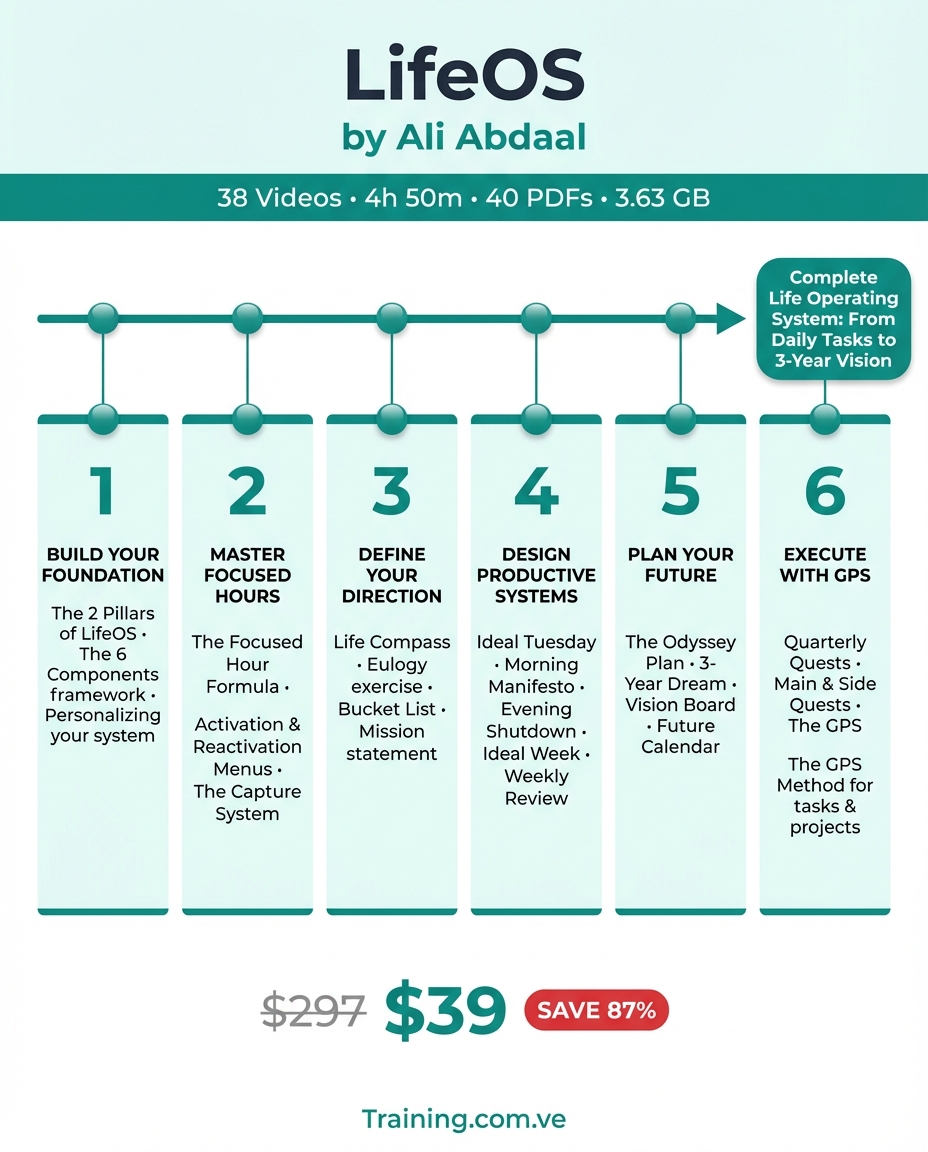
In summary, the GPS Method is one of six components inside Ali Abdaal's LifeOS framework, which treats your life and work as an operating system that can be deliberately designed rather than endlessly reacted to. The other components — including the Vision framework, the Focused Hour Formula, and the Weekly Review system — all reinforce and connect to the GPS Method.
What Ali Abdaal identified, after years of studying productivity as a Cambridge-educated doctor, successful YouTuber, and entrepreneur, is that most productivity problems are not execution problems. They are clarity problems. People are not lazy. They are disoriented. The GPS Method is, at its core, a disorientation cure. It answers the questions your brain is constantly asking in the background: Where am I going? What is the route? What do I do right now?
When those three questions have clear answers, the path forward becomes obvious. And obvious paths get walked.
Start free on Course To Action — 10 free summaries, no credit card. Use the AI "Apply to My Business" feature (3 credits) to map the GPS Method or any of the other 5 frameworks to your specific situation. Every summary includes audio. Course To Action covers 110+ courses; full access is $49/30 days or $399/year, no subscription, no auto-renewal.
Start free at Course To ActionFrequently Asked Questions
Is LifeOS worth $297?LifeOS is worth $297 if you are a solo founder or knowledge worker who feels perpetually busy but not productive. The GPS Method alone — combined with the Morning Manifesto and Weekly Review — provides a complete system for connecting daily actions to meaningful goals. Skip it if you already have a functioning system.
What does the GPS Method actually teach?The GPS Method is Ali Abdaal's 3-step process for goal achievement: Goal (a specific, time-bound outcome), Plan (12-week sprints with defined milestones), and System (recurring daily and weekly behaviors that make progress automatic). It is designed to replace vague annual goal-setting with a structured, reviewable process.
How does the GPS Method connect to the rest of LifeOS?The GPS Method is one of 6 core frameworks in LifeOS. It connects directly to the Morning Manifesto (which reloads your GPS priorities daily), the Weekly Review (which recalibrates your milestones weekly), and the Quarterly Quests structure (which sets the 90-day timeframe for each GPS cycle).
Who is the GPS Method best for?This is best suited for entrepreneurs, solo founders, and knowledge workers who set goals regularly but struggle to follow through. If your pattern is setting ambitious goals and then losing track of them within weeks, the GPS Method's System layer addresses exactly that failure mode.
Course To Action publishes independent framework-level breakdowns of online courses — the 20% that delivers 80% of the value, so you can make an informed decision before you spend a dollar.
Get All Frameworks from LifeOS
The course costs hundreds of dollars. The complete breakdown is $49/year — every course on the platform.
This is one framework. Course To Action has every framework, every lesson, and AI that applies it to your specific business. Read or listen — every summary has audio.
Start free — 10 full summaries, no credit card required