51/49 Identity Duality Explained: Claim a New Identity Without Full Conviction — from Identity Work by Melanie Ann Layer
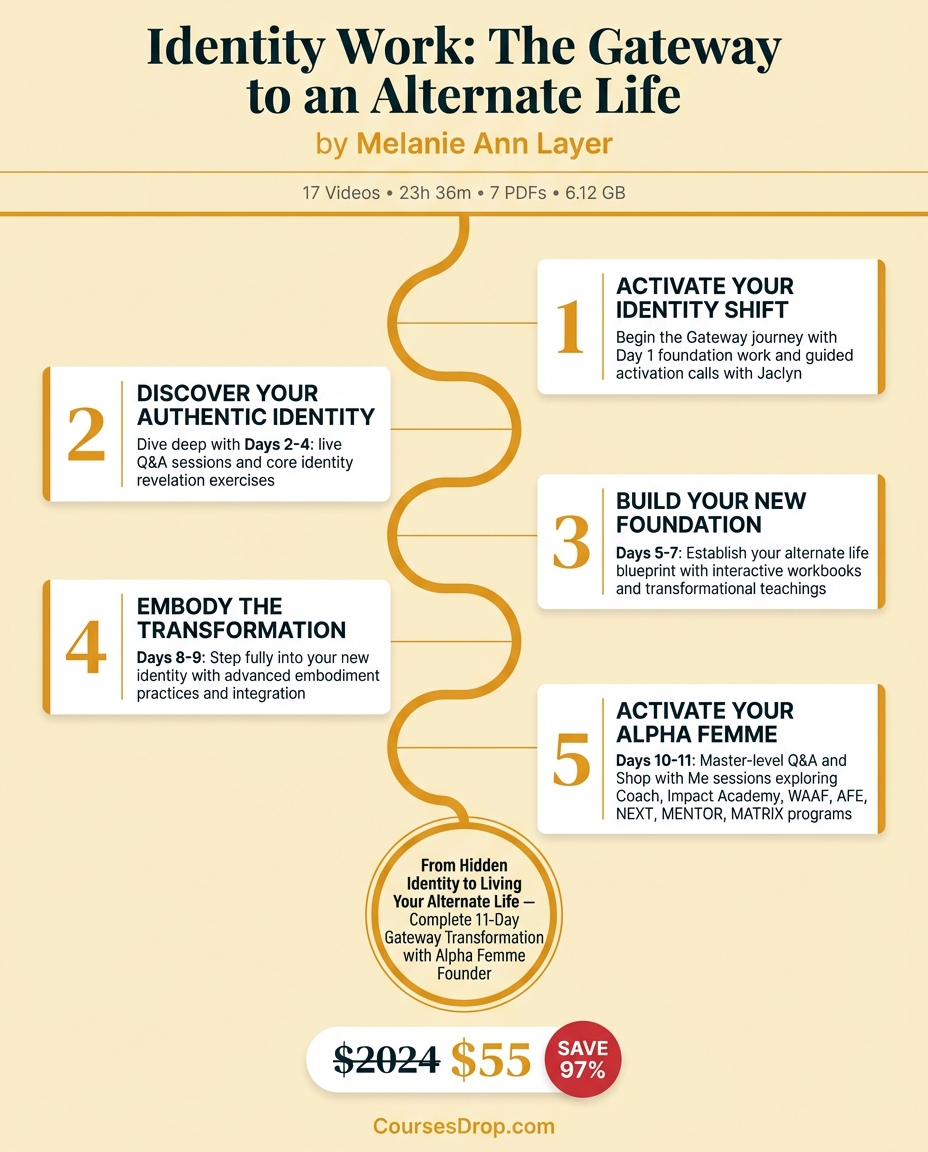
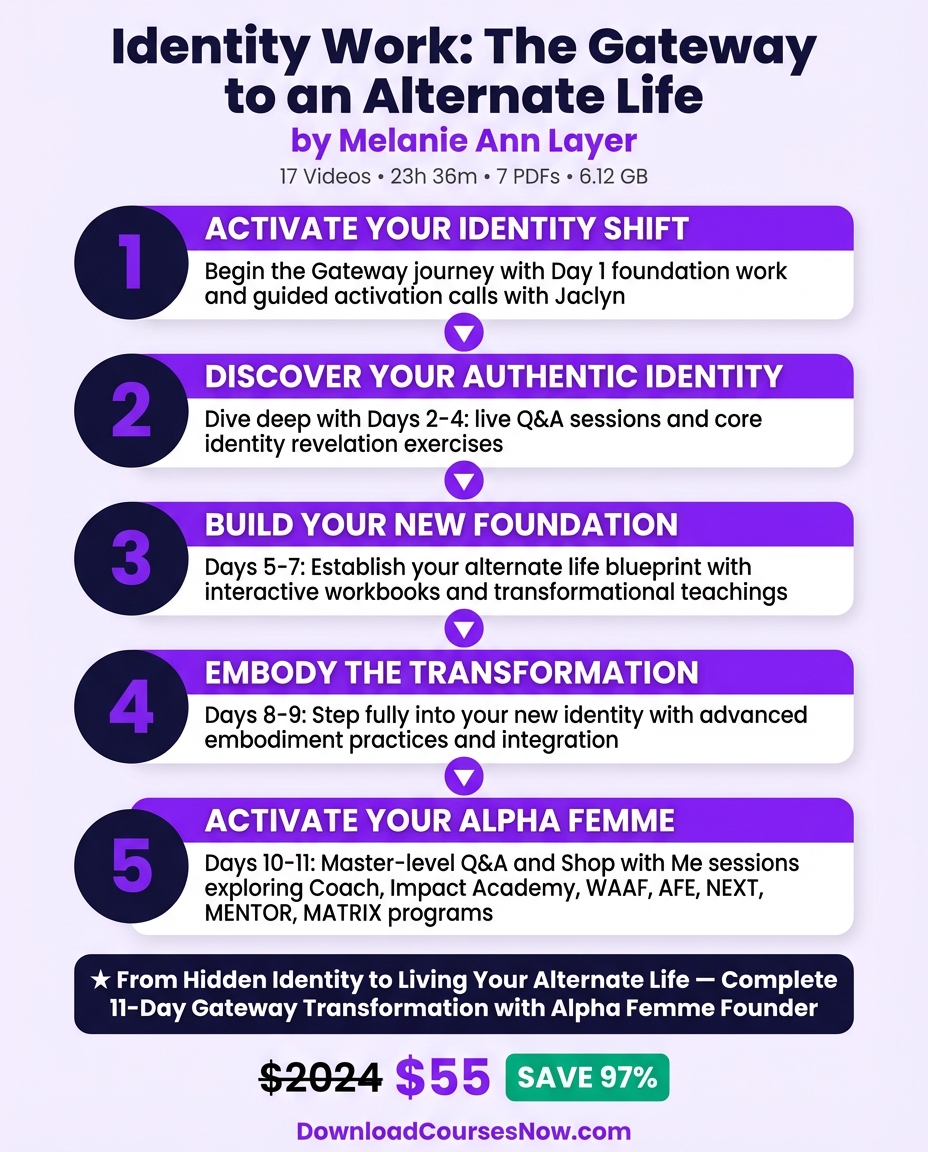
The 51/49 Identity Duality is Melanie Ann Layer's threshold framework for claiming a new identity, taught inside Identity Work — her $2,024 flagship course with 17 lessons and 23.5 hours of content. The key takeaway is that you do not need 100% conviction to act from a new identity. You need 51% — one point above the doubt — and the remaining 49% is allowed to stay exactly where it is. According to the full breakdown on Course To Action, it is the most practically applicable of the 8 frameworks in the course.
Most identity work hits a wall the moment you ask someone to "believe in themselves." The instruction sounds simple. Feel it fully. Own it completely. Decide you are the person who has already achieved the thing. The personal development world has been delivering this message in various forms for decades, and for most people it doesn't work — not because they aren't trying, but because the gap between who they currently are and who they're being asked to fully embody is too large to close by sheer force of conviction. You can stand in front of a mirror and repeat affirmations, but if some part of you doesn't believe a word of it, that part tends to win.
What Is the 51/49 Duality?
The 51/49 Identity Duality is Melanie Ann Layer's 2-part reframing of the threshold at which you are permitted to claim an identity. The parts are: the 51% new belief you act from, and the 49% old belief you acknowledge without granting authority.
The conventional model says: believe it completely, then say it. Feel it at 100% before you state it as true. This model fails predictably because 100% conviction about a new identity almost never arrives before the identity is actually lived. You end up waiting for a feeling that can't arrive until you've already done the thing you're waiting to feel ready for.
The 51/49 Duality says: you only need to hold the new identity at 51% — one percentage point above the old belief — to claim it and begin acting from it. The remaining 49% is allowed to doubt, hesitate, and resist. You are not required to silence it. You are not required to pretend it doesn't exist. You simply do not give it the casting vote.
What makes this different is that it is not a motivational trick. It's a mechanical change in how identity transitions work. The 51% isn't the finish line. It's the minimum viable belief state from which you can begin generating real evidence that the new identity is true — which is what actually moves the percentage over time.
Why the Duality Matters
The core insight is that the framework names something that most identity work refuses to acknowledge: the 49% is real.
When you decide to claim a new identity — "I am someone who earns seven figures," "I am someone who publishes their work," "I am someone who leads" — there is always a counterpart. The part that says: not yet, not really, not you. That counterpart doesn't disappear because you affirm your way through it. It tends to go quiet in the moments when conviction is high and reappear precisely when you're under pressure and need the new identity most.
The 51/49 Duality doesn't try to eliminate the 49%. It gives you a way to hold it without being governed by it. The doubt is present. It simply doesn't run the operation.
This resolves a failure mode that shows up constantly in visualization and affirmation-based practice: the feeling that you're performing a belief rather than holding one. When the threshold is 51% rather than 100%, the performance pressure drops. You're not asking yourself to feel something you don't fully feel. You're asking yourself whether you feel it slightly more than you don't — and then acting from that position.
The Connection to Identity Validation
The 51/49 framework becomes most useful when you understand what Layer calls the Validation vs. Liberation Framework — the other side of the duality.
Every time you act from the 49%, you validate the old identity. Every time you say "I can't" or make a decision that the old version of you would make, you are not being passive. You are actively casting a vote for the old identity to remain true. Layer's framing on this point is pointed: "You validate your limiting identity every day without realizing it." The validation is happening regardless. The only question is which identity is being validated.
When you hold the new identity at 51% and make one decision from it — even a small one — you are beginning to validate the new identity instead. That validation generates a small amount of evidence. The evidence adjusts the percentage. The adjustment makes the next decision slightly easier to make from the new identity. The cycle compounds.
The 51/49 Identity Duality is one of 8 frameworks in Identity Work. The sibling frameworks include the Three-Part Identity Journey, Validation vs. Liberation Framework, White Screen Clearing Technique, Identity-Imagination Feedback Loop, Fishbowl vs. Lake Metaphor, Sword in the Stone Framework, and Enough + Limitless Framework. The complete breakdown of every framework is on Course To Action. Free tier: 10 summaries, no credit card required. The full course is $2,024; Course To Action access starts at $49 for 30 days.
This is the mechanism behind the Identity-Imagination Feedback Loop, another framework in the course. The Identity-Imagination Feedback Loop is Melanie Ann Layer's model for how identity shapes what you can imagine, and what you imagine reinforces or erodes the identity that allowed you to imagine it. The 51/49 threshold is the entry point to that loop. It's the minimum belief required to start generating the evidence that shifts everything else.
Get Every Framework from Identity Work
The course costs $2024. All frameworks extracted — $49/year.
Start free — 10 full summaries, no credit card
How to Apply It
Step 1: Name the identity you want to claim. Not a goal. Not an aspiration. A state of being. "I am the kind of person who..." followed by the specific thing you're reaching for. Make it present tense and definite. Step 2: Honestly locate your current belief level. On a scale from 0 to 100, how much do you believe this is actually true of you right now? Don't inflate it. Don't perform certainty you don't have. If you're at 30%, you're at 30%. That's your starting point. Step 3: Find the path to 51%. You don't need to get to 100. You need to get to one point above 50. What would need to be true — what evidence, what decision, what single action — for you to tip slightly toward believing this identity is real? Often it's smaller than you think. A decision made. A conversation had. A piece of work published. Step 4: Act from 51%, not from 100%. Make one decision that the 51% version of you would make, that the 49% version would not. Don't wait for the certainty to arrive in full. Act from the slight majority. Document it. Step 5: Let the percentage move on its own. You don't push it to 100. The evidence from acting at 51% moves it. The decisions compound. The new identity becomes the one getting validated. The math starts to change by itself.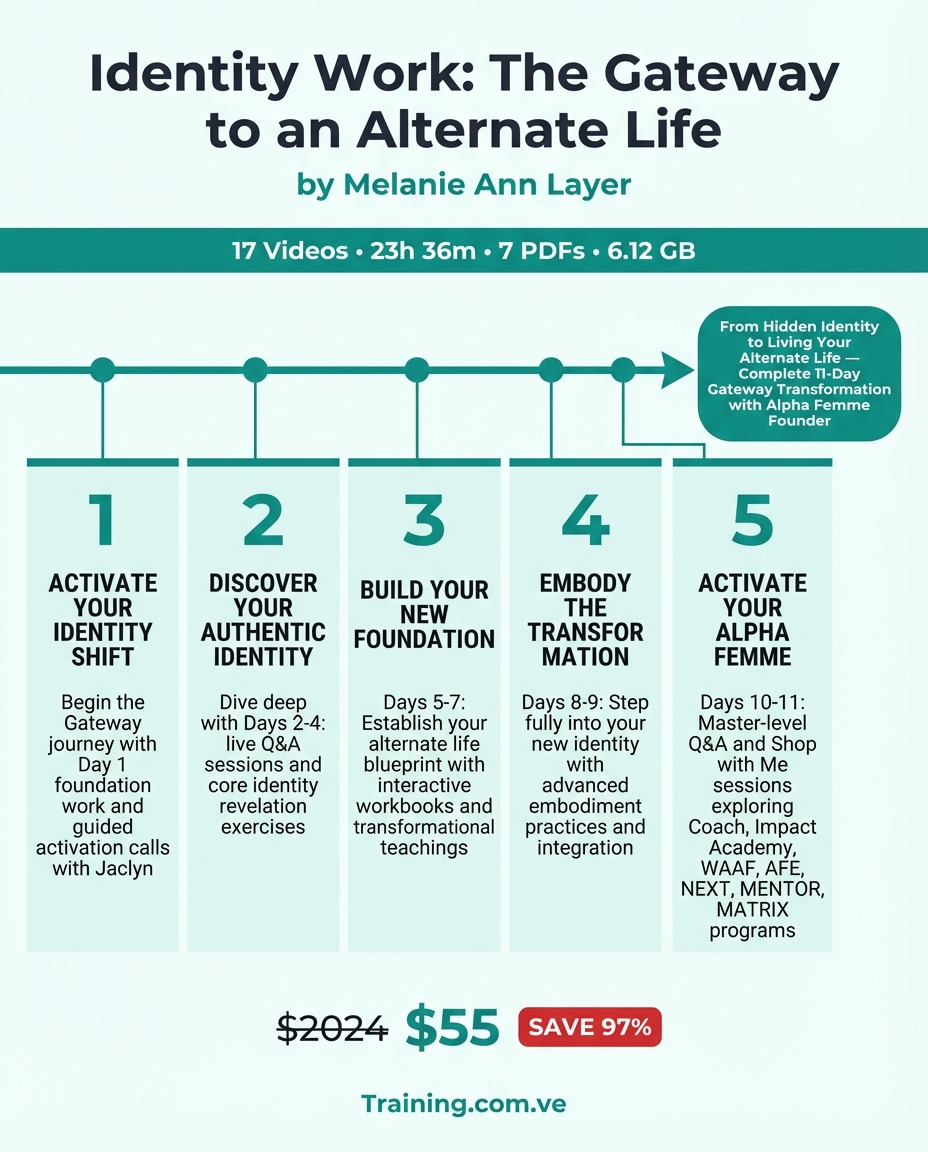
Common Mistakes
Treating 51% as a stepping stone to 100% certainty. The 51/49 Duality is not a trick to make 100% easier to reach. The 49% may always be there, in some form. The framework is about making peace with that and acting anyway — not about eliminating doubt permanently. Creators who use this framework as a path to invulnerability miss the point and often find themselves back at square one when uncertainty inevitably returns. Waiting until the 49% is quiet before acting. The 49% may never go entirely quiet. If you're waiting for it to, you've effectively returned to the 100% threshold by another name. The action must come from the 51%, while the 49% is still audible. Performing the belief rather than holding it. The framework only works if your 51% is genuine. If you're performing conviction at 90% while actually sitting at 30%, the gap between the performance and the internal reality will surface in your decisions — especially under pressure. Start where you actually are. Confusing 51% with mediocre commitment. In summary, holding an identity at 51% does not mean treating it lightly. It means claiming it precisely at the threshold where you can — and then acting with full commitment from that position. The 51% is the belief level. The commitment to action can still be 100%.The Larger Framework It Belongs To
The 51/49 Duality sits inside a broader architecture that Layer introduces in Identity Work. The course maps what she calls the Three-Part Identity Journey — a sequence of identity expansions from I Don't Matter to I Matter to We Matter — each requiring you to hold and act from a new identity before you fully feel it.
The Fishbowl vs. Lake Framework extends the same logic outward: before you can grow into a larger version of yourself, you need to enter a larger environment. The fish doesn't grow because it decided to. It grows because it's in a lake. The environment is a precondition for the growth — but the fish has to enter the lake at 51% readiness, not 100%.
The Enough + Limitless Framework is Melanie Ann Layer's resolution of the tension between claiming sufficiency and pursuing ambition — enough is the floor, not the ceiling, and limitless expansion proceeds from a foundation that is already full.
Start free — no credit card required. Course To Action gives you 10 summaries on the free tier so you can read the complete breakdown of all 8 frameworks — including the Validation vs. Liberation Framework, the Identity-Imagination Feedback Loop, the Sword in the Stone Framework, and how they connect — before spending anything.
Use the "Apply to My Business" AI tool (3 credits) to see how a framework like the 51/49 Identity Duality or the Fishbowl vs. Lake Metaphor applies to your specific situation. Every summary and every lesson has audio. Course To Action covers 110+ premium courses. Access starts at $49 for 30 days or $399/year — one payment, no subscription, no auto-renewal.
The course is $2,024. Starting the analysis is free.
Start free at Course To Action Course To Action publishes independent framework-level breakdowns of online courses — the 20% that delivers 80% of the value, so you can make an informed decision before you spend a dollar.Frequently Asked Questions
Is Identity Work worth $2,024? Identity Work is worth $2,024 if you have solid strategies you cannot consistently execute and suspect the problem is identity-level. The 51/49 Identity Duality alone provides a workable entry point to identity change that most mindset courses lack. Skip it if your problem is tactical or if spiritual language creates friction you cannot set aside. What is the 51/49 Identity Duality? The 51/49 Identity Duality is Melanie Ann Layer's framework for claiming a new identity at 51% belief — one point above the doubt — rather than waiting for 100% conviction. The remaining 49% is acknowledged but not granted authority. Acting from 51% generates evidence that gradually shifts the percentage higher. What does Identity Work actually teach? Identity Work teaches 8 named frameworks across 17 lessons: the Three-Part Identity Journey, the 51/49 Identity Duality, the Validation vs. Liberation Framework, the White Screen Clearing Technique, the Identity-Imagination Feedback Loop, the Fishbowl vs. Lake model, the Sword in the Stone Framework, and the Enough + Limitless Framework. Who is Identity Work best for? Identity Work is best for experienced entrepreneurs who have implemented proven strategies without consistent results and suspect the problem is at the identity level. It is particularly suited to coaches and service providers comfortable with spiritual and energetic frameworks. Where can I read a full breakdown of Identity Work? The complete independent framework-level breakdown of Identity Work — every framework, every limitation, and what the course does not cover — is available at coursetoaction.com/. Start free.Get All Frameworks from Identity Work
The course costs $2024. The complete breakdown is $49/year — every course on the platform.
This is one framework. Course To Action has every framework, every lesson, and AI that applies it to your specific business. Read or listen — every summary has audio.
Start free — 10 full summaries, no credit card required