The Four-Phase Cyclical Energy Model Explained: Replace Linear Productivity With Rhythm-Based Planning — from Heal the Way You Work by Kate Northrup
The Four-Phase Cyclical Energy Model is Kate Northrup's foundational framework in her $997 course Heal the Way You Work. It maps a woman's 28-day hormonal cycle onto four seasonal archetypes — Winter, Spring, Summer, and Autumn — each with a distinct energy profile and optimal work type. According to the full breakdown on Course To Action, this is one of the most genuinely original productivity frameworks available for women entrepreneurs.
Most productivity systems are built on a single, invisible assumption: that your capacity is constant. The advice tells you to wake up early, batch your most important work in the morning, structure your week the same way every week, and repeat. The system treats you like a machine — consistent inputs, consistent outputs, same performance on Monday as on Friday, same energy in week one as in week three.
But for women, that assumption is false. And building a career on top of a false assumption is how you end up exhausted, behind, and convinced that the problem is your discipline.
The core insight is this: Kate Northrup — author of Do Less and founder of The Origin Company — built her most important framework around a different premise: if you stop treating cyclical energy as a problem to overcome and start treating it as a planning tool, you do not just stop burning out. You start doing more, by doing less.
What Is the Four-Phase Cyclical Energy Model?
The Four-Phase Cyclical Energy Model is Kate Northrup's 4-phase productivity and planning framework that maps a woman's 28-day hormonal cycle onto four seasonal archetypes — Winter, Spring, Summer, and Autumn — each with a distinct energy profile, cognitive strength, and optimal work focus.
What makes this different is the way it reframes energy variation: the way you feel on day 5 of your cycle and the way you feel on day 20 are not variations on the same baseline. They are fundamentally different states, governed by different hormonal realities, each carrying different strengths. The person who is naturally introspective and idea-receptive on day 5 is not "less productive" than the person who is naturally expressive and high-energy on day 14. She is a different phase of the same system — and if you schedule accordingly, both phases produce output that the other cannot.
The model's most counterintuitive claim is also its most important: rest is not the opposite of productivity. Rest is Phase 1 of the next productive cycle. Systems that do not include real rest phases do not sustain output — they borrow it from future capacity until the account is empty.
The Four Phases: A Complete Breakdown
Phase 1: Winter (Menstruation / Days 1-5)
Winter corresponds to the menstrual phase — the lowest hormone levels of the cycle, the most inward energy, the highest need for rest and stillness. In most productivity systems, this is the phase that gets fought hardest, either by forcing through it or by calling in sick and feeling guilty about it.
Kate Northrup's reframe is direct: Winter is not downtime. It is the phase where your vision is clearest.
During the menstrual phase, the brain's pattern recognition and big-picture thinking tend to be heightened. The veil between what you genuinely think and what you have been telling yourself lifts. Women in this phase often find that they have sudden clarity on problems that felt murky all month — what is not working, what they actually want, what needs to change.
Optimal work in Winter:- Strategic reflection and journaling
- Evaluating what to stop doing
- Reviewing metrics and honest assessment of what is and is not serving you
- Visioning and long-range thinking
- Saying no to anything that can wait
Phase 2: Spring (Follicular Phase / Days 6-13)
Spring corresponds to the follicular phase — estrogen is rising, energy is building, the brain is primed for novelty and initiation. This is the phase that most closely resembles the "peak productivity" state that conventional systems assume is constant.
Energy is ascending. Motivation to start things is high. Creative thinking is expansive. This is when new projects feel genuinely exciting rather than overwhelming, when brainstorming produces real output, and when the learner in you is most receptive.
Optimal work in Spring:- Launching new projects and initiatives
- Brainstorming and creative exploration
- Learning new skills or consuming high-density content
- First drafts, pitch decks, outlines
- Anything that requires initiation energy or sustained novelty
Phase 3: Summer (Ovulatory Phase / Days 14-21)
Summer corresponds to the ovulatory phase — peak estrogen and a surge of testosterone, the highest physical energy of the cycle, and the phase where communication, presence, and connection come most naturally. This is when you are most yourself in public — most articulate, most magnetic, most able to hold space for other people.
The key takeaway is that Summer is not the phase for solitary focus work. It is the phase for everything that requires another human being.
Optimal work in Summer:- Sales calls, discovery calls, client-facing work
- Recorded content: video, podcast, live streams
- Public speaking, workshops, events
- Team collaboration and leadership moments
- Networking, pitches, and high-stakes conversations
- Community building and relationship maintenance
The Four-Phase Cyclical Energy Model is one of 7 frameworks in Heal the Way You Work — alongside the Do Less Weekly Planning Ritual, Prune Before You Plan, the Upward Cycle of Success, the Sacred Practices Calendar, the Daily Energy Tracker, and the 80/20 Two-Column Exercise. The complete breakdown of all 7 is on Course To Action. Start free with 10 summaries, no credit card required. The course is $997; access to the full breakdown starts at $49 for 30 days.
Phase 4: Autumn (Luteal Phase / Days 22-28)
Autumn corresponds to the luteal phase — progesterone is dominant, estrogen is declining, and the system is beginning its descent toward Winter. The energy in this phase is detail-oriented, completion-focused, and internally driven. The social energy of Summer has receded. What remains is a focused, slightly critical, highly effective executor.
This is when you finish things.
Autumn is also the phase most misunderstood in conventional productivity frameworks. The declining energy and increasing introversion of the luteal phase get coded as "bad PMS energy" or a drop in performance. Northrup's reframe: the Autumn phase is not declining productivity. It is a different kind of productivity — the kind that completes, refines, edits, and closes.
Optimal work in Autumn:- Completing projects started in Spring
- Editing, proofreading, final-pass reviews
- Administrative and organizational tasks
- Systems refinement and process documentation
- Deep focus work that requires solitary concentration
- Closing loops, following up, tying off open threads
The Upward Cycle of Success: How the Four Phases Connect
The most important framework that builds on the Four-Phase model is the Upward Cycle of Success — Kate Northrup's 4-stage arc that maps onto the cyclical model and describes how meaningful work actually compounds over time.
The four stages are: Emergence → Visibility → Culmination → Fertile Void
- Emergence corresponds to Winter and early Spring: the idea is born, the vision clarifies, the project takes initial form.
- Visibility corresponds to Summer: the work meets the world, the audience engages, the creator is present and visible.
- Culmination corresponds to Autumn: the work is completed, the cycle is closed, the project reaches its full expression.
- Fertile Void corresponds to the transition between Autumn and the next Winter: the empty space between completion and the next beginning.
The Fertile Void is not laziness. It is the space where the next Winter's vision becomes possible. Without it, you are not doing more — you are just starting things faster and finishing them less.
Get Every Framework from Heal the Way You Work
The course costs hundreds of dollars. All frameworks extracted — $49/year.
Start free — 10 full summaries, no credit card
How the Weekly Planning Ritual Operationalizes the Model
The Four-Phase Cyclical Energy Model is not useful as a philosophy without a mechanism for applying it. The Do Less Weekly Planning Ritual is Kate Northrup's 3-step mechanism — a ten-minute practice that translates cyclical awareness into actionable weekly structure.
The ritual has three components:
1. Identify your current phase. Before you plan the week, you locate yourself on the cyclical map. Day 8 of your cycle puts you in Spring. Day 19 puts you in Summer. Day 25 puts you in Autumn. Knowing where you are changes what you schedule. 2. Build a half-page, three-priority to-do list. Not a daily list — a weekly list. This is intentional. A weekly list builds in flexibility that a daily list destroys. If Tuesday's energy does not match the task, a weekly framework lets you move the task to Thursday without the system collapsing. The constraint to three priorities ensures that you are choosing what matters most, not cataloging everything. 3. Apply three filter questions before the list is final. These filters are the pruning mechanism — the gate between "things I could do" and "things I should do this week given where I am in my cycle." The questions vary in the course, but the function is consistent: eliminate anything that does not belong in this phase, does not serve the current cycle's most important objective, or could be done by someone else.The Weekly Planning Ritual is one of the most concrete and immediately applicable tools in the course — and it is where the Four-Phase Cyclical Energy Model moves from concept to calendar.
Who the Framework Is Actually Built For
This is best suited for women — the cyclical rhythm it tracks is biological and does not map directly to male hormonal cycles. This is not a limitation of the framework; it is the framework's central insight. The model only works because it is specific.
The course uses language and framing oriented toward women entrepreneurs, coaches, service providers, and creative professionals who have already internalized the "do more, push harder" productivity paradigm and are looking for an alternative that does not require them to override their own biology to succeed.
The model is planning-focused, not tactics-focused. It will not tell you which CRM to use or how to run a discovery call. It will tell you which phase of your cycle is most suited for discovery calls and how to cluster them accordingly.
There is approximately 30% spiritual content threaded through the course — Northrup draws on broader traditions of cyclical living and connects the productivity framework to seasonal rhythms and feminine archetypes. This resonates deeply for some students and is entirely skippable for others. The practical framework stands independently of the spiritual framing.
Start Here Before You Buy the Course
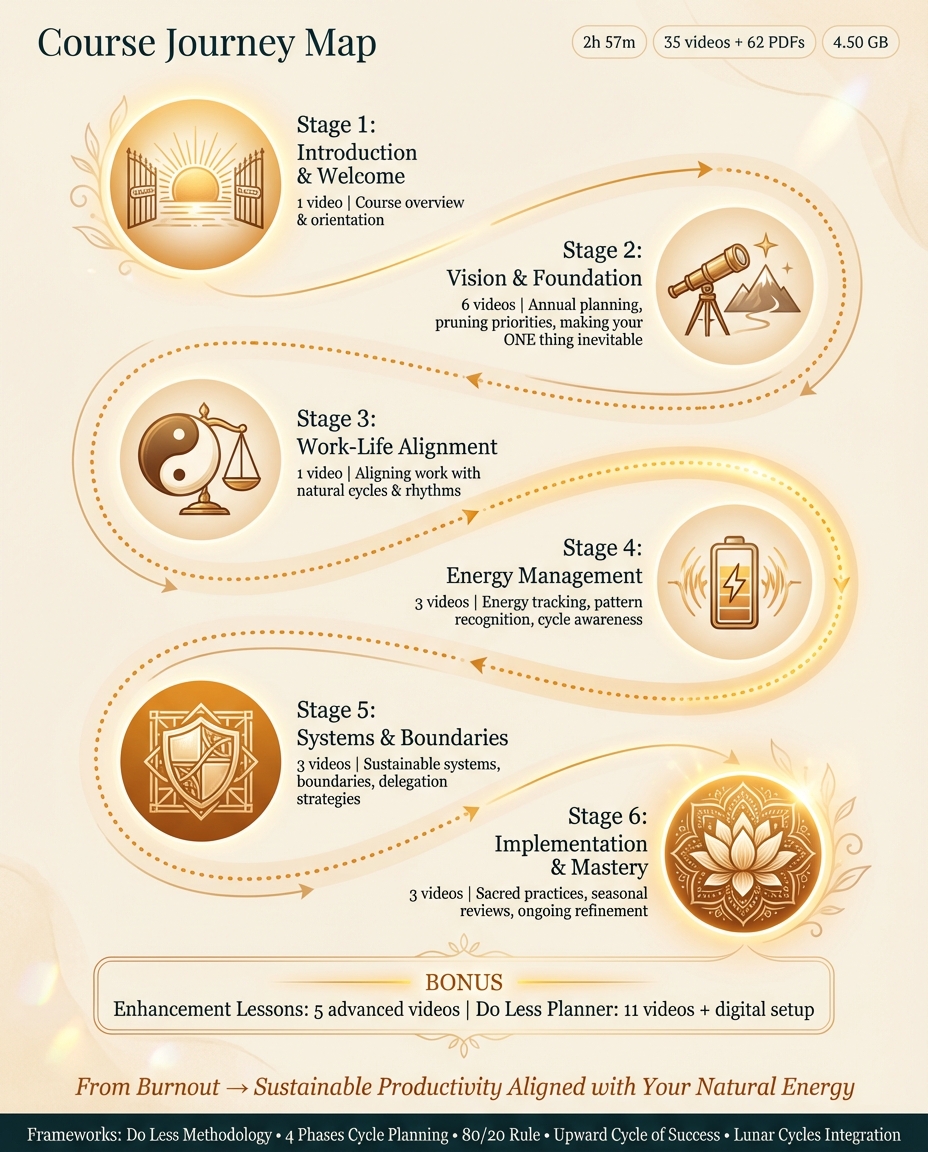
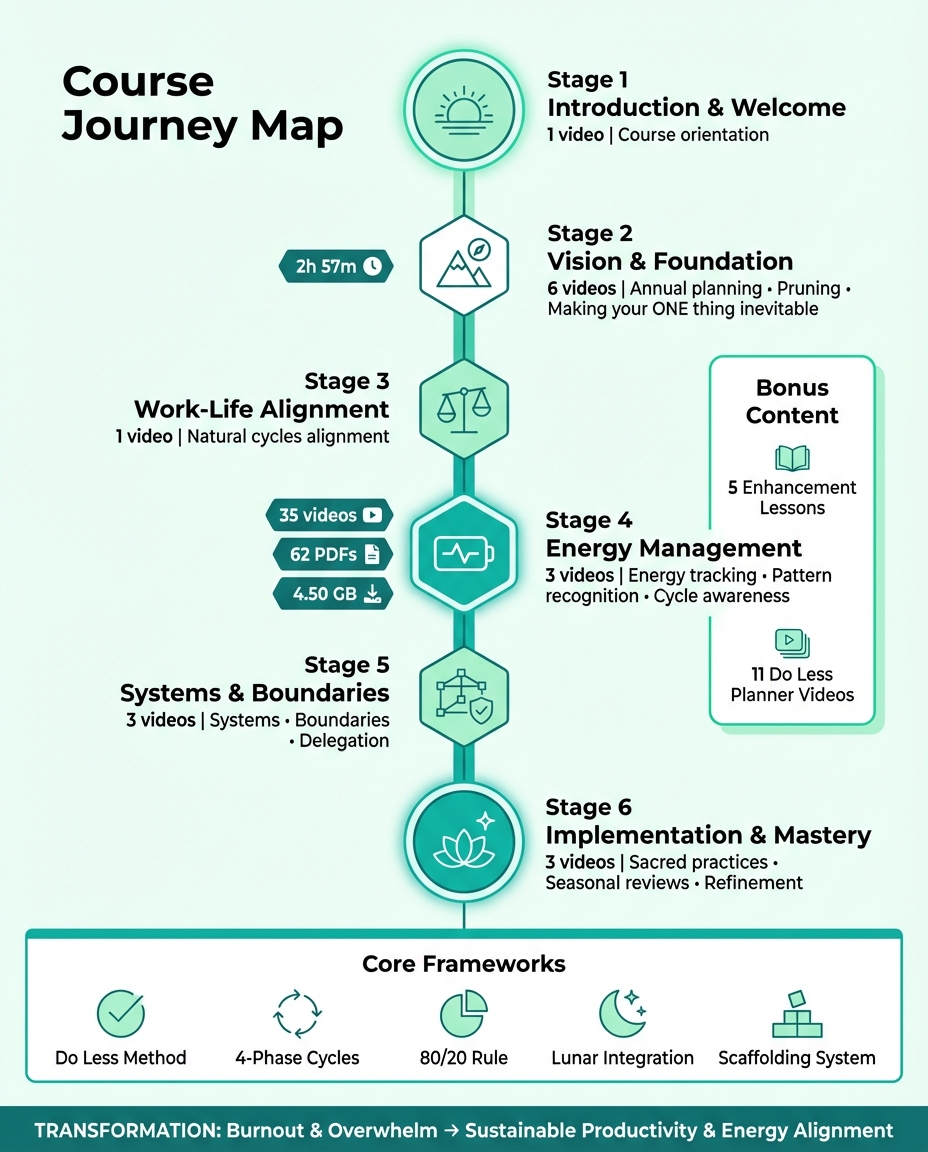
The Four-Phase Cyclical Energy Model is the structural core of Heal the Way You Work — but the course also includes the Prune Before You Plan method, the 80/20 Two-Column framework, the Upward Cycle of Success in full detail, and the Weekly Planning Ritual taught as a repeatable practice across all 35 lessons.
Start free on Course To Action — 10 summaries, no credit card required — before spending $997 on the course. The full breakdown of all 7 frameworks is available: the Four-Phase Cyclical Energy Model, the Do Less Weekly Planning Ritual, Prune Before You Plan, the Upward Cycle of Success, the Sacred Practices Calendar, the Daily Energy Tracker, and the 80/20 Two-Column Exercise. Use the "Apply to My Business" AI tool to apply any framework — the Four-Phase model, the Prune Before You Plan audit, the Upward Cycle of Success — directly to your situation. Every summary and every lesson has audio. Course To Action covers 110+ premium courses. Access starts at $49 for 30 days or $399/year — one payment, no subscription, no auto-renewal.
Start free at Course To ActionFrequently Asked Questions
Is Heal the Way You Work worth $997?Heal the Way You Work is worth $997 if you are a woman entrepreneur with an established business who recognizes a cyclical burnout pattern and wants a planning system built around her physiology. The Four-Phase Cyclical Energy Model, the Upward Cycle of Success, and the Do Less Weekly Planning Ritual are genuinely original and immediately applicable. Skip it if your primary problem is tactical rather than structural.
What is the Four-Phase Cyclical Energy Model?The Four-Phase Cyclical Energy Model is Kate Northrup's foundational framework that maps a woman's 28-day hormonal cycle onto four seasonal archetypes — Winter (rest and vision), Spring (initiation and creativity), Summer (visibility and connection), and Autumn (completion and detail work). Each phase has a distinct energy profile and corresponding optimal work type.
Does the Four-Phase model work if I am postmenopausal?Yes. Northrup offers the lunar cycle as an external proxy — Winter maps to new moon, Spring to waxing moon, Summer to full moon, Autumn to waning moon. The practical frameworks function identically regardless of whether you track a menstrual or lunar cycle. The menstrual cycle is the primary framework; the lunar cycle is positioned as an alternative.
What does Heal the Way You Work NOT cover?The course does not cover marketing strategy, offer design, revenue models, or client acquisition tactics. It has no community component, no cohort, and no live coaching. Approximately 30% of the content is spiritual or metaphysical in framing. The total runtime is 3-4 hours across 35 lessons.
How does the Four-Phase model differ from Alisa Vitti's cycle syncing?Alisa Vitti focuses more heavily on the hormonal and nutritional science of cycle syncing, with detailed protocols for diet, exercise, and lifestyle. Northrup's Four-Phase model is more business-planning-specific and more spiritually inflected, with operational frameworks like the Weekly Planning Ritual and the Upward Cycle of Success that translate cyclical awareness into calendar decisions. They are complementary rather than redundant.
Course To Action publishes independent framework-level breakdowns of online courses — the 20% that delivers 80% of the value, so you can make an informed decision before you spend a dollar.
Get All Frameworks from Heal the Way You Work
The course costs hundreds of dollars. The complete breakdown is $49/year — every course on the platform.
This is one framework. Course To Action has every framework, every lesson, and AI that applies it to your specific business. Read or listen — every summary has audio.
Start free — 10 full summaries, no credit card required