The Three-Tier Break-Even Explained: Reveal the Structural Pricing Problem Hiding in Your Business — from Financial Optimization Strategies for Small Business Owners by Kelsa Dickey
Financial Optimization Strategies for Small Business Owners is a $1,997 course by Kelsa Dickey that teaches 7 frameworks across 17 lessons for diagnosing and fixing structural pricing problems in service-based businesses. The Three-Tier Break-Even is the course's central diagnostic tool — and the framework that reveals, faster than anything else, whether a business owner's pricing model is structurally viable. The core insight is that most struggling business owners have a structural pricing problem, not a discipline problem. You can read the full course breakdown on Course To Action.
What Is the Three-Tier Break-Even?
The Three-Tier Break-Even is Kelsa Dickey's 3-level diagnostic framework for calculating whether a pricing model actually supports the business owner's life. The three tiers are: Business Break-Even (covering operating costs only), Personal Break-Even (adding the owner's living expenses), and Full Financial Health (adding retirement, reserves, and future investment).
A traditional break-even calculation tells you the minimum revenue your business needs to cover its costs. Useful, but incomplete. The Three-Tier Break-Even goes further by layering three distinct financial targets on top of each other, each representing a different operational reality.
Tier 1 — Business Break-Even This is the baseline: the revenue required to cover all your business expenses. No profit, no owner pay. Just keeping the lights on. For many business owners, this number alone contains a shock. When you add up software subscriptions, contractor fees, insurance, marketing costs, and overhead, the monthly floor is often much higher than expected. Tier 2 — Personal Break-Even This tier adds your personal financial needs to the business number. What does it actually cost you to live — rent or mortgage, groceries, car, health insurance, savings, debt payments? What makes this different is that this is where the framework starts revealing problems that discipline alone cannot fix. Your business may be technically "profitable" on paper while still failing to support your actual life. Tier 3 — Full Financial Health The third tier incorporates the targets that represent genuine financial stability: retirement contributions, an emergency fund, business reserves, and future investment in growth. This is not a luxury tier — it is the number that tells you whether your business is building toward something or just surviving.Why Three Tiers Instead of One?
The key takeaway is that separating these three tiers gives you diagnostic information that a single break-even number cannot provide.
If your revenue consistently lands between Tier 1 and Tier 2, you know your business is covering its own costs but not actually paying you a viable wage. That is a pricing or volume problem. If you are consistently hitting Tier 2 but never approaching Tier 3, you are functional but fragile — one slow month or unexpected expense away from a cash crisis.
The framework also changes the nature of the conversation you have with yourself about money. Instead of "Why am I always behind?" you start asking, "Which tier am I actually operating in, and what would it take structurally to move up?"
The Hours-Per-Week Revelation
One of the most confronting outputs of the Three-Tier Break-Even is what Kelsa Dickey calls the hours-per-week test. Once you know your Tier 2 or Tier 3 monthly revenue target, you divide it by your current hourly rate (or session rate, or project rate) to find out how many billable hours per month — and per week — your pricing model actually requires.
For many service providers and coaches, this number exceeds 100 hours per week.
That is not a scheduling problem. That is a pricing problem.
When a business owner sees that their current rates require them to work 14 hours a day, seven days a week just to cover their personal expenses, the framing shifts. It is no longer about whether they are disciplined enough with money. It becomes a clear, mathematical case that their pricing model is structurally unviable.
The most important framework is the Three-Tier Break-Even precisely because of this moment: the shift from "I'm bad with money" to "my pricing model doesn't work." The first framing leads to shame. The second leads to action.
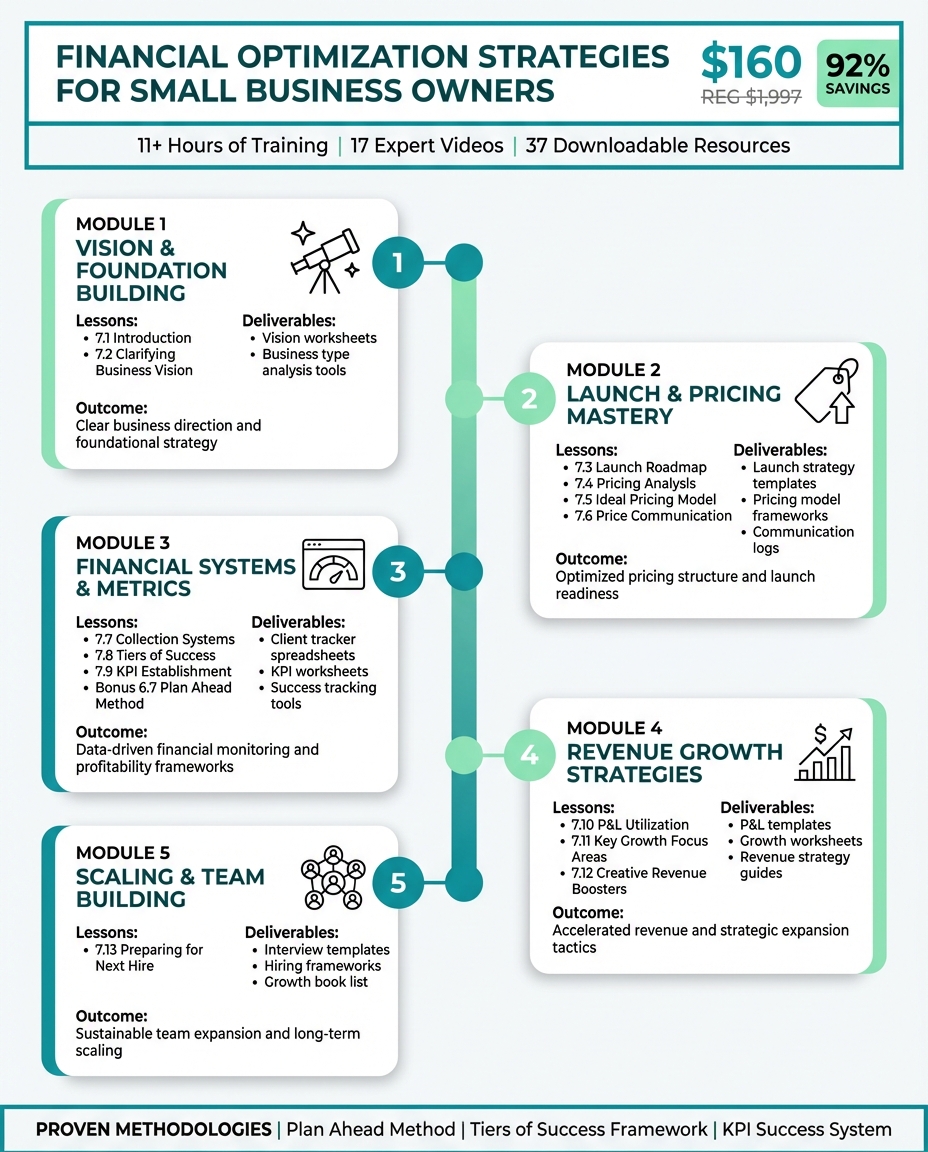
The Three-Tier Break-Even is one of 7 frameworks in Financial Optimization Strategies for Small Business Owners. The others are: EAC (Emotional Accounting Cycle), Three Creative Revenue Strategies, Nine Indicators for Raising Prices, Key Focus Areas Assessment, 7-Step KPI Process, and the Plan Ahead Method. The complete breakdown of every framework is on Course To Action — free to start, no credit card required. The course is $1,997. A Course To Action membership starts at $49 for 30 days.
How the Framework Connects to the Nine Indicators for Raising Prices
The Three-Tier Break-Even does not operate in isolation. It feeds directly into another framework in the course: the Nine Indicators for Raising Prices. The Nine Indicators for Raising Prices is Kelsa Dickey's structured checklist for evaluating whether a price increase is both justified and viable. The indicators span market positioning, demand signals, client retention data, value delivery, and competitive landscape.
Working through them after completing the Three-Tier Break-Even calculation means you are not raising prices arbitrarily — you are doing it with a clear understanding of your financial floor and a structured read of whether the market will support the move.
Get Every Framework from Financial Optimization Strategies for Small Business Owners
The course costs $$1,997. All frameworks extracted — $49/year.
Start free — 10 full summaries, no credit card
The EAC Framework and Budget Integration
The Three-Tier Break-Even also connects forward into the Education-Application-Commitment (EAC) Framework and the Plan Ahead Method budget, two other core tools in the course. The EAC Framework is Kelsa Dickey's 3-phase coaching protocol for structuring financial conversations: Education (teaching the concept), Application (applying it to the client's actual numbers), and Commitment (securing a specific action). The Plan Ahead Method budget helps you build those targets into a forward-looking financial plan rather than a backward-looking expense tracker.
Together, the three tools form a sequence: calculate your real financial targets (Three-Tier Break-Even), manage your cash against those targets (EAC), and plan your revenue activity around them (Plan Ahead Method). In summary, the frameworks are designed to work together, which is why the course structures them in this order across its 17 lessons.
Who This Framework Is Built For
The Three-Tier Break-Even is most powerful for:
- Service providers and coaches who set rates based on market norms rather than personal financial math
- Solopreneurs transitioning to small business owners who have never formalized their personal financial needs as a business cost
- Business owners who feel perpetually behind despite revenue that looks adequate from the outside
- Anyone who has avoided the numbers because they expect the results to be discouraging
The course is US-focused in its financial examples and does not cover marketing or sales strategy. Its scope is financial clarity, pricing structure, and business health metrics.
What It Doesn't Cover
The Three-Tier Break-Even and the broader course do not address marketing, sales, lead generation, tax strategy, legal structure, or investment decisions. The main limitation is that if a business owner's primary problem is not having enough clients, this framework will clarify their financial targets but will not help them reach those targets through client acquisition. The course is also US-centric in its examples and financial benchmarks.
The Shift the Framework Creates
What makes the Three-Tier Break-Even more than an accounting exercise is what it does to the narrative a business owner carries about themselves.
Financial struggle in business is frequently internalized as a character flaw. Business owners tell themselves they are irresponsible, or not cut out for entrepreneurship, or simply bad with money. These stories are persistent and damaging — and they also happen to be wrong in a large percentage of cases.
The Three-Tier Break-Even replaces a story with a structure. It takes the vague, shame-laden question of "Why am I always struggling?" and converts it into a precise, solvable question: "What revenue, at what price point, for how many hours, actually covers my life?"
That conversion — from personal failure to structural analysis — is what makes this framework the foundation of everything else in Financial Optimization Strategies for Small Business Owners by Kelsa Dickey.
If the math reveals a problem, the problem is fixable. If the problem is that you are a flawed person, it is not. Kelsa Dickey's course is built on the premise that the math almost always reveals a fixable problem.
Frequently Asked Questions
What is the Three-Tier Break-Even from Financial Optimization Strategies for Small Business Owners?
The Three-Tier Break-Even is Kelsa Dickey's 3-level diagnostic framework for calculating whether a business owner's pricing model supports their actual life. The three tiers are Business Break-Even (operating costs), Personal Break-Even (living expenses), and Full Financial Health (retirement, reserves, investment). It is the central framework in the course.
Is Financial Optimization Strategies for Small Business Owners worth $1,997?
For financial coaches expanding into business clients, yes. The Three-Tier Break-Even and EAC framework provide immediately usable tools. If the diagnostic reveals a structural pricing problem and the coach corrects it, the course pays for itself quickly through corrected pricing.
What does Financial Optimization Strategies for Small Business Owners NOT cover?
The course does not cover marketing, sales, lead generation, tax strategy, legal structure, or investment decisions. It is focused entirely on financial clarity, pricing structure, and business health metrics, and its examples are US-centric.
Who is the Three-Tier Break-Even best for?
Service providers, coaches, and consultants who set rates based on market norms rather than personal financial math — and who have never calculated whether their pricing model actually supports their life. Also strong for financial coaches who want a client-ready diagnostic tool.
Start free — no credit card required. Course To Action gives you 10 free summaries so you can read the full breakdown of all 7 frameworks in Financial Optimization Strategies for Small Business Owners — Three-Tier Break-Even, EAC (Emotional Accounting Cycle), Three Creative Revenue Strategies, Nine Indicators for Raising Prices, Key Focus Areas Assessment, 7-Step KPI Process, and the Plan Ahead Method — before you spend $1,997.
Once you're inside, the AI "Apply to My Business" tool (3 credits) lets you apply any framework to your situation — run the Three-Tier Break-Even against your own numbers, or pressure-test your pricing with the Nine Indicators for Raising Prices. Every summary and every lesson also has audio. Course To Action covers 110+ premium courses. Membership is $49 for 30 days or $399/year — one payment, no subscription, no auto-renewal.
Start free at Course To ActionCourse To Action publishes independent framework-level breakdowns of online courses — the 20% that delivers 80% of the value, so you can make an informed decision before you spend a dollar.
Get All Frameworks from Financial Optimization Strategies for Small Business Owners
The course costs $$1,997. The complete breakdown is $49/year — every course on the platform.
This is one framework. Course To Action has every framework, every lesson, and AI that applies it to your specific business. Read or listen — every summary has audio.
Start free — 10 full summaries, no credit card required