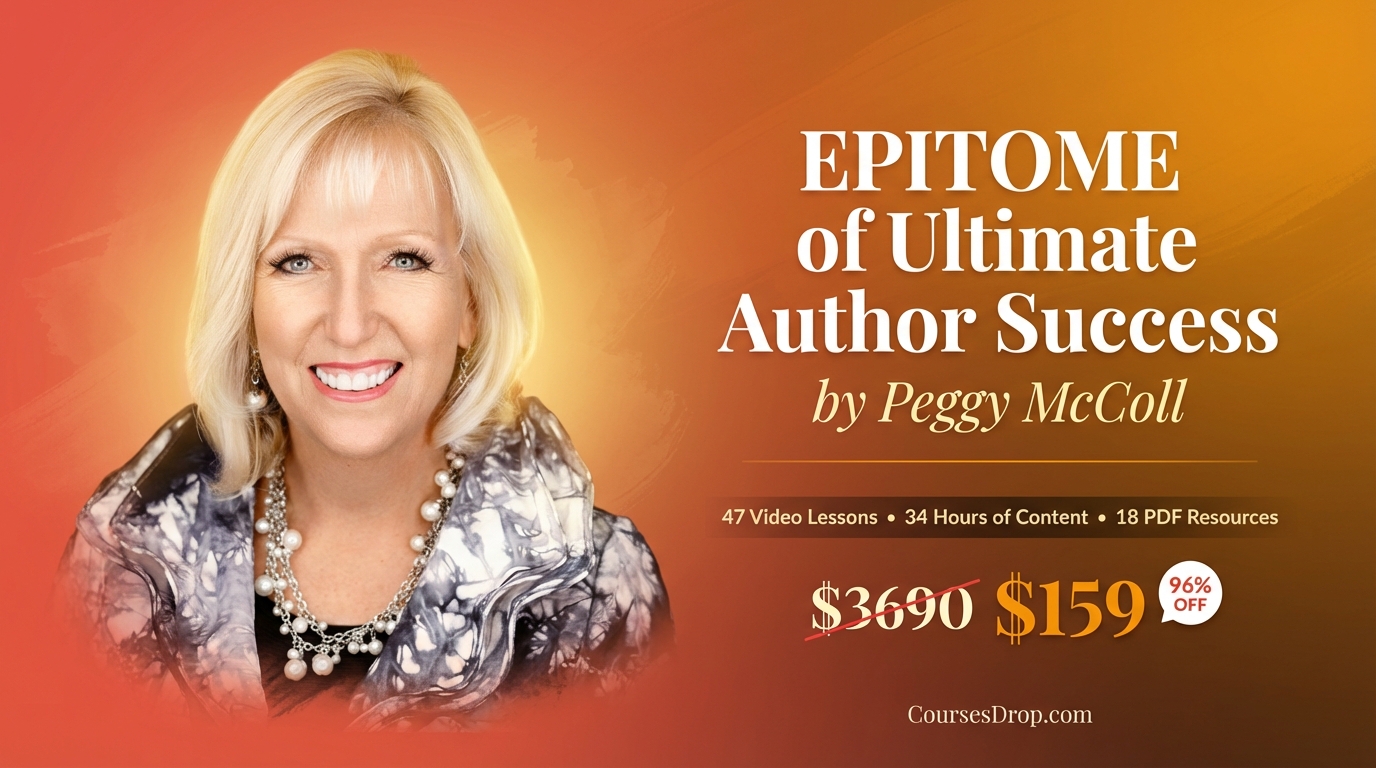
The One-Sheet Media Pitch Explained: Get Your Book Into Media — from EPITOME of Ultimate Author Success by Peggy McColl
The One-Sheet Media Pitch is Peggy McColl's 4-component framework for turning authors into interview-ready media subjects, taught inside her $3,690 course, EPITOME of Ultimate Author Success. It is the most immediately deployable framework in the course — an author can build a functional One-Sheet within a day of learning the system. The core insight is that most author pitches fail because they describe what the author will say, instead of what the audience will gain.
The gap between a published book and a bestselling book is rarely the quality of the writing. It is almost always the absence of a system for getting that book in front of audiences who did not know they needed it. That system begins with this single document, and according to the full breakdown on Course To Action, it is the framework that most immediately separates authors who get coverage from authors who send unanswered emails.
What Is the One-Sheet Media Pitch?
The One-Sheet Media Pitch is a single-page document designed to communicate an author's media value to producers, podcast hosts, journalists, and event coordinators in under thirty seconds. It functions as a professional calling card — compact, visual, and structured so that a busy media booker can immediately assess whether a guest is ready for air and worth their audience's time.
The framework has four components: a headline, a sub-headline, a benefits section, and a professional photo and bio. None of these elements are optional. Together they answer the only question a media booker is actually asking: "What does my audience get from interviewing this person, and why should I trust they can deliver it?"
Peggy McColl has applied variations of this system across 21 books and dozens of bestseller campaigns. She built the One-Sheet framework from direct experience pitching media, coaching authors through launches, and observing what actually moves the needle when a book is competing with thousands of other new releases for finite interview slots.
The Core Components
Component 1: The Headline
The headline is not the book's title. This is the first mistake most authors make. The book title belongs on the book cover. The headline on a media pitch answers a different question: what transformation, insight, or controversy does this author bring to an interview?
A strong One-Sheet headline positions the author as the source of a specific idea that is relevant, timely, and useful for the host's audience. It is written in the language of the media outlet, not in the language of the author's niche. A book about business finances might produce a headline like: "Why Most Entrepreneurs Are Confusing Revenue With Success." That headline works for a morning drive radio program. It works for a business podcast. It works for a personal finance newsletter. It is not about the book. It is about the idea the book represents.
The key takeaway is this: could a producer read it, immediately picture a fifteen-minute segment, and know who the audience is? If yes, the headline is doing its job.
Component 2: The Sub-Headline
The sub-headline expands the headline into a single sentence that adds specificity. Where the headline opens the door, the sub-headline clarifies what is behind it.
If the headline is "Why Most Entrepreneurs Are Confusing Revenue With Success," the sub-headline might be: "A 21-book author on the overlooked distinction between income and wealth that is keeping business owners stuck at the same revenue ceiling year after year."
Three things happen in a well-crafted sub-headline. The author's credibility is established quickly — twenty-one books is a number that does not require explanation. The specific audience is identified — business owners at a particular stage. And the hook is articulated — a concrete problem with a promised insight.
Component 3: Benefits
The benefits section is the most counterintuitive component for authors because it requires them to stop thinking about themselves entirely and think about the host's audience.
The benefits are not features of the book. They are not chapter summaries. They are the answers to this question: what will someone who listens to this interview know, believe, or be able to do that they could not before?
McColl structures benefits as bullet points — three to five, typically — each written from the listener's perspective. Not "Peggy will discuss her Seven Methods for Content Creation" but "Listeners will leave with a framework for producing book content without sitting down to write a single word." What makes this different is the shift from author to audience, from credential to value, from what the author knows to what the listener gains.
This is where most author pitches collapse. They describe what the author will say. A One-Sheet that converts describes what the audience will receive.
Component 4: Photo and Bio
The photo and the bio are the trust components. They answer the media booker's implicit question: is this person credible, presentable, and worth the risk of putting in front of my audience?
The photo requirement is specific: professional, recent, well-lit, appropriate to the author's brand. The bio leads with the information most relevant to the media outlet — number of books, a specific achievement, and the core topic the author addresses. It ends with a contact line and website.
Why This Framework Works
The One-Sheet solves a resource scarcity problem on the producer's side. Media bookers, podcast hosts, and journalists are receiving hundreds of pitches in the time window around any significant news cycle. They are not spending more than thirty seconds on most of them.
A pitch buried in a five-paragraph email competes poorly with a single page that immediately communicates credibility, audience value, and interview readiness. The most important framework in the course for immediate results, it is the document that makes everything else you say legible.
There is also a deeper logic in the framework's structure. Each component corresponds to a stage in the decision process. The headline creates attention. The sub-headline creates context. The benefits create desire (for the host's audience). The photo and bio create trust. This mirrors how a media professional actually processes a pitch, from curiosity to consideration to confidence.
The One-Sheet Media Pitch is one of 8 frameworks in EPITOME of Ultimate Author Success. The sibling frameworks — the 5%/95% Author Success Rule, The Approach (3-Part Pre-Project), Seven Methods for Book Content Creation, Power Life Script Method, Daily Six Tasks System, Book-as-Business Revenue Model, and the Brigham Young Accountability Progression — are all broken down on Course To Action. Free tier includes 10 summaries, no credit card required. The course costs $3,690 — access the full breakdown for $49/30 days.
Real Application: From Author to Media Subject
The distinction McColl draws throughout EPITOME is between an author and a media subject. Authors write books. Media subjects appear in interviews, on stages, and in publications — and they generate the kind of visibility that transforms a book from a project into a business asset.
The One-Sheet is the instrument that makes that transition possible. Without it, an author sends emails and waits. With it, an author enters a professional conversation on equal footing with the media professionals they are pitching.
Step 1: Identify your core idea. Before touching the One-Sheet template, identify the single most counterintuitive or useful idea your book teaches. Not a chapter summary. A specific, testable claim. "Most authors spend 95% of their time on writing, which accounts for 5% of their success" is a specific, counterintuitive claim. Build the headline from there. Step 2: Write three audience-perspective benefits. Take each of your book's major teaching points and rewrite it from the perspective of a listener who has never heard of you. What can they now do, know, or believe? Step 3: Build credibility signals into the bio. Numbers are the most efficient credibility signals. Books published. Students taught. Years of experience. Pick the two or three signals most relevant to the media outlet you are pitching and lead with them. Step 4: Get a professional photo taken. This is the component authors most frequently defer and most frequently regret skipping. Budget for it. It is not optional. Step 5: Test the headline with someone outside your industry. Read the headline to someone who does not know your book or your niche. Ask them: what would the interview be about, and would you listen to it? If they cannot answer the first question clearly, the headline is not doing its job.Get Every Framework from EPITOME of Ultimate Author Success
The course costs hundreds of dollars. All frameworks extracted — $49/year.
Start free — 10 full summaries, no credit card
Common Mistakes
Mistake 1: Pitching the book instead of the author. The One-Sheet is a pitch for the author as a media subject, not a pitch for the book as a product. Producers book guests. Listeners discover books as a result. The sequence matters. Mistake 2: Writing benefits in the author's language instead of the audience's. "McColl will share her Seven Methods for Content Creation framework" is an author-centric benefit. "You'll leave knowing how to write a book without sitting at a keyboard" is an audience-centric benefit. Every benefits bullet should pass the test: does this tell me what I gain, or what the author does? Mistake 3: Using the same One-Sheet for every outlet. The headline and benefits section should be adapted for each category of media outlet. A personal development podcast and a business podcast serve different audiences with different interests. The book does not change. The angle does.
What the One-Sheet Does Not Cover
This is best suited for earned media — podcast interviews, radio, online publications, and speaking invitations. The One-Sheet framework does not address paid media placements, Amazon advertising, BookBub promotions, or social media ad campaigns. McColl's entire marketing approach inside EPITOME is organic and relationship-driven. Authors who need paid acquisition strategies will need to supplement this framework with other resources.
The Framework Inside a Larger System
The One-Sheet Media Pitch is one component of McColl's broader publishing framework. It connects directly to what she describes as the 5%/95% Rule — the principle that writing a book represents approximately 5% of author success, while marketing, visibility, and platform-building account for the remaining 95%.
In summary, the One-Sheet is a marketing instrument that converts a finished book into media appearances, which convert into audiences, which convert into book sales, speaking invitations, and the downstream revenue streams that make publishing economically viable as a long-term business.
Frequently Asked Questions
What is the One-Sheet Media Pitch from EPITOME of Ultimate Author Success? The One-Sheet Media Pitch is Peggy McColl's 4-component, single-page document framework for pitching media outlets. The four components are: a headline (your core idea as a segment pitch), a sub-headline (one sentence with credibility signals), a benefits section (written from the listener's perspective), and a professional photo and bio. How long does it take to build a One-Sheet? An author can build a functional One-Sheet within a single day of learning the framework. The headline and benefits section require the most thought. The photo and bio are typically pre-existing assets that need formatting. Does the One-Sheet replace a publicist? No. The One-Sheet is a DIY earned-media tool for authors without a PR budget. It gives authors a professional-grade pitch document, but it does not replace the relationships and industry access a professional publicist provides. Is the One-Sheet only for book authors? The framework translates directly to anyone building an expertise-based business. Consultants, coaches, and course creators can use the same structure for podcast pitching, speaking outreach, and media positioning.Start free before you spend $3,690. Course To Action's free tier gives you 10 summaries — no credit card required. The full breakdown of all 8 frameworks in EPITOME of Ultimate Author Success is there: the One-Sheet Media Pitch, the 5%/95% Author Success Rule, the Book-as-Business Revenue Model, the Daily Six Tasks System, the Seven Methods for Book Content Creation, and more. Use the AI "Apply to My Business" tool (3 credits) to apply the One-Sheet Media Pitch or the Brigham Young Accountability Progression directly to your situation before you commit to the course. Every summary and every lesson has audio. Course To Action covers 110+ premium courses. Access starts at $49 for 30 days or $399/year — one payment, no subscription, no auto-renewal.
Start free at Course To Action Course To Action publishes independent framework-level breakdowns of online courses — the 20% that delivers 80% of the value, so you can make an informed decision before you spend a dollar.Get All Frameworks from EPITOME of Ultimate Author Success
The course costs hundreds of dollars. The complete breakdown is $49/year — every course on the platform.
This is one framework. Course To Action has every framework, every lesson, and AI that applies it to your specific business. Read or listen — every summary has audio.
Start free — 10 full summaries, no credit card required