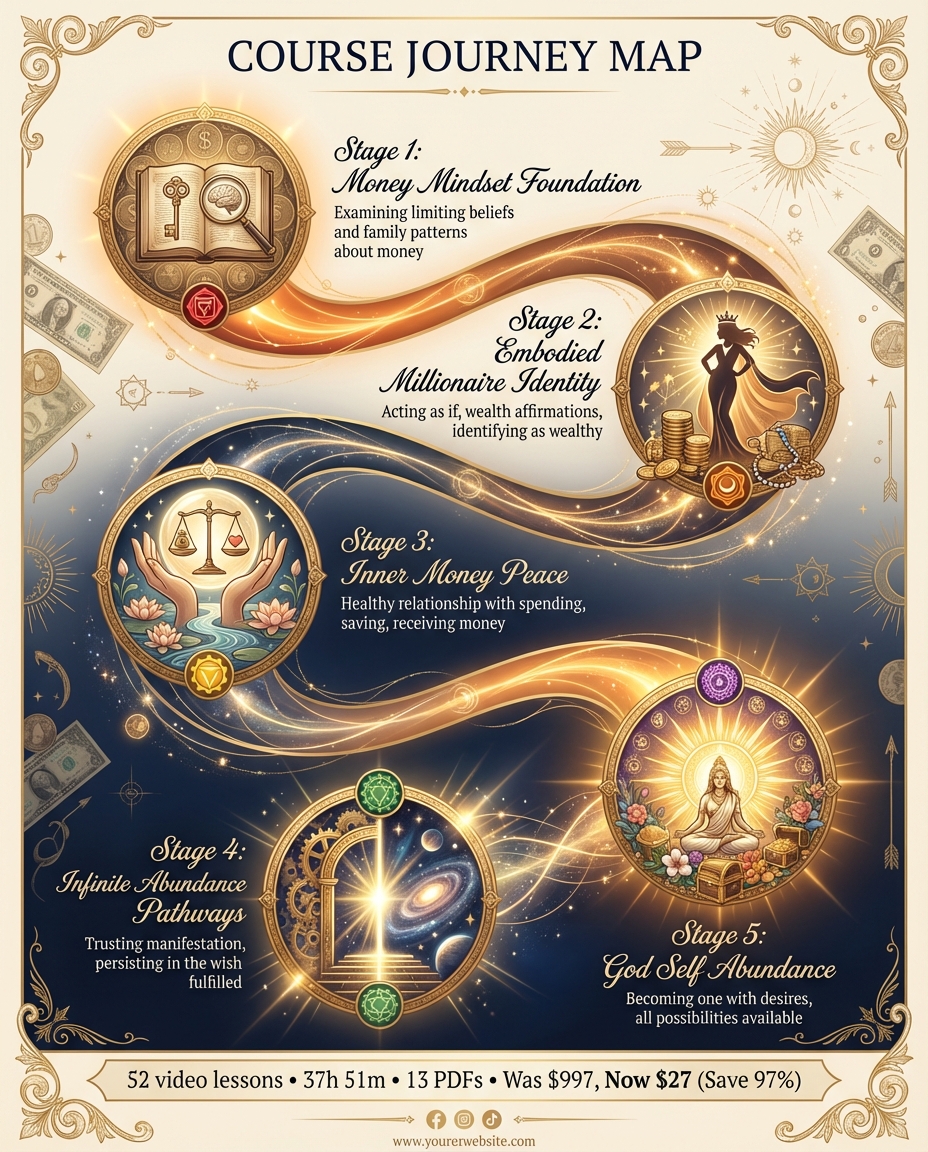
Messing with the Middle Explained: Stop Engineering the Pathway to Wealth — from Embodied Millionaire by Shelly Bullard
Messing with the Middle is Shelly Bullard's framework for breaking the habit of obsessing over how money will arrive — taught inside her $997 course Embodied Millionaire. The framework draws directly from Neville Goddard's Law of Assumption and instructs you to stop engineering the pathway between your current financial reality and your desired one, and instead fix your attention on the end state. The course contains 44 lessons across 21.1 hours, and this framework is one of 6 named models Bullard teaches. The complete independent breakdown is available on Course To Action.
Most money advice lives entirely in the middle. Get a better offer. Run better ads. Build a bigger list. Optimize the funnel. Raise your rates. Negotiate harder. The entire infrastructure of financial education is constructed around teaching you to engineer the pathway between where you are and where you want to be. Map every step. Anticipate every obstacle. Control every variable.
The core insight is this: Messing with the Middle challenges the premise underneath all of that. Not the tactics themselves, but the assumption that the pathway is where your attention should live.
The Problem the Framework Diagnoses
Before the framework makes sense, the problem it addresses needs to be stated precisely.
When most people try to change their financial situation, they do what feels rational: they think about money. How to get more of it. Which avenue to pursue. What steps to take next. They analyze options, weigh strategies, try to figure out the most efficient path from current reality to desired outcome.
Bullard argues that this is where the problem lives — not in the lack of thinking, but in the thinking itself. Specifically: obsessing over the pathway keeps you emotionally anchored to your current financial reality, not to the one you want to create. You are feeling the problem while trying to solve the problem. And feeling — in Bullard's framework — is not incidental to your financial results. It is causal.
The key takeaway is that the middle — the how, the pathway, the mechanics of getting from A to B — is precisely the thing that keeps pulling your identity back to A. Every time you focus on figuring out how money will come, you are implicitly confirming that you don't yet have it. You are reinforcing the self-concept of someone who needs to figure things out, rather than someone who already has what she wants.
The framework is not telling you to stop taking action. It is telling you to stop treating the pathway as the primary object of your attention.
What Neville Goddard Actually Said
Goddard's formulation, which Bullard uses directly, is this: live in the end. Do not focus on the gap between your current state and your desired state. Do not plan your route across the gap. Instead, move into the consciousness of the end result — inhabit it imaginatively, emotionally, sensorially — and allow the pathway to emerge from that state of being.
This sounds impractical to analytically-trained minds. It sounds like magical thinking. Goddard's response to this objection, and Bullard's after him, is that it is the conventional approach that misunderstands causation. The conventional model says: take the right actions, and results will follow. Goddard's model says: be the person who already has the result, and the actions that match that state will become obvious and available.
What makes this different is not motivational. It is ontological. It is a claim about the order of causation — which comes first, the internal state or the external result.
Bullard does not ask you to accept this on faith. She asks you to test it through a specific practice: instead of working on figuring out how money will arrive, spend your attention on what it feels like to already have it. Not as a visualization exercise. As a felt sense. As an embodied experience of your expanded financial self.
The Core Components of the Framework
The End State, Not the Pathway
The first component is a deliberate redirection of attention. When your mind drifts toward the how — as it will, constantly, especially when you're under financial stress — Messing with the Middle asks you to notice the drift and return to the end state.
What does it feel like to be someone who has already achieved the financial result you want? Not what does it look like from the outside. What does it feel like from the inside? The weight in your body. The quality of your mornings. The ease or absence of ease in your relationship with money. Bullard's work is specifically somatic — it is concerned with the felt, embodied experience of the identity you are trying to inhabit, not with the conceptual description of it.
This component is more demanding than it appears. The mind under financial stress has strong gravitational pull back to the problem space. Messing with the Middle requires you to consistently interrupt that pull and return to the end — not just once, not as an affirmation recited mechanically, but as a genuine practice of sustained attention on the desired state.
Releasing the How
The second component is stranger and more counterintuitive: actively releasing attachment to the specific mechanism by which money will come.
This does not mean passivity. It does not mean declining to take action. It means refusing to allow your sense of possibility to be limited by your ability to imagine the pathway. Bullard's underlying argument is that the universe — or consciousness, or the subconscious mind, depending on how you prefer to frame this — has access to routes and mechanisms that the analytical mind cannot anticipate. Locking your attention onto a specific pathway closes off those alternatives. Releasing attachment to the how opens the space for unexpected routes.
In practical terms, this looks like noticing when you are anxiously trying to figure out exactly how a financial goal will be achieved — which client will pay, which launch will succeed, which opportunity will arrive — and consciously loosening that grip. Not forcing a different plan. Not suppressing the anxiety. But stopping the compulsive loop of pathway-planning and returning attention to who you are becoming.
The Self-Concept Underneath
Messing with the Middle connects directly to Bullard's broader Self-Concept Shift Method, which is the other central model in Embodied Millionaire. The Self-Concept Shift Method is Bullard's 3-step process for rewriting your identity around money: Discover, Tell the New Story, Practice and Repeat. The reason the middle matters so much is not just attentional — it is identity-level.
When you obsess over the how, you are operating from the self-concept of someone who does not yet have the result. The framework is trying to help you shift that self-concept before the external result arrives — to become, internally, the person who already has it. Messing with the Middle is one of the primary tools for that shift. By withdrawing your attention from the pathway and placing it on the end state, you are practicing the identity, not waiting for the identity to be delivered by circumstance.
Messing with the Middle is one of 6 frameworks in Embodied Millionaire — alongside the Self-Concept Shift Method, the Two-Pillar Manifesting Map, God Self vs. Self-Concept, the 80/20 Affirmation Strategy, and the 7-Day Money Relationship Program. The complete breakdown of every framework and every limitation is available on Course To Action. Start free — 10 summaries, no credit card required. The course costs $997; access to the full breakdown starts at $49 for 30 days.
The Two-Pillar Context
Messing with the Middle does not operate alone. It sits inside Bullard's Two-Pillar Manifesting Map, which pairs two complementary practices:
Pillar One: Embody the wish fulfilled. This is the Goddard-derived practice — inhabit the consciousness of the end state. Feel, as fully as possible, what it is like to already be the person who has achieved the financial result. Pillar Two: Soothe the fears with bridge affirmations. This is where Bullard departs from pure Goddard territory and addresses something he largely bypassed: the resistance. The fear. The doubt that arises when the gap between your current reality and your desired state is significant.Bridge affirmations are not the end-state claims of conventional affirmation practice. They are not "I am a millionaire" when you have $200 in your account. They are gradual stepping stones — statements like "I am getting better at receiving money" or "money is becoming more natural to me" — that move you from fear toward neutral without requiring you to make claims your nervous system will immediately reject.
The most important framework is the pairing itself. Messing with the Middle — the Goddard principle — addresses the direction of attention. The bridge affirmations address the fear that makes that direction of attention nearly impossible to sustain without support. Together, they form a practice that is both aspirationally oriented and psychologically realistic.
Get Every Framework from Embodied Millionaire
The course costs $$997. All frameworks extracted — $49/year.
Start free — 10 full summaries, no credit card
Real Application: The Spending Moment
One of the most concrete places Bullard applies this is in how you relate to spending money — a moment that typically activates financial anxiety most acutely.
Conventional wisdom says: track every dollar, feel the weight of outflows, maintain vigilance. Bullard's framework inverts this. Through her 7-Day Money Relationship Program — a structured 7-day onboarding sequence for rewiring your emotional relationship with money — she teaches a practice of blessing money when you spend it — a ritual acknowledgment that you are participating in circulation, not in depletion.
This is Messing with the Middle applied to a single moment: instead of relating to an outgoing payment from the self-concept of someone who is losing something, you relate to it from the self-concept of someone who is in an abundant relationship with money. The spending moment becomes a practice in identity, not just a transaction.
The Limitation Worth Naming
The main limitation is this: Messing with the Middle is entirely a consciousness practice. There are no tactics inside it. No business strategy. No funnel, no sales training, no operational framework. The framework operates exclusively at the level of identity, attention, and felt state.
This is not a weakness for the right person. But it means the framework assumes a specific context: you already have the external capabilities — or access to them — that your financial goals require. What you are working on is the internal state that will allow you to deploy those capabilities without the self-sabotage that comes from operating from the wrong self-concept.
This is best suited for someone who needs business fundamentals sourced elsewhere. It will give you the internal orientation to act from abundance rather than fear. The action itself you'll need to source elsewhere.
The Framework in Summary
In summary, Messing with the Middle, as Bullard teaches it inside Embodied Millionaire, is built on a single Goddard-derived insight: your attention to the pathway is what keeps you anchored to your current reality, not moving toward your desired one. The intervention is to redirect that attention — persistently, somatically, with specific practices — toward the end state. Toward the felt experience of being the person who already has what you want.
It is paired with bridge affirmations that make the practice sustainable when the fear is real. It connects to a broader Self-Concept Shift that positions identity, not action, as the primary lever of financial change.
Whether or not you accept the metaphysical framing, the practice it produces — learning to inhabit the consciousness of your desired state rather than obsessing over the pathway to it — has a distinct psychological logic. The person you need to become to achieve the financial result is, in some sense, the prerequisite for achieving it. Messing with the Middle is a system for becoming that person before the result arrives to confirm it.
Frequently Asked Questions
What is Messing with the Middle?Messing with the Middle is Shelly Bullard's framework inside Embodied Millionaire for breaking the habit of obsessing over how money will arrive. It draws from Neville Goddard's instruction to "live in the end" — redirect attention from the pathway to the end state and let the mechanism emerge from your shifted identity.
Does Messing with the Middle mean you stop taking action?No. The framework does not instruct passivity. It instructs you to stop treating pathway-obsession as the primary object of your attention. You continue taking action, but from the identity of someone who already has the result rather than someone anxiously trying to figure out how to get it.
How does Messing with the Middle relate to the other frameworks in Embodied Millionaire?It sits inside the Two-Pillar Manifesting Map and connects directly to the Self-Concept Shift Method. Messing with the Middle addresses where your attention goes. The Two-Pillar Map provides the tools — embodiment practice and bridge affirmations — for sustaining that redirection. The Self-Concept Shift Method is the broader identity-change loop that all frameworks serve.
Is Embodied Millionaire worth $997?Embodied Millionaire is worth $997 if your income ceiling is a belief and identity problem rather than a tactics problem. It contains 6 named frameworks, 44 lessons, and 21.1 hours of content. It does not contain any business strategy. The full independent breakdown is available at Course To Action.
Start free on Course To Action — 10 summaries, no credit card required — before you commit $997. Read the full breakdown of all 6 frameworks (Messing with the Middle, the Self-Concept Shift Method, the Two-Pillar Manifesting Map, God Self vs. Self-Concept, the 80/20 Affirmation Strategy, and the 7-Day Money Relationship Program), then use the "Apply to My Business" AI tool to see how any framework applies to your specific situation. Every summary and every lesson has audio. Course To Action covers 110+ premium courses. Access starts at $49 for 30 days or $399/year — one payment, no subscription, no auto-renewal.
Start free at Course To Action Course To Action publishes independent framework-level breakdowns of online courses — the 20% that delivers 80% of the value, so you can make an informed decision before you spend a dollar.Get All Frameworks from Embodied Millionaire
The course costs $$997. The complete breakdown is $49/year — every course on the platform.
This is one framework. Course To Action has every framework, every lesson, and AI that applies it to your specific business. Read or listen — every summary has audio.
Start free — 10 full summaries, no credit card required