The Buyback Loop Explained: Scale Without Burning Out — from Elite Business Coaching Program by Dan Martell
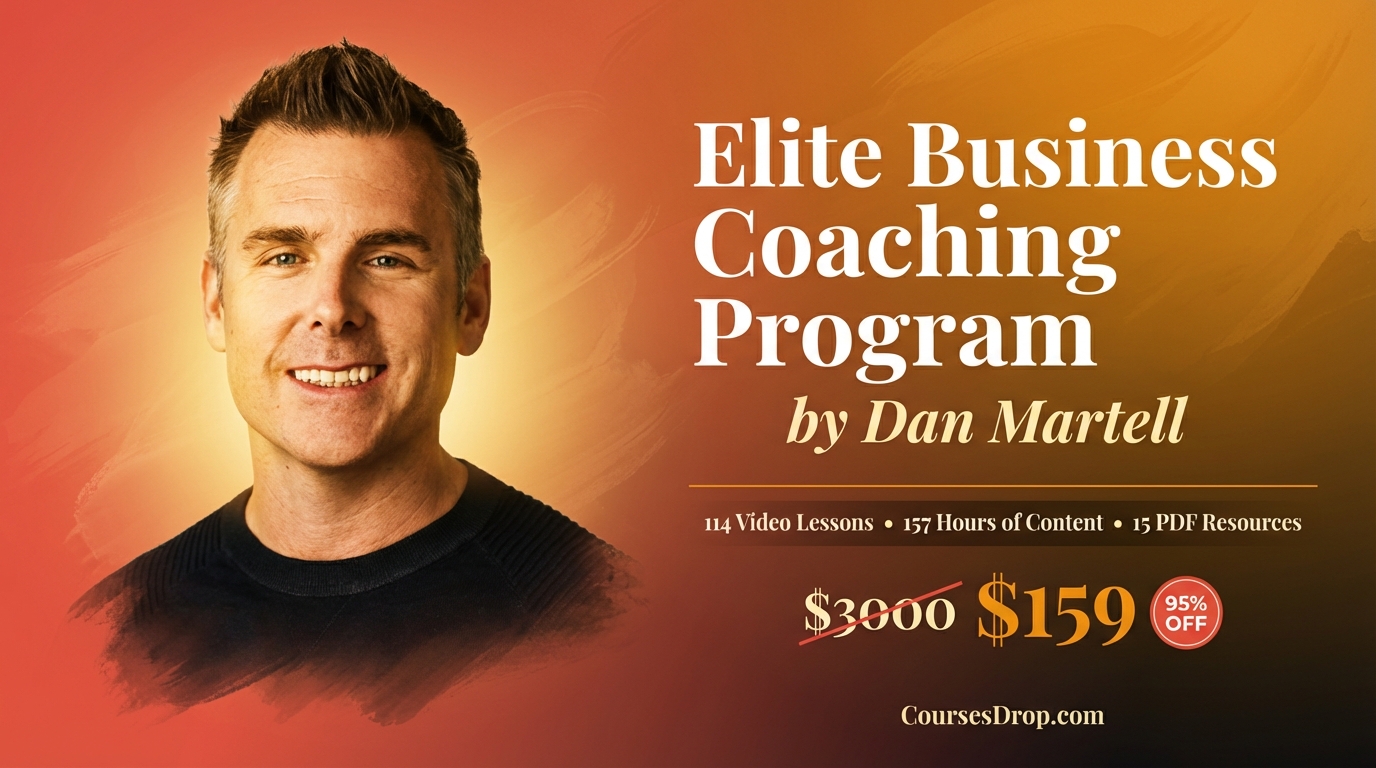
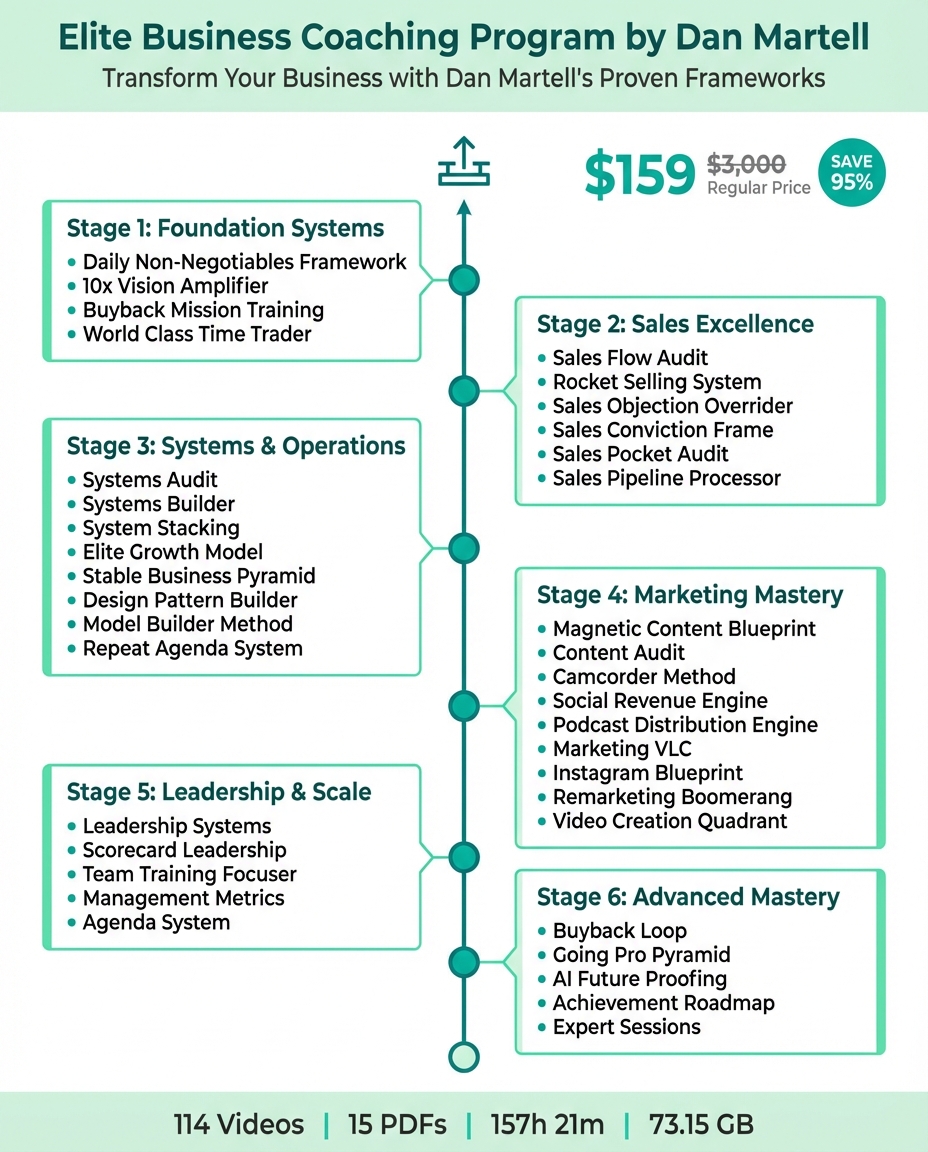
The Buyback Loop is Dan Martell's three-step recurring cycle for systematically removing founders from low-leverage work so they can scale their business without burning out. It is the foundational framework inside the Elite Business Coaching Program, a $3,000 course with 114 lessons and 156.5 hours of content. The core insight is that most business owners hire people to grow their company, but Martell says that is the wrong reason — and that getting this backwards is what keeps founders stuck, overworked, and unable to scale past themselves.
According to the full breakdown on Course To Action, the Buyback Loop is arguably the most practically actionable framework in the course, applicable equally to a solo consultant billing $10K a month and a service company doing $5M in annual revenue.
The Core Insight: You Are the Bottleneck
Before the framework makes sense, the premise needs to land. Martell argues that most founders operate in what he calls the "Pain Line" — spending the majority of their working hours on tasks that drain energy, could be done by someone else, and actively prevent the business from moving forward.
These are not catastrophic failures. They are mundane ones: answering customer support emails, scheduling calls, building out SOPs from scratch, managing social media posting, reconciling invoices. Each task feels necessary. Each one pulls a founder further from the high-leverage work only they can do.
What makes this different is that the Buyback Loop provides a structured exit from that trap, not just advice to "delegate more."
Stage One: Audit
The Audit stage is Dan Martell's method for building an honest, granular picture of where your time is actually going — before making any hiring decisions.
Martell's audit process asks founders to track every task they perform over a defined period (typically two weeks) and rate each one across two dimensions:
- Energy — Does this task give you energy or drain it?
- Skill — Are you uniquely qualified to do this, or could a competent hire do it in your place?
The key takeaway is this: most founders discover they are spending 40 to 60 percent of their week on work that has a clear market rate of $15 to $25 per hour, while they are theoretically worth $500 to $1,000 per hour in their zone of genius.
The audit is not a one-time exercise. It repeats at every growth stage because the tasks that drain you at $500K revenue are different from the ones that drain you at $2M.
Stage Two: Transfer
Identifying the tasks is straightforward. Transferring them cleanly is where most founders fail — and where the Buyback Loop's second stage introduces its most practical tool: the Camcorder Method.
The Camcorder Method is Dan Martell's zero-friction delegation system. It works as follows:
- Record — The next time you perform a task you want to delegate, record yourself doing it. Screen recording for digital tasks, phone video for physical ones. Do not prepare. Do not clean it up. Just do the task and narrate your decisions as you make them.
- AI SOP — Feed the recording (or its transcript) into an AI tool. Prompt it to extract a step-by-step standard operating procedure. Review and edit as needed. This takes minutes, not hours.
- Delegate — Hand the SOP to the hire along with the recording. Let them shadow your process, then take it over.
The Transfer stage also introduces the Replacement Ladder — Dan Martell's recommended hiring sequence for founders. The ladder runs: Administrative Assistant, then Delivery, then Marketing, then Sales, then Leadership. Most founders jump straight to sales or marketing hires because those feel like growth moves. Martell argues the assistant hire comes first because it immediately frees founder time for everything else.
This is one of 6+ frameworks in the Elite Business Coaching Program. The $3,000 course also covers the DRIP Matrix, Scaling Credo, Sell By Chat, Scorecard Leadership, 10X Vision Map, and Replacement Ladder — all named, step-by-step systems. The complete breakdown of every framework is on Course To Action. Start free: 10 full summaries with AI credits, no credit card required.
Stage Three: Fill
The Fill stage is where the Buyback Loop earns its name. Once time has been audited and tasks transferred, the founder has reclaimed hours. The Fill stage asks a precise question: what is the highest-leverage activity you can now spend that time on?
Martell is deliberate about this. "Fill" does not mean take on more operational work. It does not mean answer more emails or attend more meetings. It means fill the recovered time with the activities that sit in your unique zone of genius — the work that only you can do and that has the highest impact on the business moving forward.
The most important framework insight here is that most founders skip the Fill step entirely. They delegate, feel productive, and immediately backfill the reclaimed hours with more low-value activity. The loop stalls. Nothing changes at the top line.
The Fill stage also acts as a diagnostic. If a founder reclaims time through Transfer but cannot identify high-leverage activities to fill it with, that is a signal about clarity of strategy — and feeds directly into another Martell framework, the Scaling Credo: one target market, one product, one channel, one tool, one year.
Get Every Framework from Elite Business Coaching Program
The course costs $3000. All frameworks extracted — $49/year.
Start free — 10 full summaries, no credit card
Why the Loop Is a Loop
The Buyback Loop does not terminate. Each time a founder fills their reclaimed time with high-leverage work, the business grows. Growth creates new complexity. New complexity creates new low-leverage tasks that begin draining the founder's time again. The Audit stage runs again, new tasks are identified for Transfer, and the cycle continues.
In summary, this compounding structure is what separates the Buyback Loop from a one-time delegation checklist. It is a repeating operating rhythm — one that, if internalized, becomes the way a founder relates to their own role at every stage of growth.
Who This Framework Serves Best
The Buyback Loop is most immediately useful for:
- Solo founders or early-stage operators who are doing everything themselves and beginning to feel the ceiling of their own bandwidth
- Service business owners (agencies, coaches, consultants, professional services) where the founder's time is directly tied to revenue delivery
- Founders making their first or second hire who want a principled basis for what to hire for, in what order, and how to transfer work without losing quality
Frequently Asked Questions
What is the Buyback Loop from the Elite Business Coaching Program?
The Buyback Loop is Dan Martell's three-step recurring cycle — Audit, Transfer, Fill — for systematically removing founders from low-leverage work. It is the foundational framework inside the Elite Business Coaching Program and is designed to repeat at every growth stage as new tasks accumulate.
How does the Camcorder Method work in the Buyback Loop?
The Camcorder Method is the Transfer tool within the Buyback Loop. You record yourself performing a task, feed the recording into an AI tool to generate a step-by-step SOP, and hand both the video and document to the hire. It collapses SOP creation time from days to minutes.
Who is the Buyback Loop best for?
The Buyback Loop is best suited for service business owners (agencies, coaches, consultants) generating $300K–$3M annually who feel like they are the ceiling of their own company. It requires existing operational work worth delegating, so pre-revenue founders will find it less applicable.
What does the Elite Business Coaching Program NOT cover?
The program does not cover SaaS-specific scaling, product-led growth, paid acquisition systems, or early-stage business validation. The frameworks assume you are selling a repeatable service with a defined client engagement model.
The Practical Takeaway
If there is one thing to internalize from the Buyback Loop before doing anything else in the Elite Business Coaching Program, it is this: your hourly rate as a founder is not what you charge clients — it is what you would have to pay someone else to free you from a task.
Run that math on your calendar. Every hour spent on a $20/hour task is not just lost productivity. It is an active choice to undervalue yourself, and it compounds every week you repeat it.
The Audit stage makes that cost visible. The Transfer stage — powered by the Camcorder Method — makes elimination of that cost achievable. The Fill stage makes the recovered time count.
That is the loop. And in Martell's framework, running it consistently is what separates founders who feel trapped by their businesses from the ones who are finally building something that can grow beyond them.
For the complete breakdown of all 6+ frameworks in the Elite Business Coaching Program — the Buyback Loop, DRIP Matrix, Camcorder Method, Replacement Ladder, Scaling Credo, Sell By Chat, Scorecard Leadership, and 10X Vision Map — the independent course deconstruction is available at Course To Action.
Start free: 10 full summaries with AI credits, no credit card required. Every summary includes audio so you can absorb the frameworks anywhere. Use the AI "Apply to My Business" tool to test how the Buyback Loop or Sell By Chat maps to your actual situation before spending $3,000 on the course. The full library of 110+ course breakdowns is $49/30 days or $399/year — one payment, no subscription, no auto-renewal.
Not a review. Not a rating. A complete framework-level analysis so you know exactly what you're buying — or whether you need to buy it at all — before you spend $3,000.
Start free at Course To Action — 10 summaries, AI credits, no credit card. Course To Action publishes independent framework-level breakdowns of online courses — the 20% that delivers 80% of the value, so you can make an informed decision before you spend a dollar.Get All Frameworks from Elite Business Coaching Program
The course costs $3000. The complete breakdown is $49/year — every course on the platform.
This is one framework. Course To Action has every framework, every lesson, and AI that applies it to your specific business. Read or listen — every summary has audio.
Start free — 10 full summaries, no credit card required