
The Chef's Value Ladder Explained: Separate Your Worth from Your Price — from Currency by Melanie Ann Layer
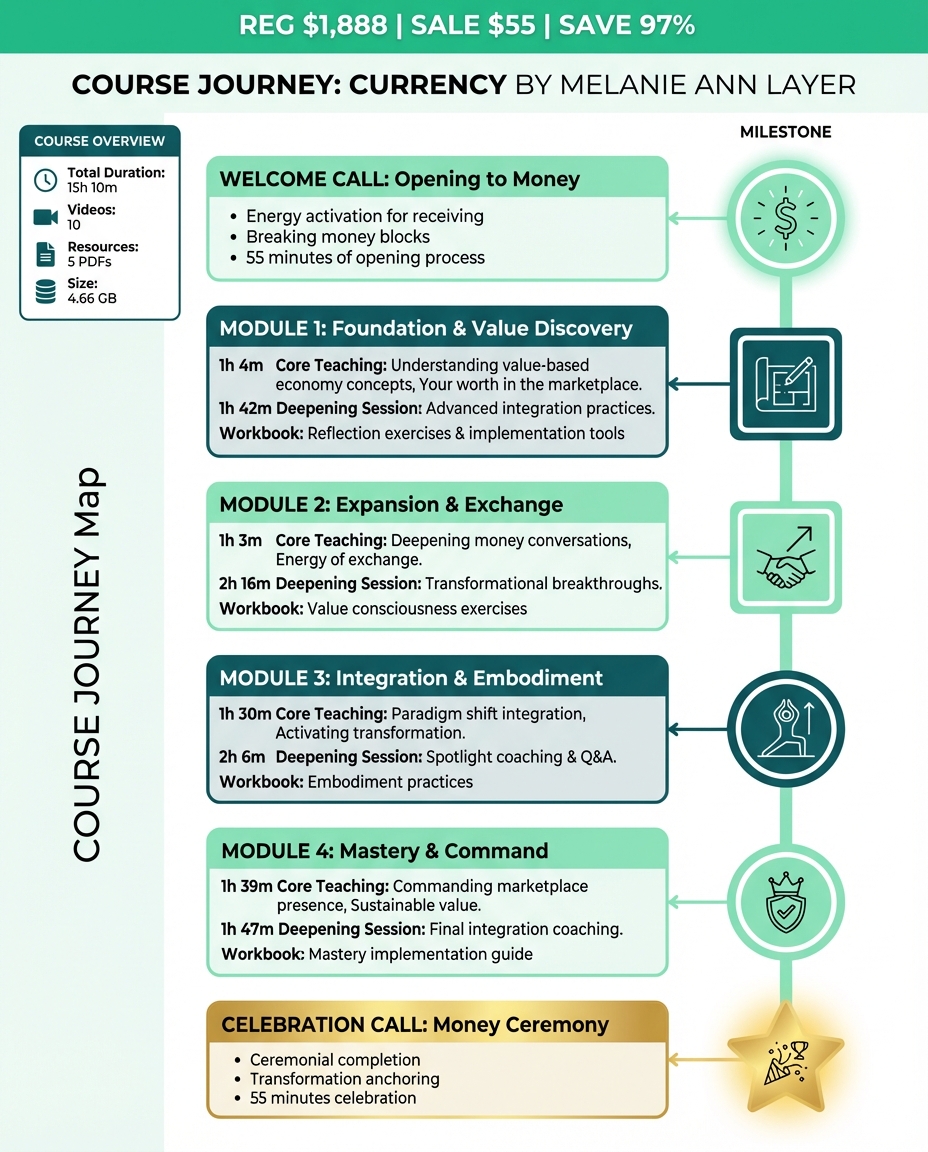
The Chef's Value Ladder is Melanie Ann Layer's 4-rung framework for demonstrating that intrinsic worth and marketplace value are categorically separate things. It is one of the central frameworks inside her $1,888 course Currency, which teaches 8 frameworks for separating self-worth from financial results across 10 lessons. The core insight is that your skill does not change across contexts — but the price the market assigns to that skill changes dramatically based on context, volume, and excellence. You can read the full course breakdown on Course To Action.
There is a chef cutting onions.
In one scenario, she is standing in her own kitchen, prepping dinner for her family. She earns nothing. In the next, she is a line cook at a local diner — minimum wage. In the third, she has been promoted to sous chef — she earns a raise. In the fourth and final scenario, she is a private chef flown to a billionaire's yacht in Monaco for a weekend. She earns $1,500 per hour.
Same hands. Same knife. Same onion. Same skill.
Four entirely different outcomes.
What the Framework Actually Teaches
Most people who feel underpaid or undervalued have been asking the wrong question. They ask: "Am I good enough at what I do?" They tie their rates to their confidence, their credentials, or how long they have been doing the work. The Chef's Value Ladder cuts through all of that.
The key takeaway is this: your intrinsic worth never changes, but your marketplace value is a product of context, volume, and excellence — not of the skill itself.
The chef's ability to cut an onion is identical across all four scenarios. What changes is:
- Context — Who is receiving the output, in what setting, and why it matters to them
- Volume — How scarce or accessible that output is in that particular market
- Excellence — The degree to which the execution meets or exceeds the expectations of that specific buyer
The Four Rungs, Explained
Rung One: Zero Pay — The Domestic Context
The chef at home produces real output. The onions get cut. The skill is deployed. But the context carries no monetary exchange because the recipient is herself, and the market for domestic labor — by default — is unpaid.
This rung is important because many business owners are operating here without realizing it. They are doing skilled work in a context that does not create a transaction. They are producing, but not for a market. Currency asks you to notice when you are on this rung not by choice, but by accident.
Rung Two: Minimum Wage — The Commodity Context
The local diner pays the chef because the context now involves a transaction. But it is a commodity context: onion-cutting is a task that any trained line cook can do. The skill is accessible. The volume of people who offer it is high. The excellence threshold is low — you just need to not mess it up.
This is the rung where most people start their careers, and it is appropriate for that phase. The mistake is staying here while the skill has grown beyond it. Many freelancers and service providers price themselves at this rung long after they have accumulated context-specific expertise that would qualify them for a much higher rung.
Rung Three: A Raise — The Recognized Expertise Context
The sous chef earns more because the context has shifted. There is hierarchy, specialization, and a recognized level of excellence within a defined system. The skill is the same, but the buyer — the restaurant — is now paying for the chef's ability to hold a standard across the kitchen, not just cut her own onions.
Here, excellence plays the biggest role. Two sous chefs in the same restaurant may have identical technical skills, but the one who earns more is the one whose output is consistently reliable at a higher bar. This is where most employed professionals live, and where many coaches, consultants, and service providers who work with companies find themselves.
Rung Four: $1,500 per Hour — The Rare, Unique, Contextually Irreplaceable Expertise
The private chef on the yacht has combined all four pillars of monetary value that Currency teaches alongside the Value Ladder: her skill is Rare in that specific context, Unique in its application to the client's preferences, Limited in access because few chefs are available for that kind of engagement, and Useful at a level that directly serves something the buyer cares deeply about — an impeccable experience for their guests.
The context elevates the transaction. The buyer is not paying for onion-cutting. They are paying for certainty, experience, and exclusivity. The chef's worth as a human being is unchanged from rung one. Her marketplace value at rung four is exponentially higher.
The Chef's Value Ladder is one of 8 frameworks in Currency ($1,888). The others — including the Three Assignments Framework, Transformational Linguistics, the Value vs. Gratitude Framework, and the Four Core Currencies — are broken down in full at Course To Action. The free tier gives you 10 complete summaries with no credit card required.
Why This Framework Matters for Pricing Your Own Work
The Chef's Value Ladder is disarming because it removes ego from the pricing conversation entirely. You do not need to feel "worth it" in some abstract emotional sense. You do not need to believe you are the best in the world. You need to accurately read which rung you are operating on — and whether the context you have built around your skill matches the rung you want to be paid for.
The core insight Currency makes through this framework is a permanent separation of two things most people conflate:
- Personal worth — constant, non-negotiable, not subject to market forces
- Marketplace value — variable, context-dependent, entirely improvable through strategic positioning
The Value Ladder separates them permanently. Your worth as a person is not on the ladder. Your skill's price is.
The Four Pillars of Monetary Value (Used Alongside the Ladder)
The Four Pillars of Monetary Value is Melanie Ann Layer's complementary diagnostic framework that helps you identify what rung you are on and what it would take to climb it. The four pillars are:
- Rare: How few people offer what you offer in your specific context?
- Unique: How differentiated is your approach, voice, or method?
- Limited: How much access do buyers have to your time or output?
- Useful: How directly does your output serve something your buyer urgently needs?
Get Every Framework from Currency
The course costs $$1,888. All frameworks extracted — $49/year.
Start free — 10 full summaries, no credit card
The Practical Application: Climbing the Ladder by Changing the Context
The Chef's Value Ladder is not just descriptive — it is prescriptive. In summary, if you want to earn more, you do not necessarily need a new skill. You may need a new context for the skill you already have.
Melanie built over $7 million in revenue with no paid advertising by understanding this deeply. The skill of coaching existed at every rung. She positioned herself at the rung where context, volume, and excellence combined to make her offer both scarce and indispensable.
Practical steps for applying the framework:
- Audit your current context. Who are you selling to? What is the ambient expectation of what you offer in that market? Are you a line cook when you could be a private chef?
- Identify which pillar is weakest. If your work is not rare, build a niche. If it is not unique, develop a proprietary methodology. If it is not limited, create access constraints. If it is not useful enough, get closer to outcomes that genuinely change your buyer's situation.
- Stop repricing your worth and start repricing your context. The number on your invoice is not a statement about who you are. It is a reflection of the context you have built — and context is something you can change.
What the Chef's Value Ladder Doesn't Cover
What makes this framework different from generic pricing advice is its specificity — but that specificity has boundaries. The Chef's Value Ladder does not teach marketing tactics, funnel construction, or how to find higher-rung clients. It is a diagnostic and philosophical framework, not a tactical playbook. If you need the mechanics of client acquisition or offer positioning, those are separate skills that Currency does not address.
Is Currency Right for You?
If you have ever lowered your rates because a client pushed back and you felt, somewhere underneath the negotiation, that they were probably right — this course is for you.
If you have ever looked at someone earning ten times what you earn for what appears to be similar work and concluded that they must simply be more talented or more confident — this framework will reframe that entirely.
The Chef's Value Ladder does not ask you to believe you are worth more. It asks you to build the context that makes your marketplace value accurately reflect what you already bring.
That is a solvable problem. And Currency is the map.
The Chef's Value Ladder is one of 8 frameworks in Currency. The full breakdown — including Transformational Linguistics, the Three Assignments Framework, the Four Core Currencies, the Value vs. Gratitude Framework, the Three Money Pathways, and the Before-During-After Money Framework — is at Course To Action.
Start free: the free tier gives you 10 complete summaries with no credit card required. Every summary includes audio. The AI "Apply to My Business" feature applies each framework directly to your situation — so you can test whether the Chef's Value Ladder changes how you think about your own pricing before spending $1,888 on the full course.
Course To Action covers 110+ premium courses. Full access is $49/30 days or $399/year — one payment, no subscription, no auto-renewal.
Not a review. Not a rating. A complete framework-level analysis so you know exactly what you're buying — or whether you need to buy it at all — before you spend $1,888.
Start free at Course To ActionFrequently Asked Questions
Is Currency worth $1,888? Currency is worth $1,888 if your primary financial constraint is internal — specifically, if you have fused your self-worth to your price and cannot hold your rates under pressure. One corrected pricing conversation after applying the Chef's Value Ladder can recoup the cost. If your constraint is tactical (marketing, sales, funnels), Currency does not address those and the price is not justified. What does Currency actually teach? Currency teaches 8 named frameworks across 10 lessons for separating personal worth from marketplace value. The Chef's Value Ladder is the central framework, supported by the Four Pillars of Monetary Value, Transformational Linguistics, the Three Assignments Framework, the Value vs. Gratitude Framework, the Three Money Pathways, the Before-During-After Money Framework, and the Four Core Currencies. What does Currency NOT cover? Currency does not cover marketing, sales, funnels, lead generation, or any tactical business-building mechanics. It also does not include worksheets, structured exercises, or written materials between sessions. The entire course is delivered through recorded live calls. Who is Currency best for? Currency is best for experienced coaches, healers, and service providers who know their work is valuable but cannot charge accordingly. It is particularly well-suited for entrepreneurs whose financial results correlate more closely with their emotional state than their effort level. How does the Chef's Value Ladder compare to other pricing frameworks? Most pricing frameworks focus on competitive analysis, cost-plus calculations, or value-based pricing mechanics. The Chef's Value Ladder is distinct because it addresses the psychological fusion of self-worth and market price that prevents those other frameworks from working. It is a prerequisite framework — it clears the internal block that makes strategic pricing feel emotionally impossible. Course To Action publishes independent framework-level breakdowns of online courses — the 20% that delivers 80% of the value, so you can make an informed decision before you spend a dollar.Get All Frameworks from Currency
The course costs $$1,888. The complete breakdown is $49/year — every course on the platform.
This is one framework. Course To Action has every framework, every lesson, and AI that applies it to your specific business. Read or listen — every summary has audio.
Start free — 10 full summaries, no credit card required