Brand Deal Planner Explained: The Floor Price Calculator That Ends Undercharging — from Creator Startup Cohort 2 by Colin and Samir
Most creators price brand deals the wrong way. They look at what a similar-sized creator charges, cut 20% to seem competitive, and call it a rate card. The problem: that number has nothing to do with whether the deal will actually sustain their business. It's a guess dressed up as a strategy.
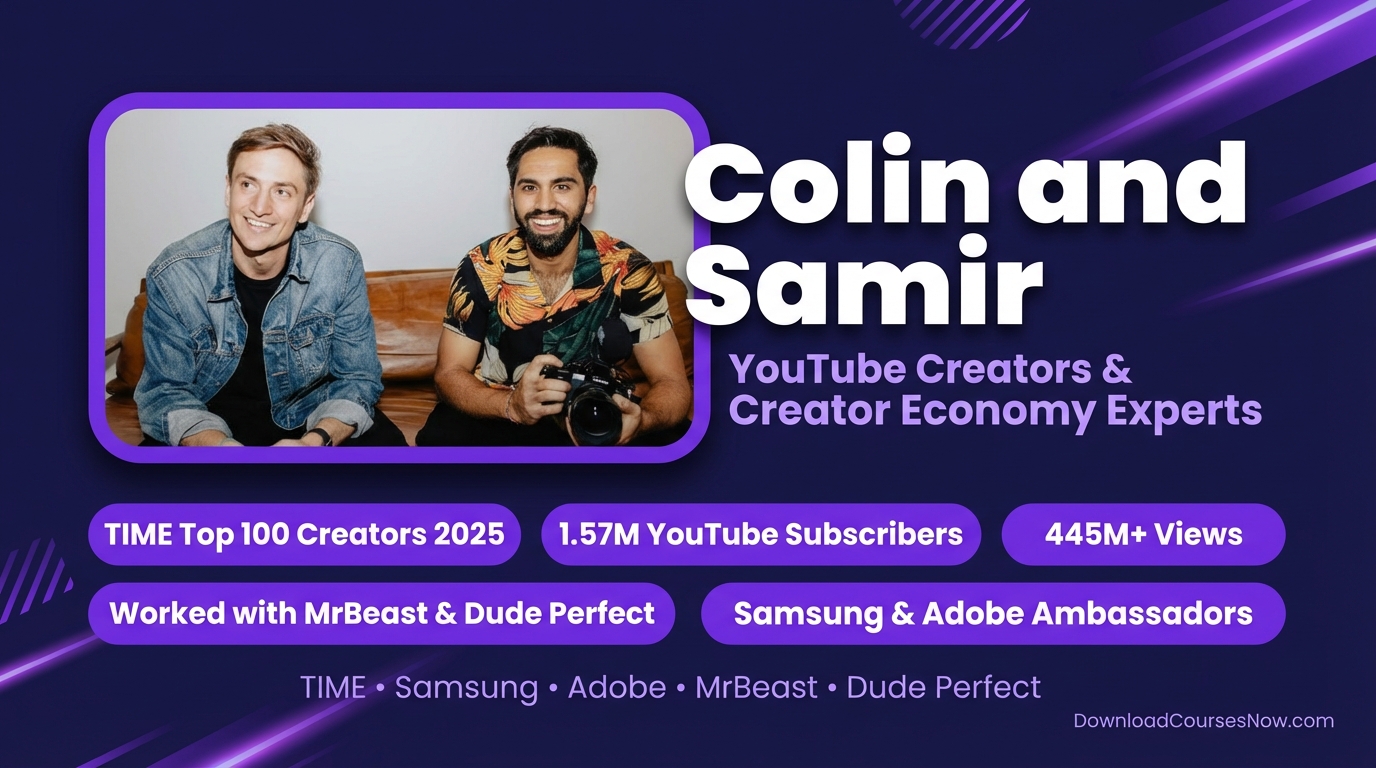
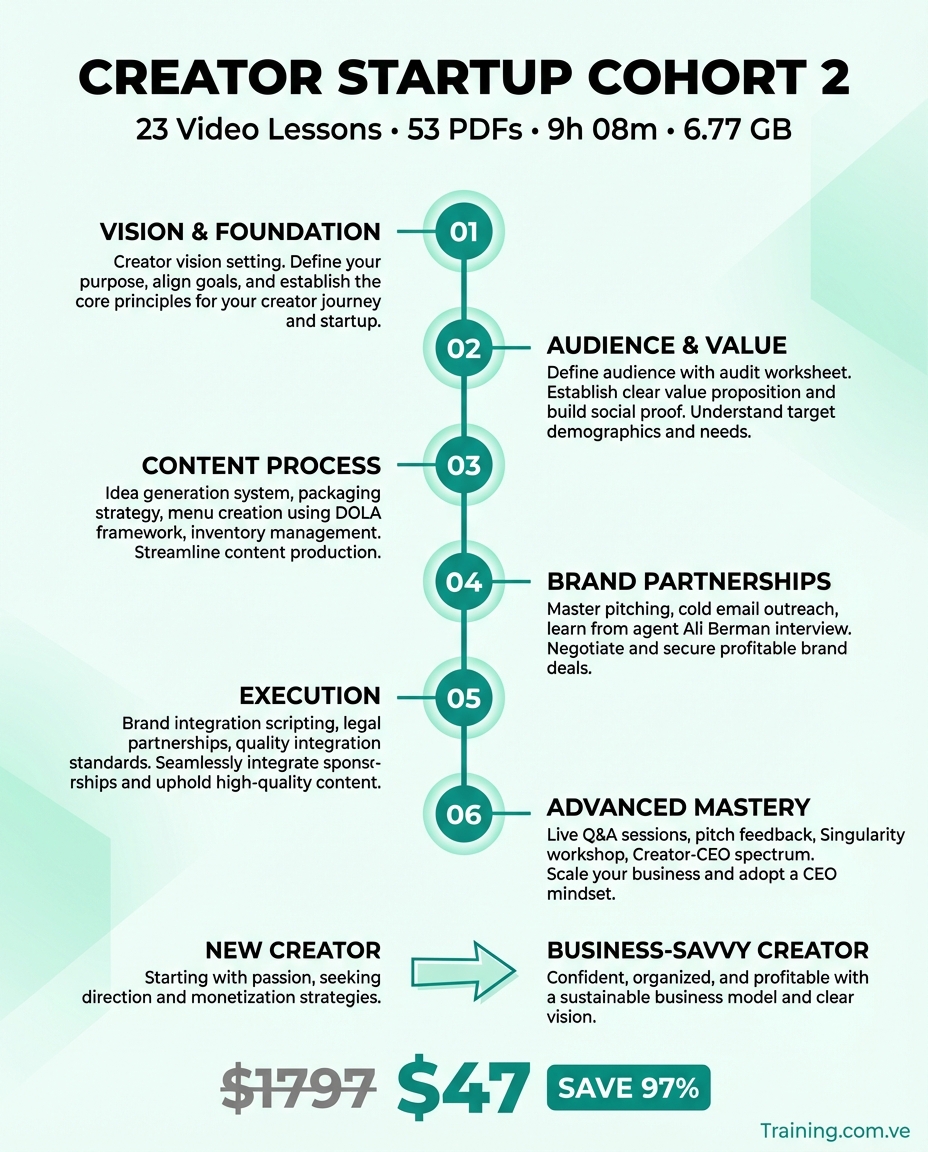
The Brand Deal Planner is Colin and Samir's bottoms-up floor price calculator from Creator Startup Cohort 2 — a $1,797, 23-lesson course on building a repeatable brand deal business. It introduces a floor price calculator — a bottoms-up model built from your actual operating expenses — that tells you the minimum you can charge before a deal hurts more than it helps. Everything above the floor is negotiable. Everything below it is charity.
The core insight is that pricing brand deals from comparable rates is the equivalent of pricing a consulting engagement based on what your friend charges — it has no relationship to whether the deal is financially viable for your specific business.
Here is how the framework works, why it matters, and how to apply it in under 30 minutes.
For the full framework-level context, see the complete Creator Startup Cohort 2 breakdown on Course To Action.
The Core Insight Behind the Framework
Colin and Samir built Creator Startup around a single reframing: your product is not content. Your product is access to a hyper-specific audience.
When you understand that, pricing stops being about what feels fair and starts being about what the access is worth to a brand and what it must be worth to you. The Brand Deal Planner is how you calculate the "must be worth to you" side of that equation. It anchors every negotiation in reality rather than in ego, anxiety, or guesswork.
Sean Frank, CEO of Ridge — a brand doing over $10 million per year in creator partnerships — confirms this perspective from the brand side. When his team evaluates creators, they are not paying for views. They are paying for trust, specificity, and the right to speak directly to an audience that has already opted into that creator's worldview. The price needs to reflect that.
Step 1: Calculate Your Actual Monthly Operating Expenses
The formula starts with a number most creators have never looked at honestly: what does it cost to run this business every single month?
This is not just your camera gear. It is everything:
- Employee salaries and contractor fees (editors, thumbnail designers, social media managers)
- Software subscriptions (editing tools, project management, analytics platforms)
- Studio rent or home office allocation
- Equipment maintenance and replacement amortized monthly
- Health insurance and benefits if you are paying out of pocket
- Travel, production, and shoot costs averaged across the year
- Platform fees and hosting
- Taxes set aside at the appropriate self-employment rate
Let's say your total monthly operating expenses come to $12,000.
Step 2: Apply the 40% Margin Buffer
Running at your cost is not a business. It is freelancing with extra steps. The Brand Deal Planner builds in a 40% margin on top of expenses to account for:
- Business reinvestment (equipment, team, production quality)
- Income volatility months when deals fall through or pay late
- The founder salary you actually deserve
This is not what you want to make. This is what you need to make for the business to be healthy. The distinction matters enormously when you are in a negotiation and a brand pushes back on your rate.
Step 3: Divide by Integrations Per Month
Now you need to know how many brand integrations you realistically produce each month. Be conservative. Factor in:
- How many videos you post per month (not how many you want to post — how many you actually post)
- What percentage of those typically carry a brand integration
- Whether you hold back certain formats (vlogs, personal videos) from sponsorship
$16,800 ÷ 5 integrations = $3,360 per integration as your floor price.
That is the number below which you should not sign a deal. Not because you are being precious about it, but because every deal below that number means you are subsidizing the brand's marketing budget with your own operating deficit.
Step 4: Apply the 50% Fill Rate Assumption
Here is where many creators get hurt: they assume they will sell every integration slot every month. Real creator businesses do not work that way. Brands take time to close. Deals fall through. Campaigns get paused. Budget cycles shift.
The Brand Deal Planner assumes a 50% fill rate — meaning in a given month, only half your available slots will actually be filled and paid.
Recalculate: if you need $16,800 per month and you can only count on filling five of your ten available slots:
$16,800 ÷ 5 paid integrations = $3,360 floor (same as before, because the integration count already reflects realistic output)
But now you must also stress-test the model: if only three integrations close in a bad month, does $3,360 × 3 = $10,080 cover your operations? No — it leaves a $5,920 gap. This tells you either your floor needs to be higher, your expenses need to come down, or you need a retainer structure that smooths revenue across months.
Step 5: Add 10–15% for Agent Commission
If you work with a talent manager or agent (or plan to), they typically take 10–15% of the deal value. This comes out of your pocket, not the brand's. Failing to factor it in means your effective floor is lower than you calculated.
Adjust accordingly: if your floor is $3,360 and your agent takes 15%, your listed floor needs to be $3,360 ÷ 0.85 = $3,953 to net the same amount.
Round up to $4,000 for a clean number.
Get Every Framework from Creator Startup Cohort 2
The course costs $$1,797. All frameworks extracted — $49/year.
Start free — 10 full summaries, no credit card
Step 6: List at 1.5x Your Floor for Negotiation Room
Every experienced sales person knows that you never open at your walk-away number. The Brand Deal Planner recommends listing at 1.5x your floor price to give yourself room to negotiate while still landing at or above what you need.
Floor: $4,000 List price: $4,000 × 1.5 = $6,000
Now when a brand comes back and says "we love you but our budget is $4,500," you can negotiate down from $6,000 to $4,500 and still be comfortably above your floor. The brand feels like they won. You kept the lights on.
If you had listed at your floor, you would have had nowhere to go except below it — which is exactly where most creators end up when they guess their rates.
The Brand Deal Planner is one of 7 frameworks in Creator Startup Cohort 2. You have not yet seen the 7 Sources of Friction, the Four Approaches to Singularity, or the Three Brand Motivations — the buyer-side model that reorients every pitch conversation. Before spending $1,797 on the course, read the full breakdown on Course To Action. Start free — 10 summaries and AI credits, no credit card required.
The Floor Price Is Not Your Goal — It's Your Protection
One clarification worth making: the floor price is not a target. It is a boundary condition. As your audience grows, your specificity deepens, and your track record with brands strengthens, your market rate will often be well above your floor. Sean Frank noted that a 2019 Theo Vaughn ad for Ridge still generates sales monthly — years after the campaign ran. That kind of durable, audience-embedded trust commands a premium far above any floor calculation.
The floor price protects you from deals that drain your energy and your business simultaneously. The market rate rewards you for building something genuinely valuable.
What makes this different from generic pricing advice is that the floor price is derived entirely from your own numbers — not industry benchmarks, not what similar-sized creators charge, not what feels comfortable in a negotiation. It is a math problem with a defensible answer.
How This Fits Into Creator Startup Cohort 2
The Brand Deal Planner is one of several interconnected frameworks inside Creator Startup Cohort 2. It connects to:
- The 5 Stages of a Creator Startup — Colin and Samir's lifecycle model that places creators in one of five sequential phases (Exploration, Development, Growth, Expansion, Diversification). Understanding which stage you are in determines how aggressively you should be filling your integration slots versus building brand equity.
- Three Brand Motivations — Colin and Samir's buyer-side segmentation model with three categories: Awareness, Conversion, and Community Trust. Knowing why a brand wants to work with you tells you how much leverage you have in pricing conversations.
- The 6-Box Integration Checklist — Colin and Samir's 6-point pre-deal quality control framework. A pre-deal checklist that ensures integrations land in a way that protects your audience relationship while serving the brand's objective.
- The Northstar Brand List — a curated target list of brands you actually want to work with, built so your outreach is never cold.
In summary, the Brand Deal Planner works as a standalone calculation but reaches full power when combined with the buyer-side frameworks that tell you which brands to target and how to structure the pitch.
Who This Framework Is For
The Brand Deal Planner is most valuable for creators who:
- Have at least some brand deal history but feel uncertain about whether they are pricing correctly
- Are growing fast enough that underselling is starting to be a real cost — not just a missed opportunity
- Have tried raising rates and felt the anxiety of not knowing how to justify the number
- Are building toward brand deals as a primary revenue stream rather than a side income
This is best suited for Growth-stage YouTube creators who have an existing production rhythm and some brand deal history but have never formalized the pricing model underneath their negotiations.
Frequently Asked Questions
What is the Brand Deal Planner in Creator Startup Cohort 2?The Brand Deal Planner is Colin and Samir's bottoms-up floor price calculator — a 6-step pricing model that derives a creator's minimum viable deal price from their actual monthly operating expenses, a 40% margin buffer, and realistic production capacity. It replaces guesswork with a defensible, math-backed number.
How does the floor price formula work?Add up your total monthly operating expenses, multiply by 1.40 to include a 40% margin, then divide by the number of brand integrations you can produce per month. List your rate at 1.5x that floor to build in negotiation room. Factor in a 50% fill rate and 10-15% agent commission if applicable.
Is Creator Startup Cohort 2 worth $1,797?For Growth-stage YouTube creators doing sporadic or under-priced brand deals, the ROI is straightforward: the floor price formula alone frequently reveals that creators are leaving 30-50% on the table per deal. One properly priced negotiation recovers the course price. For pre-audience creators, the price is not justified.
What does Creator Startup Cohort 2 NOT cover?The course does not cover course creation, memberships, physical products, licensing, AdSense optimization, or multi-platform monetization. It does not cover short-form content strategy. The legal and brand partnership frameworks are US-centric. It is designed for Growth-stage creators and above only.
Final Thoughts
The Brand Deal Planner framework gives creators something rare: a defensible, math-backed answer to the question every brand will eventually ask — "Why do you charge this much?"
The answer is not "because that's what other creators charge." The answer is "because this is what it costs to run a business that can serve your audience — and yours — with integrity."
That is a very different negotiating position. And it comes directly from knowing your floor.
The Brand Deal Planner is one piece of a 7-framework system. The complete picture — the 7 Sources of Friction that kill deals before they start, the Four Approaches to Singularity that make your pitch self-evident, and the Three Brand Motivations that tell you exactly how a buyer is thinking before you open your mouth — is in the full breakdown on Course To Action.
Start free — no credit card required. Course To Action's free tier includes 10 summaries and AI credits. The AI "Apply to My Business" feature takes each framework and applies it to your actual channel and revenue situation, not a generic creator template. Every summary has audio so you can work through the 7 Sources of Friction or the Four Approaches to Singularity while commuting or exercising. The paid tier is $49 for 30 days or $399/year — one payment, no auto-renewal — for access to 110+ course breakdowns, against the $1,797 you would spend on Creator Startup Cohort 2 itself.
Start free at Course To Action — 10 summaries and AI credits, no credit card required.Course To Action publishes independent framework-level breakdowns of online courses — the 20% that delivers 80% of the value, so you can make an informed decision before you spend a dollar.
Get All Frameworks from Creator Startup Cohort 2
The course costs $$1,797. The complete breakdown is $49/year — every course on the platform.
This is one framework. Course To Action has every framework, every lesson, and AI that applies it to your specific business. Read or listen — every summary has audio.
Start free — 10 full summaries, no credit card required