
The Content Buckets System Explained: Build Compounding YouTube Growth Through Format-Based Algorithm Relationships — from Channel JumpStart by Derral Eves
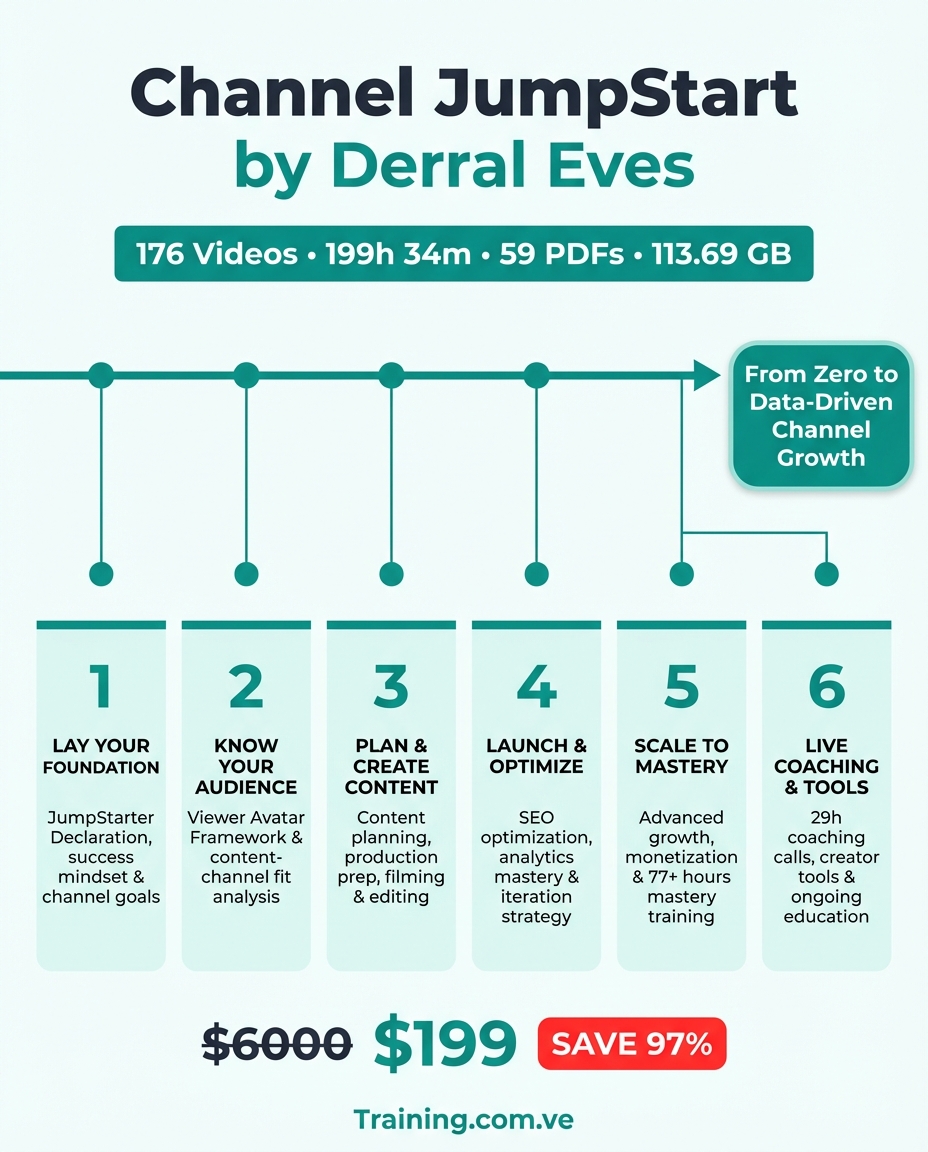
Channel JumpStart is a $6,000 course by Derral Eves that teaches a complete operating system for YouTube channel growth across 86 lessons and 49.5 hours of instruction. The Content Buckets System is the structural centerpiece of that program — the framework Eves uses to engineer compounding growth rather than chase viral luck.
There is a moment every YouTube creator recognizes. A video takes off — it gets more views in 48 hours than any other video on the channel. The natural impulse is to analyze what made it work: the topic, the thumbnail, the timing, the hook. Then the creator tries to replicate the result by making another video on the same topic.
It rarely produces the same outcome. The second video underperforms. The creator concludes the first video was lucky.
The full breakdown of Channel JumpStart — including every framework and honest limitations — is available at Course To Action. Start free.
Derral Eves disagrees with this conclusion. In his view, the first video did not underperform because YouTube is unpredictable. It underperformed because the creator failed to build the structure that would have allowed the algorithm to recognize the relationship between the two videos — and surface them together.
That structure is the Content Buckets System. It sits at the center of Channel JumpStart, Eves's $6,000, 86-lesson program for building channels that grow through engineered compounding rather than viral luck.
Who Derral Eves Is, and Why That Matters
Before examining the framework, the source deserves attention.
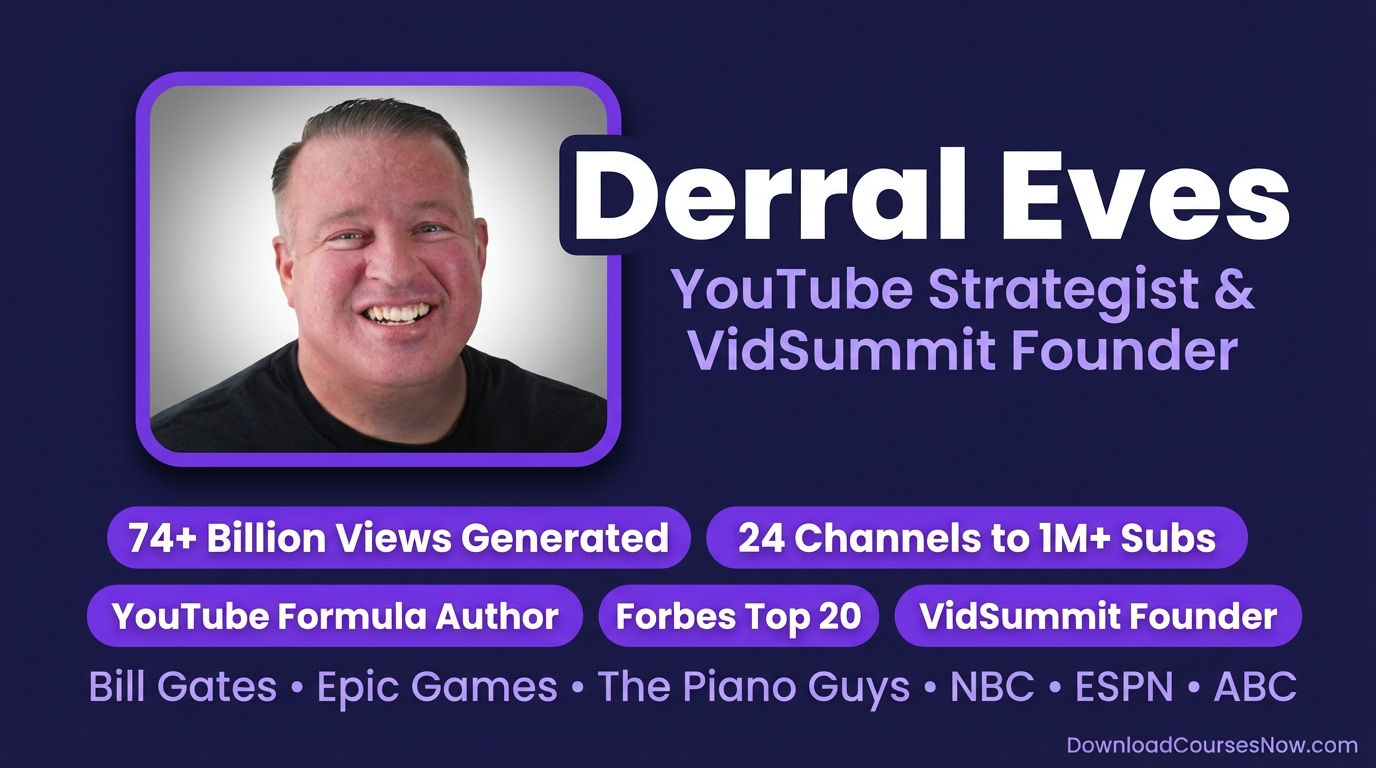
Derral Eves has generated over 101 billion views on YouTube across the channels he has advised and helped build. He has taken 34 channels from zero to one million subscribers. He is the author of "The YouTube Formula," which carries a foreword written by MrBeast — not as a celebrity endorsement, but because MrBeast hired Eves as a consultant during the period his channel crossed from large to historically dominant. Eves is also the founder of VidSummit, the largest data-focused conference for YouTube creators, and the executive producer of The Chosen, the highest-grossing crowdfunded media project of all time.
What makes this different is the source of the frameworks. This is not the biography of a course creator who built an audience teaching YouTube. It is the biography of someone who has operated inside YouTube's mechanics at the highest level, across the widest range of channel types and sizes, for decades. The frameworks in Channel JumpStart are derived from that operational history — from watching what actually compounds across thousands of channels, not from theoretical optimization.
The Core Problem the Content Buckets System Solves
Most YouTube growth advice is video-level advice. Make a better hook. Optimize the thumbnail. Research the keyword. Use pattern interrupts. All of this operates on the assumption that growth is the sum of individual video performance.
Eves's observation, built from consulting channels at scale, is that this assumption is incomplete. Individual video performance matters, but it does not explain the growth curves of channels that compound — the ones that accumulate views across their library, not just on the most recent upload.
The key takeaway is this: the difference between a channel that grows linearly and one that grows exponentially is not video quality. It is whether YouTube's algorithm has developed a clear enough understanding of the channel's format to surface related content when any single video gains traction.
YouTube's recommendation system does not just track topics. It tracks relationships between videos — specifically, whether videos that share certain structural characteristics are watched by the same viewers in the same behavioral patterns. When the algorithm identifies a cluster of videos it has learned to associate, a performance spike on any one of them becomes a discovery mechanism for all of them. The views compound across the cluster rather than staying isolated in the individual video.
The Content Buckets System is the method for building those clusters deliberately, before any individual video takes off — so that when it does, the compounding mechanism is already in place.
What a Content Bucket Actually Is
The Content Buckets System is Derral Eves' framework for structuring a YouTube channel around five to seven repeatable content formats, each defined by three consistent elements held together across multiple videos: a bounded theme, a consistent title pattern, and a consistent visual and production style.
The term "bucket" is intentionally informal, but the definition is precise.
Consistent theme. Each bucket operates within a clearly bounded topic territory. Not "business" or "fitness" — a theme specific enough that a viewer who watches one video in the bucket has a clear expectation of what another video in the bucket will cover. The theme is narrow enough to create a recognizable content category, but broad enough to sustain 15 to 30 videos before exhaustion. Similar metadata, especially title format. This is where the Content Buckets System diverges most sharply from conventional content strategy. The metadata consistency — particularly the structure and phrasing pattern of video titles — is not about keyword optimization. It is about pattern recognition. When multiple videos share a consistent title format, YouTube's algorithm can identify them as a cluster based on signals the human viewer may not even consciously notice. Eves is specific about this: the title format should be consistent enough that a viewer who sees three of your bucket videos would recognize the family relationship, even without knowing anything about your channel structure. Consistent video style. This includes production approach, video length range, pacing, presentation format, and structural template. A bucket video shot in one format should be visually and structurally recognizable as belonging to the same family as other bucket videos. This consistency creates behavioral predictability for viewers — a viewer who enjoyed one bucket video has an accurate expectation of what another will feel like — and it creates classification clarity for the algorithm.The three-element definition matters because any single element in isolation is insufficient. A consistent theme without consistent metadata and style is a topic, not a bucket. Consistent style without consistent theme is an aesthetic, not a format. All three in combination create the structured relationship the algorithm can identify and act on.
The Compounding Mechanism
The reason the Content Buckets System produces compounding growth rather than linear growth is the way YouTube's recommendation logic responds to the format cluster.
When a video gains views — through search, through external traffic, through an algorithm recommendation triggered by a viewer's watch history — YouTube observes the viewer behavior that follows. Which viewers watched the video? What did they watch next? Did viewers who liked that video show interest in any other videos on the channel?
If the channel has content buckets built correctly, the answer to that last question produces a consistent signal: viewers who engaged with video A in Bucket 1 also engaged with videos B, C, and D in Bucket 1. The metadata and style consistency reinforces the behavioral clustering. The algorithm learns that this cluster of videos serves a consistent audience with consistent engagement patterns.
The consequence is that when video E in Bucket 1 is uploaded, or when video A gains a new spike of traffic from an external source, YouTube has a trained association to act on. It surfaces the other bucket videos alongside the high-performing one. The views that entered the channel through one video distribute across the cluster.
This is the compounding mechanism Eves describes. It is not viral luck compounding. It is structured algorithmic surfacing that compounds because the channel was built to make the algorithm's classification job unambiguous.
Get Every Framework from Channel JumpStart
The course costs $6000. All frameworks extracted — $49/year.
Start free — 10 full summaries, no credit card
The 5-7 Bucket Architecture
Channel JumpStart specifies maintaining 5 to 7 active buckets simultaneously, with rotation between them across the upload schedule.
The reasoning for the range is not arbitrary. Fewer than five buckets produces a channel the algorithm can classify, but limits the surface area for discovery — each bucket can only attract the specific audience it is calibrated for, and with only a few buckets, the total audience ceiling is lower. More than seven active buckets produces a channel the algorithm struggles to classify clearly, because the behavioral signals are distributed across too many distinct format clusters to build strong associations for any of them.
The 5 to 7 range allows a channel to serve multiple distinct viewer needs and attract multiple audience segments while still building per-bucket algorithmic authority quickly enough to see compounding within a reasonable time window.
The rotation element is equally important. Uploading exclusively into one bucket and ignoring others weakens the associations for the neglected buckets. The upload schedule should distribute content across the active buckets consistently, reinforcing the behavioral signals for all of them simultaneously. Eves frames this as treating the channel like a portfolio — the goal is portfolio-level compounding, not single-asset performance.
This is one of 7 frameworks in Channel JumpStart. The course costs $6,000. The complete breakdown — every framework, every limitation — is on Course To Action. Free account, 10 summaries, no credit card. Or unlock all 110+ courses for $49/30 days — audio summaries and the "Apply to My Business" AI tool included.
What Content Buckets Are Not
The most important distinction in the framework is the one between content buckets and playlists.
Playlists are viewer-facing organizational tools. They group videos the creator has designated as related, typically by topic or series. They are useful for navigation. They do not, on their own, produce the algorithmic relationship that content buckets create.
The algorithmic relationship in the Content Buckets System is not created by grouping — it is created by format consistency. YouTube's classification system responds to structural signals the viewer may not consciously register: the pattern of the title, the consistent video length, the consistent visual style, the consistent pacing of the hook. These signals, held consistently across a cluster of videos, are what allow the algorithm to build the association without the creator explicitly telling it that the videos are related.
A playlist tells viewers that videos are related. A content bucket teaches the algorithm that videos are related — through behavioral and structural consistency that the algorithm can detect and act on independently.
In summary, the playlist creates the organizational structure. The bucket creates the algorithmic relationship. Creators who rely on playlists alone without format consistency do not see the same compounding effect.
The Derral Eves Track Record as Proof of Concept
The Content Buckets System is not a theoretical framework. It is a distillation of what Eves has observed working across 101 billion views and 34 channels taken from zero to one million subscribers.
The channels Eves has built or consulted — including MrBeast during a period that produced some of the fastest subscriber growth in platform history — demonstrate a consistent structural pattern: multiple recognizable content formats running simultaneously, each with distinctive but consistent title patterns, visual styles, and thematic territory. The MrBeast channel, in particular, is built on a clear bucket architecture: challenge videos, philanthropy videos, recreation-at-scale videos, and food-focused videos each have their own format consistency that allows the algorithm to surface them to different audience segments while the channel accumulates cross-bucket authority.
The core insight is that this framework works at the scale of the largest channels on the platform. Channel JumpStart is the structured methodology for applying the same logic at the starting stage.
What Channel JumpStart Contains Beyond the Buckets System
The Content Buckets System is the structural foundation of the program, but it operates inside a larger 86-lesson curriculum that covers the full technical and strategic stack of channel growth: viewer avatar development (the psychographic depth required to build buckets that attract real people rather than theoretical audiences), metadata optimization, analytics interpretation, the channel audit process Eves uses with consulting clients, thumbnail and title testing frameworks, and the launch sequencing that establishes algorithmic signals correctly from the first upload.
The most important framework beyond Content Buckets is the Jumpstarter Way — Eves' Plan-Execute-Analyze-Adjust cycle that governs how you iterate on each bucket over time. Without the PEAA cycle, even a well-constructed bucket architecture stagnates.
The complete independent deconstruction of Channel JumpStart's frameworks — including the Viewer Avatar methodology, the launch sequencing logic, and the analytics interpretation system — is available at Course To Action.
Not a review. Not a rating. A framework-level analysis so you know exactly what you are buying — or whether you need to buy it at all — before you spend $6,000.
Full breakdown at Course To Action — free account, no credit card. Or unlock all 110+ courses for $49/30 days — audio summaries and the "Apply to My Business" AI tool included. One payment, no auto-renewal.Frequently Asked Questions
What is the Content Buckets System in Channel JumpStart?The Content Buckets System is Derral Eves' framework for structuring a YouTube channel around five to seven repeatable content formats. Each bucket is defined by three consistent elements — a bounded theme, a consistent title pattern, and a consistent visual and production style — so YouTube's algorithm can identify and surface related videos together as a compounding cluster.
Is Channel JumpStart worth $6,000?For creators and entrepreneurs who are serious about YouTube as a primary platform and want a systematic, data-driven growth process, Channel JumpStart delivers a complete operating system from one of the most credentialed practitioners in the field. For casual creators, $6,000 is not calibrated to that level of commitment. The answer depends on how central YouTube is to your business or career goals.
What does Channel JumpStart NOT cover?The course does not cover monetization beyond AdSense basics — no sponsorship negotiation, merchandise strategy, or course creation. Editing instruction assumes Adobe Premiere Pro. YouTube Shorts-specific strategy is absent. Some content is redundant across the 86 lessons.
How does the Content Buckets System differ from playlists?A playlist tells viewers that videos are related through manual grouping. A content bucket teaches the algorithm that videos are related through behavioral and structural consistency — consistent title patterns, visual styles, and thematic boundaries — that the algorithm can detect and act on independently. Playlists create organizational structure; buckets create algorithmic relationships that drive compounding growth.
Where can I read the full breakdown of Channel JumpStart?The complete independent breakdown — every framework extracted, every lesson documented, every limitation noted — is at Course To Action. Not cliff notes. Full deconstructions. Start free.
Course To Action publishes independent framework-level breakdowns of online courses — the 20% that delivers 80% of the value, so you can make an informed decision before you spend a dollar.
Get All Frameworks from Channel JumpStart
The course costs $6000. The complete breakdown is $49/year — every course on the platform.
This is one framework. Course To Action has every framework, every lesson, and AI that applies it to your specific business. Read or listen — every summary has audio.
Start free — 10 full summaries, no credit card required