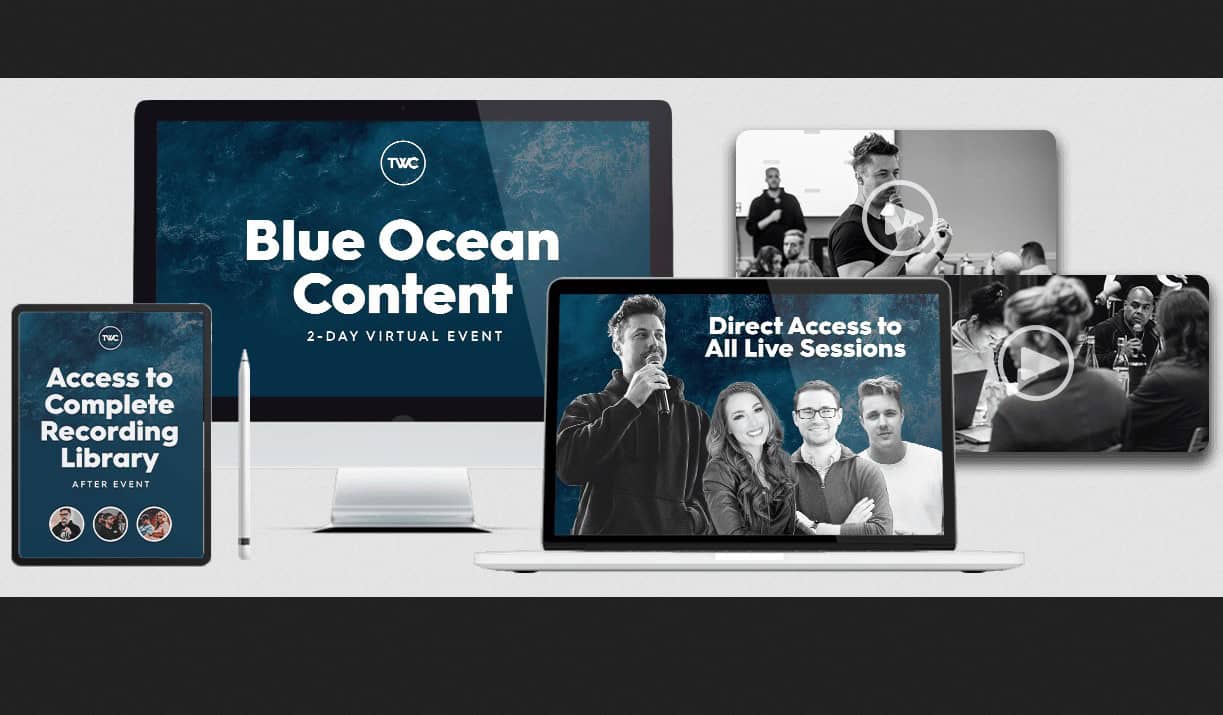
The Interdisciplinary Branding Model Explained: Build a Category-of-One YouTube Channel — from Blue Ocean Content YouTube Mastery by Taylor Welch
Blue Ocean Content YouTube Mastery is a $1,000 workshop by Taylor Welch that covers 8 frameworks for positioning, algorithm optimization, and interdisciplinary branding on YouTube. The most important of those frameworks — the one that the rest of the course builds on — is the Interdisciplinary Branding Model. This article is a full deconstruction of what it is, how it works, and why it produces the outcomes it claims.
There is a question every serious YouTube creator eventually hits: why do channels with objectively better production, more polished editing, and larger existing audiences sometimes grow slower than someone who appeared from nowhere six months ago?
Taylor Welch — co-founder of Traffic and Funnels, a business that crossed $30M in annual revenue advising over 50,000 clients, and the creator behind the Deep End podcast — spent years inside this question before arriving at an answer that contradicts most YouTube growth advice. The answer is not better thumbnails. It is not posting frequency. It is not optimizing for the algorithm. It is something that happens before you hit record.
The framework is called the Interdisciplinary Branding Model. It sits at the core of his $1,000 course, Blue Ocean Content YouTube Mastery, and it is the structural reason some channels create category-of-one positioning while most compete in red ocean content markets that look increasingly identical.
The Problem: Why Most YouTube Channels Are Invisible Before They Start
YouTube is not short on content. Any niche you can name — business strategy, productivity, personal finance, fitness, spirituality, marketing — has hundreds of creators producing technically competent videos on similar topics, using similar structures, appealing to similar search terms.
The conventional growth advice operates inside this assumption: compete harder, post more consistently, optimize better, reverse-engineer what is working for the top channels in your space. This advice is not wrong. It is just insufficient. Because the underlying positioning problem it ignores is that if you build your channel inside an existing category, you are competing for attention against every other creator who built their channel inside the same category.
Welch's framing for this is the difference between red ocean and blue ocean content. Red ocean channels compete in defined, crowded markets — they are fighting for the same viewers, the same search queries, the same algorithmic attention as dozens or hundreds of similar channels. Blue ocean channels operate in a category they effectively define. The competition is not absent; it simply does not yet exist in the form required to compete directly.
The Interdisciplinary Branding Model is the mechanism for building the second type of channel.
What the Interdisciplinary Branding Model Is
The Interdisciplinary Branding Model is Taylor Welch's 4-stage framework for building a category-of-one YouTube channel by identifying three domains of genuine expertise from unrelated fields and constructing a content identity at their intersection. The stages are: (1) inventory your actual expertise across your professional, intellectual, and personal history; (2) select three fields with genuine distance between them; (3) identify the coherent through-line connecting all three; (4) build content exclusively at that intersection.
The model operates on a single core insight: your brain is neurochemically wired to seek novelty. Specifically, the dopaminergic system that drives engagement — the same system behind compulsive content consumption — is activated most strongly not by familiar things executed exceptionally well, but by unexpected combinations of familiar things.
When a viewer encounters a channel that covers business strategy, they process it through existing pattern recognition. They have a mental file for "business YouTube." The channel fits the file. They may watch, they may subscribe, but there is no neurochemical spike because there is no novelty. The brain has seen this before.
When a viewer encounters a channel that covers business strategy through the lens of Jungian psychology and contemplative spirituality — combining three disciplines they have seen individually but never together — the pattern recognition system encounters something it cannot file. This is the neurochemical event that drives compulsive engagement. The brain does not just want to watch the next video. It needs to, because the combination is genuinely new and the brain is wired to pursue novelty to resolution.
The key takeaway is that novelty is not manufactured through production quality or content density — it is engineered through the deliberate combination of unrelated expertise domains that no other creator can replicate.
The Three-Discipline Architecture
The framework requires three inputs, not two and not four. The specificity matters.
Two disciplines produces a niche — useful for initial positioning, but replicable. Another creator with overlapping expertise can build inside the same two-discipline space and compete directly. Four or more disciplines produces incoherence. The pattern recognition system cannot hold the combination, and the novelty becomes noise instead of intrigue. Viewers cannot form a clear expectation of what they are subscribing to. Three disciplines, selected correctly, produces what Welch describes as a content category: a space the viewer cannot name but immediately recognizes as distinct, with no obvious alternative occupying the same position.The selection criteria for the three disciplines are equally important as the number:
Criterion one: genuine depth. All three areas need to reflect real expertise, not surface-level familiarity. The interdisciplinary model creates novelty through the collision of frameworks — you need actual frameworks to collide. A creator who has studied one area professionally and is passingly familiar with two others will produce shallow interdisciplinary content. The depth of each discipline is what makes the combination generative rather than superficial. Criterion two: real distance between fields. Adjacent disciplines — sales and marketing, productivity and time management, fitness and nutrition — are too close. Their collision does not produce the neurochemical novelty the model depends on. The disciplines need to be genuinely unrelated at the level of typical association. Spirituality, business strategy, and psychology, for example. Or engineering, philosophy, and physical performance. Or theology, financial systems, and communication theory. The combination should feel unexpected on first encounter. Criterion three: a coherent through-line. The three disciplines need a connective logic — a way of talking about all of them that reveals a genuine relationship between them, not just sequential coverage of three unrelated topics. The through-line is what prevents the channel from feeling like a content variety show. It is the creator's actual perspective: the specific way their background in all three areas produces an insight no single-discipline creator could generate.Why This Creates Compulsive Engagement
Welch's explanation for why the model produces binge behavior goes deeper than "novelty is engaging." He points to the specific neurological mechanism underneath.
The brain does not just seek novelty. It seeks novelty resolution — the satisfaction of having a new pattern explained and integrated. When a viewer encounters an unexpected combination of frameworks, the brain generates a low-level state of productive tension: the dopaminergic system is activated but not yet satisfied, because the pattern is novel enough to be interesting but not yet fully understood. The next video is not just appealing — it is the resolution mechanism. The viewer needs to keep watching to complete the pattern.
This is structurally different from how most YouTube channels generate engagement. Most channels produce engagement through satisfaction: a useful piece of information, an entertaining story, a relatable moment. Satisfaction produces a good viewing experience. The interdisciplinary model, executed correctly, produces something closer to productive compulsion: the viewer is engaged not just by what they received but by what the combination is still promising.
The result, in practical terms, is a different relationship between viewer and channel. Standard channels get subscribers who check back occasionally. Interdisciplinary channels get viewers who work through archives.
What makes this different from standard YouTube growth advice is that it addresses the source of compulsive engagement at the neurochemical level, rather than treating watch time as a tactical problem to be solved with editing tricks and pattern interrupts.
Get Every Framework from Blue Ocean Content YouTube Mastery
The course costs $$1,000. All frameworks extracted — $49/year.
Start free — 10 full summaries, no credit card
Taylor Welch as the Working Example
The Deep End podcast — Welch's primary content platform, generating 3 to 5 million monthly views — is a live implementation of this model. The disciplines in combination are: high-level business strategy and sales systems (from two decades of direct business building, including Traffic and Funnels); psychology and human behavior (a consistent thread in both his content and his framework-development work across multiple courses); and what he describes as spirituality or the deeper interior game of ambition, identity, and meaning.
No single one of these three disciplines is unusual on YouTube. Business channels are abundant. Psychology channels are abundant. Spirituality channels are abundant. The combination — processed through a single creator's coherent perspective — produces content that viewers consistently describe as unlike anything else they are watching, despite the fact that each component discipline is familiar.
This is the practical proof of concept for the model. The novelty is not in the topics themselves but in the lens through which the topics are processed and combined.
How to Apply the Interdisciplinary Branding Model
The implementation process inside Blue Ocean Content YouTube Mastery follows a structured sequence:
Stage one: inventory your actual expertise. Not the expertise you want to have or the expertise you think would be marketable — the expertise accumulated through your actual professional, intellectual, and personal history. Welch pushes creators to include areas they have dismissed as irrelevant or too personal to be commercially useful. These are often the disciplines that produce the most distinctive combinations. Stage two: run the distance test. For every pairing of potential disciplines, evaluate whether a typical viewer would naturally associate the two fields. If yes, the pairing is too adjacent. Keep testing combinations until you arrive at three that produce genuine surprise — combinations that are unexpected but, on reflection, coherently interesting. Stage three: identify the through-line. Write one paragraph that explains how your background in all three disciplines produces an insight that a creator working in only one of them could not generate. This paragraph becomes the foundation of your channel's content identity. If you cannot write it, the through-line is not yet clear enough, and the combination needs refinement. Stage four: stress-test with the binge prompt. For your three-discipline combination, generate ten potential video topics that genuinely require all three frameworks to address fully. If the topics only need one or two of the disciplines, the combination is not integrated enough. If all ten topics feel genuinely generative, the model is working.This is one of 8 frameworks in Blue Ocean Content YouTube Mastery. The complete breakdown — including the 3Cs Video Optimization templates, Linear Flow Method, and the positioning diagnostic — is on Course To Action. Free account, 10 summaries, no credit card. Or unlock all 110+ courses for $49/30 days.
The Positioning Consequence
The competitive consequence of the Interdisciplinary Branding Model is significant and often underappreciated.
When you build inside an existing content category, algorithm shifts, new entrants with larger budgets, and changes in search behavior are genuine competitive threats. The category can be disrupted because it is defined by something outside your control.
When you build a category, the disruption dynamic inverts. Other creators can enter adjacent spaces. They cannot occupy your specific combination of frameworks without replicating your exact intellectual history, which is by definition impossible. The moat is not budget, production quality, or posting frequency. It is the irreproducibility of the specific lens through which you process your content.
This is what Welch means by blue ocean positioning. Not a market with no competition — a market where the competition cannot form in the shape required to compete with you directly.
In summary: the Interdisciplinary Branding Model is not a branding exercise. It is a competitive moat strategy disguised as a content identity framework. The reason it works is structural — it produces genuine novelty that no competitor can replicate without replicating your exact life — and the reason most creators miss it is that they are looking for tactical advantages in a game where the structural position has already determined the outcome.
Before you spend $1,000 on the workshop, read the complete breakdown on Course To Action. Free account — 10 summaries + AI credits, no credit card required. Or unlock all 110+ premium courses, structured audio, and the 'Apply to My Business' AI tool for $49/30 days (one payment, no auto-renewal).
The AI has read the entire workshop — tell it about your YouTube channel and get a custom content positioning strategy.
Read the summary or listen to the audio version.
Frequently Asked Questions
What is the Interdisciplinary Branding Model from Blue Ocean Content YouTube Mastery?The Interdisciplinary Branding Model is Taylor Welch's 4-stage framework for building a category-of-one YouTube channel. The stages are: inventory your actual expertise across professional, intellectual, and personal history; select three fields with genuine distance between them; identify the coherent through-line connecting all three; and build content exclusively at that intersection. The result is a content identity no competitor can replicate.
Is Blue Ocean Content YouTube Mastery worth $1,000?For entrepreneurs and founders who have tried YouTube and stalled below 10,000 views per video despite genuine expertise, yes. The Interdisciplinary Branding Model and TAM vs. Niche × Depth Matrix address the positioning problem most YouTube courses skip entirely. For beginners or creators seeking a Shorts strategy, the fit is poor regardless of price.
What does Blue Ocean Content YouTube Mastery NOT cover?YouTube Shorts strategy, monetization beyond ad revenue (no course launches, coaching funnels, or affiliate structures), beginner YouTube basics, and e-commerce or product business channel strategy. The course also integrates a spiritual framework throughout that some buyers will find essential and others will find misaligned.
How does the Interdisciplinary Branding Model differ from standard niche advice?Standard niche advice tells you to narrow your focus and go deep in one area. The Interdisciplinary Branding Model instructs the opposite: combine three unrelated areas of genuine expertise and build your content identity at their intersection. The strategic rationale is neurochemical — the brain cannot disengage from content that does not fit an existing pattern, which produces compulsive engagement that the algorithm rewards with distribution.
Where can I read a full summary of Blue Ocean Content YouTube Mastery?The independent framework-level breakdown — every framework extracted, every lesson documented, every limitation noted — is available at Course To Action. Start free.
Course To Action publishes independent framework-level breakdowns of online courses — the 20% that delivers 80% of the value, so you can make an informed decision before you spend a dollar.
Get All Frameworks from Blue Ocean Content YouTube Mastery
The course costs $$1,000. The complete breakdown is $49/year — every course on the platform.
This is one framework. Course To Action has every framework, every lesson, and AI that applies it to your specific business. Read or listen — every summary has audio.
Start free — 10 full summaries, no credit card required