
The Ceiling and Basement Framework Explained: Why You Self-Sabotage When Life Gets Good — from Authentic Creation Program 2.0 by Mandy Morris
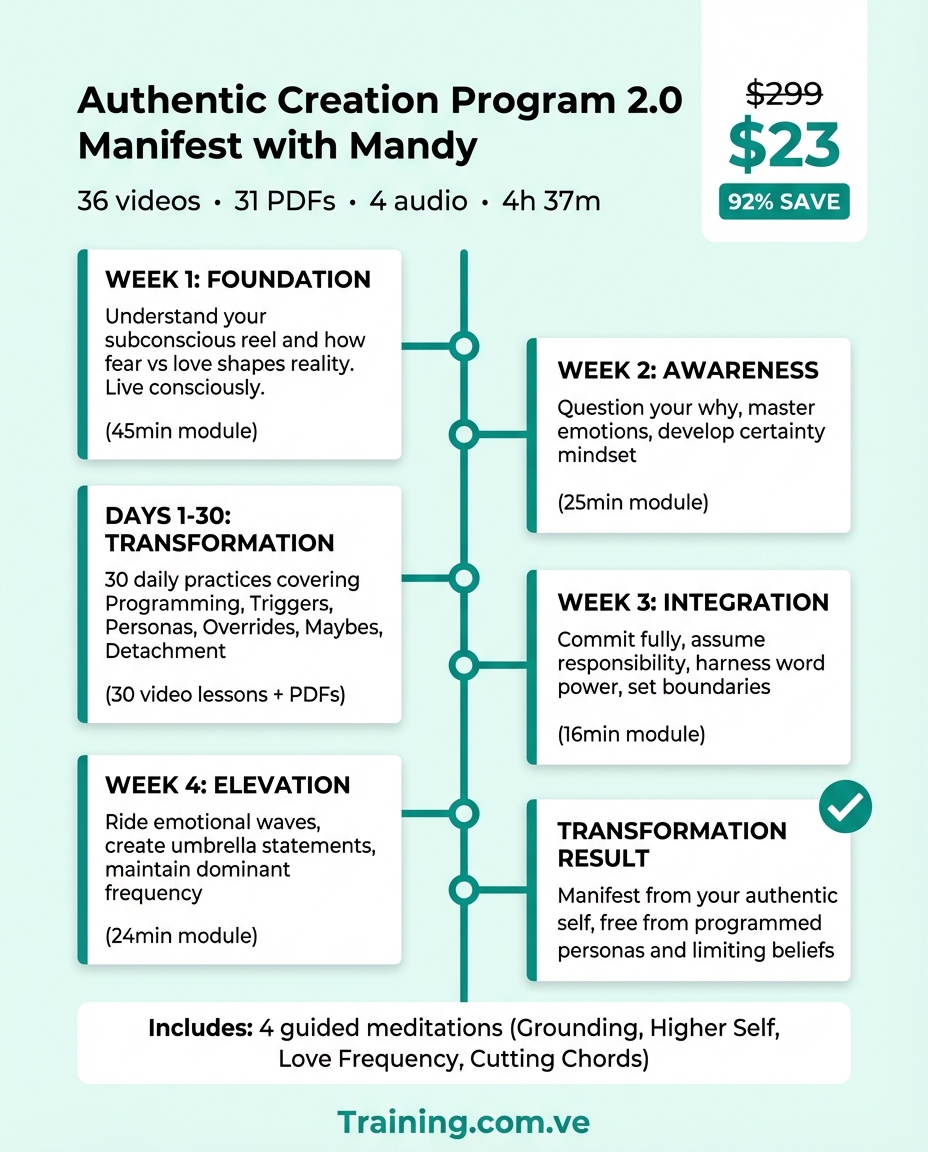
The Ceiling and Basement Framework is Mandy Morris's diagnostic model from the Authentic Creation Program 2.0 — a $299, 37-lesson course — for understanding the unconscious upper and lower limits that govern every major life area. The framework explains self-sabotage not as a character flaw but as a predictable, mechanical response to a calibration system your subconscious has been running since childhood.
Things are finally going well. The relationship feels easy. The income is climbing. Your health is the best it has been in years. And then — without any clear reason — something breaks.
You pick a fight that didn't need to happen. You take on a client that drains you. You skip the gym for two weeks and don't notice until the streak is gone. The good thing you built starts quietly coming apart.
You call this self-sabotage. You are right. But the word explains nothing about the mechanism — which means it gives you nothing to work with.
Mandy Morris, energy coach and two-time bestselling author whose Authentic Living programs have reached more than 3 million people in 80 countries, calls this mechanism the Ceiling and Basement Framework. It is the foundational diagnostic tool inside her Authentic Creation Program 2.0 — a $299 course with 37 lessons built around identifying and dissolving the unconscious programs that keep your life within a narrow, self-imposed range.
The Ceiling and Basement Framework does not treat self-sabotage as a character flaw. It treats it as a calibration — a predictable, mechanical response to an unconscious set point that your system will defend with remarkable consistency. Understanding the framework does not just explain why the pattern happens. It gives you the specific intervention point for changing it.
What Is the Ceiling and Basement Framework?
The Ceiling and Basement Framework is Mandy Morris's 2-component model for mapping the unconscious range within which your life actually operates. The framework identifies two invisible limits — a Ceiling (upper limit) and a Basement (lower limit) — that define what your subconscious system considers normal, safe, and sustainable across income, relationships, health, and self-expression.
The core claim of the framework is this: every major area of your life — relationships, income, health, creativity, self-worth — has two unconscious boundaries operating simultaneously.
The ceiling is an upper limit. It is the level of good beyond which your system cannot comfortably remain. When circumstances push you above it — when things are going better than your unconscious programming considers normal or safe — the self-sabotage response activates automatically. Not from conscious choice. From a deeper, older mechanism that has decided this level of good is outside the range of what is meant for you, sustainable for you, or safe for you.
The basement is a lower limit. It is the floor below which things must not remain. When circumstances push you below it — when pain, lack, or failure becomes severe enough — that same system activates a different response: the sudden clarity, the willingness to change, the motivation that was unavailable before everything got bad enough.
Together, these two limits define the range within which your life actually operates, regardless of what your conscious goals say. You may want to earn significantly more. But if your ceiling is set at your current income, any upward movement will be quietly corrected. You may want to stay in a better relationship longer. But if your ceiling is set at a particular level of intimacy or ease, the system will find a way to reintroduce friction.
The insight that makes this framework practically useful: the ceiling and the basement are linked. Raise your basement — raise the minimum you are willing to tolerate — and the ceiling rises automatically.
How the Ceiling Works
The ceiling is not a belief you hold consciously. It is a frequency — a felt sense of what normal is supposed to feel like — that your system has been calibrating since childhood.
When life exceeds that frequency, a gap opens between the reality of your circumstances and the unconscious expectation of what your circumstances should be. That gap produces discomfort. Not the identifiable discomfort of pain or loss, but the quieter discomfort of unfamiliarity — the sense that something is off, that the good thing is too good, that it will be taken away, that you do not deserve to remain here.
Mandy Morris's broader framework includes the concept of dominant frequency — the energetic signature your system treats as home base. The ceiling is the upper edge of the range that dominant frequency permits. Exceed it, and the system works to restore equilibrium. This is not willpower failure. It is homeostasis operating exactly as designed.
The behaviors that the ceiling produces are typically not dramatic. They are mundane-looking. A slightly cooler response to a partner when closeness reaches a certain intensity. A delay on the proposal that would bring in significantly more revenue. A craving for a drink or a distraction precisely when momentum in a project is highest. The ceiling's defense mechanisms are subtle because subtlety is more reliable than drama. Drama can be noticed and resisted. Ambient self-correction usually cannot.
What makes this different is that the ceiling operates through behavior that looks, in the moment, entirely rational or environmentally caused. That is precisely what makes it invisible without a diagnostic framework.

How the Basement Works
The basement operates differently, but it comes from the same calibration.
The basement is the pain threshold that produces change. It is the point at which suffering has become severe enough that transformation becomes possible — not because you suddenly have more willpower, but because remaining at the current level has become more uncomfortable than changing would be.
This is why people who have been in destructive relationships for years will suddenly leave. Why entrepreneurs who have been stuck at the same income for a decade will abruptly commit to something different. Why someone who has ignored their health for years will completely overhaul their diet after a diagnosis. The basement was reached. The pain exceeded the threshold. Action became available that was not available before.
The problem with relying on the basement as your activation mechanism is that it requires you to descend to genuine crisis before your system permits genuine change. The periods of growth you generate from basement moments are then capped by the ceiling — and the cycle repeats. Enough pain to change, not enough capacity to sustain the change.
The framework's central reframe: you do not have to wait until things get bad enough. The action you take at rock bottom is available to you right now. The basement defines when you are willing to take it. Raising your baseline for what you are willing to tolerate — deciding, now, that certain conditions are not acceptable rather than waiting until they become intolerable — is the mechanism for raising your floor without requiring the crisis.
Get Every Framework from Authentic Creation Program 2.0
The course costs $299. All frameworks extracted — $49/year.
Start free — 10 full summaries, no credit card
A Real Example: Income and the Invisible Limit
Consider someone who has been self-employed for four years. Their income varies significantly month to month, but the annual average is remarkably stable — not because the market is not there and not because their skill is insufficient, but because a consistent pattern plays out whenever income approaches a certain level.
Above that level, they find themselves taking on a difficult client who costs them more than they earn. Or they have an unexpected expense that pulls the balance back down. Or they procrastinate on the follow-up that would close a significant contract. The specific behavior changes. The outcome does not: income reverts toward the average.
Below a certain threshold, a different pattern appears. Clarity. Urgency. A sudden willingness to do the outreach they had been delaying, to charge more, to say no to the draining client they had been tolerating. The pain of being below the floor produces the motivation that abundance had not.
Through the lens of the Ceiling and Basement Framework, neither pattern is mysterious. The ceiling is the unconscious definition of how much this person is allowed to earn — shaped by early programming about what money means, who deserves it, and whether financial security is something available to them specifically. The basement is the pain level that temporarily overrides those programs.
The core insight is that the intervention the framework proposes is not motivational: identify the ceiling, trace it to its source using Morris's 5 Whys Emotional Root-Cause process, and simultaneously raise the basement by deciding — not in a crisis, but now — what minimum conditions you are no longer willing to accept.
The Authentic Creation Program 2.0 covers 7 frameworks — including the Ceiling and Basement model, Love vs Fear Compass, 5 Whys Emotional Root-Cause Method, Personas and Unhealed Parts, Programming Inventory, Dominant Frequency Effect, and the Umbrella Statement. The complete breakdown of every framework — plus every limitation — is on Course To Action. Audio on every summary. Use the "Apply to My Business" AI tool to test these frameworks against your own situation. Start free — no credit card required.
How to Apply the Framework
Step 1: Map your ceilings by life area. Take one area at a time — income, relationships, health, creative output, self-expression. Ask: when things are going well in this area, at what point does something reliably break? Not dramatically — subtly. When do you notice yourself doing the thing that introduces friction or distance or regression? That point is approximately where your ceiling sits. Write it down concretely: not "I self-sabotage with money" but "when my account balance reaches X, I find reasons to spend." Step 2: Identify the early warning signs. The ceiling does not announce itself. It produces behaviors that feel rational, spontaneous, or environmentally caused. Learn to recognize the specific behaviors that appear when you are approaching your limit. In relationships, it might be picking arguments about trivial matters. In business, it might be a sudden exhaustion with the project that was previously energizing. In health, it might be skipping the workout you actually enjoy. Naming the early warning sign is how you interrupt the cycle before it completes. Step 3: Raise your basement by raising your floor. For each life area, identify the current basement — the level of bad you have been willing to tolerate before taking action. Then ask: what would you do if things were at absolute rock bottom in this area? What action would that version of you take? That action is available to you now. Taking it from a position of relative stability rather than crisis is how you raise the floor without requiring the descent. Step 4: Take the rock-bottom action — early. This is the core practice of the framework in daily life. Identify the action that you would take if things had finally gotten bad enough. Then take it today. This is not about manufacturing urgency. It is about recognizing that the urgency the basement produces is artificial — a product of pain, not of genuine insight. The insight was always available. The basement was just the delivery mechanism.Common Mistakes
Mistake 1: Treating the ceiling as an external problem. When things go well and then break, the natural interpretation is that something external caused the break — a difficult client, a partner's behavior, an unexpected expense, bad timing. The ceiling operates precisely by producing circumstances that appear external. The work of the framework is recognizing when the external event is an expression of an internal limit rather than a genuinely independent cause. Mistake 2: Trying to push through the ceiling without locating it. Motivation, discipline, and affirmations are tools for operating within your existing ceiling. They cannot raise it. Attempting to push through an unconscious upper limit with conscious effort produces the behaviors Morris calls "manifestation contradictions" — you want one thing but your energy is calibrated for another, and the energy always wins. The ceiling must be identified and traced to its source before it can be moved. Mistake 3: Waiting for the basement to activate change. The most common relationship with the Ceiling and Basement dynamic is passive: rise until the ceiling pushes back, fall until the basement fires, repeat. The framework is designed to interrupt this cycle by making the basement's mechanism conscious and therefore available before crisis. If you are reading this during a relatively stable period, that is precisely the right moment to do the work — not when things have gotten bad enough to force it.Start Here Before You Buy the Course
The Ceiling and Basement Framework is one of seven major frameworks inside the Authentic Creation Program 2.0, alongside the Love vs Fear Compass, the 5 Whys Emotional Root-Cause method, the Personas and Unhealed Parts model, the Programming Inventory, the Dominant Frequency concept, and the Umbrella Statement process. Each framework addresses a different layer of the same underlying problem: the gap between what you consciously want and what your unconscious programming is actually producing.
This is best suited for entrepreneurs, people-pleasers, and self-directed learners who recognize a pattern of self-sabotage and want a structured methodology for tracing it to its origin — not just managing it at the surface level.
This framework is from the Authentic Creation Program 2.0 by Mandy Morris, priced at $299 for 37 lessons. Before you commit, start free at Course To Action — no credit card required. The full breakdown of all 7 frameworks, audio on every summary, and the "Apply to My Business" AI tool are available for $49/month across 110+ courses.
Not a review. Not a rating. A complete framework-level analysis so you know exactly what you're buying — or whether you need to buy it at all — before you spend $299.
Start free at Course To Action — then decide whether $299 is the right next step. Course To Action publishes independent framework-level breakdowns of online courses — the 20% that delivers 80% of the value, so you can make an informed decision before you spend a dollar.Get All Frameworks from Authentic Creation Program 2.0
The course costs $299. The complete breakdown is $49/year — every course on the platform.
This is one framework. Course To Action has every framework, every lesson, and AI that applies it to your specific business. Read or listen — every summary has audio.
Start free — 10 full summaries, no credit card required