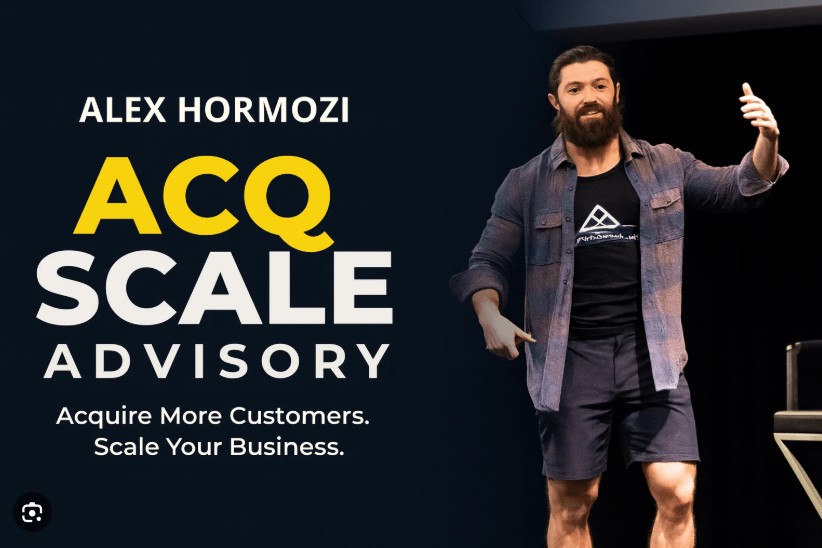
Client-Financed Acquisition Explained: How Alex Hormozi's CFA Model Makes Your Customers Fund Your Growth — from ACQ Scale Advisory by Alex Hormozi
Client-Financed Acquisition (CFA) is Alex Hormozi's 3-level framework from his high-ticket ACQ Scale Advisory — a 36-lesson monetization program — for structuring your offer stack so that the gross profit collected from each new customer within 30 days fully exceeds what you spent to acquire them. The core claim: when 30-day gross profit exceeds your Customer Acquisition Cost, your customers are funding their own acquisition, and growth becomes self-financing. This is the foundational framework inside ACQ Scale Advisory, and it reframes the entire relationship between your margins and your growth rate.
The full breakdown of all 36 lessons is on Course To Action — including every CFA level, the Four-Prong Money Model, and the Five Upsell Timing Windows.
Most businesses treat customer acquisition cost like a tax — an unavoidable expense that drains cash before revenue arrives to replenish it. Alex Hormozi built a $250M+ portfolio by treating it as something else entirely: a constraint that disappears when you structure your monetization correctly.
The framework is called Client-Financed Acquisition. It is the foundational idea inside his high-ticket ACQ Scale Advisory, and it reframes the entire relationship between your margins and your growth rate. The core claim is precise: if you design your offer and upsell stack correctly, your customers will fund the cost of acquiring the next customer — and eventually, each customer will fund two.
That is not a metaphor. It is a math problem. And Hormozi lays out exactly how to solve it.
What Is Client-Financed Acquisition?
Client-Financed Acquisition (CFA) is Alex Hormozi's monetization and offer-design framework that uses gross profit from existing customers — specifically the gross profit generated within a defined time window — to fully offset Customer Acquisition Cost before you need to deploy additional capital for growth.
The key takeaway is this: CFA is not about reducing your ad spend — it is about engineering what happens after the customer arrives so that the money model makes further ad spend self-sustaining.
The traditional model looks like this: you spend $500 to acquire a customer, that customer generates $100/month in gross profit, and you break even in five months. During those five months, growth consumes cash. Scale fast, and you are perpetually cash-poor regardless of how profitable the business looks on paper.
CFA flips the question. Instead of asking "when do we recover CAC?" it asks: "how do we structure the offer so that the gross profit we collect immediately — or within 30 days — already exceeds what we paid to acquire this customer?"
The answer involves two levers: reducing acquisition costs and increasing upfront gross profit through well-timed upsells. Hormozi addresses both throughout the 36-lesson advisory, but CFA is the north star that every other framework — the Menu Upsell, the Five Timing Windows, Big Head Long Tail Pricing — ultimately serves.
The Three Levels of CFA
Hormozi does not present CFA as a binary you either achieve or don't. He maps it as a progression across three distinct levels, each one unlocking a different growth capability.
Level 1: Lifetime Gross Profit Exceeds CAC
This is the baseline. Your total gross profit from a customer, over their entire lifetime with your business, is greater than what you paid to acquire them.
If it costs you $500 to acquire a customer and they generate $800 in lifetime gross profit, you are at Level 1. The business is profitable. But it is not scalable in any aggressive sense, because you have to wait out the customer's full lifetime to recover that CAC. Growth is slow, and it is largely funded by debt or retained earnings.
Most businesses that consider themselves healthy are stuck at Level 1. They are profitable. They are not compounding.
Level 1 is necessary but insufficient. It is the floor, not the goal.
Level 2: 30-Day Gross Profit Exceeds CAC
Level 2 is where the model becomes genuinely interesting. Here, the gross profit you collect in the first 30 days of a customer relationship is greater than the cost of acquiring them.
At $500 CAC and $600 in gross profit within the first month — through a combination of the core offer margin and a well-executed upsell — you have already recovered your acquisition cost before the second month begins. You owe no future revenue to the past. Every dollar that comes in after day 30 is net growth capital.
This is the threshold at which a business can grow without debt. You do not need to borrow to fund the gap between spend and recovery, because the gap no longer exists. This unlocks a specific kind of operational freedom: you can increase ad spend, hire, and expand without needing a credit facility to bridge cash flow.
Hormozi describes Level 2 as "growth without debt." It is a meaningful milestone for any founder who has experienced the cash-flow squeeze of trying to scale a business where revenue always lags the spend that generated it.
Level 3: 30-Day Gross Profit Exceeds 2x CAC
Level 3 is where CFA becomes a compounding machine. Here, the gross profit you generate in the first 30 days is not just greater than your CAC — it is greater than twice your CAC.
At $500 CAC and $1,100+ in 30-day gross profit, you are collecting enough from each new customer to fund the acquisition of the next one and still have margin left over. Every customer arrival funds the next arrival. Growth becomes self-sustaining and, because each cycle generates surplus capital, the rate of growth itself accelerates.
What makes this different is that at Level 3, growth no longer requires any external capital — the business generates its own acquisition budget with each customer it signs.
Hormozi's phrase for this is "each customer funds the next, exponential compounding." That is not marketing language. It is a description of what happens mathematically when the reinvestment rate exceeds 100% of the cost it is replacing. The business stops requiring external capital to grow and starts generating more acquisition budget with every customer it signs.
This is the level at which portfolio companies in the Acquisition.com model are able to scale aggressively without diluting equity or taking on debt.
This is one of 6 frameworks in ACQ Scale Advisory. The complete breakdown — every framework, every limitation — is available on Course To Action. Start free.
Real Example: Hormozi's Gym Story
Hormozi built his initial framework in gyms — specifically through Gym Launch, the business he scaled before selling a majority stake in 2021 for $46.2M alongside Prestige Labs.
The gym model had a familiar problem: gyms spent heavily on paid advertising and referral programs to acquire new members, but membership fees alone were thin-margin, and the industry average churn was punishing. A gym spending $200 to acquire a member paying $39/month with 60% churn inside six months was nowhere near Level 1 — they were destroyers of capital.
Hormozi's intervention was offer architecture. By introducing a front-end offer with a higher price point — a six-week challenge at $299, for example — a gym that spent $200 on acquisition could collect $299 upfront, with gross margins well above 50%, generating immediate gross profit that exceeded the acquisition cost on day one. That is Level 2 at acquisition.
The members who converted from the challenge to a standard membership then generated ongoing gross profit that layered on top. Gyms that added a supplements upsell — Prestige Labs being one avenue — pushed their 30-day gross profit further and began approaching Level 3.
The math changed the trajectory of the business. Not because the marketing improved. Because the offer was restructured so that money arrived before the month was out.
Get Every Framework from Alex Hormozi $18k Upsell / ACQ Scale Advisory
The course costs $High-ticket. All frameworks extracted — $49/year.
Start free — 10 full summaries, no credit card
How to Apply CFA in Your Business
Step 1: Calculate your current CAC with precision. Total acquisition spend — ad spend, sales salaries, referral fees, agency costs — divided by new customers acquired in the same period. Be exact. Most operators undercount CAC by excluding overhead from the sales function. Step 2: Map your 30-day gross profit per new customer. This is revenue collected in the first 30 days minus the direct cost of delivering that revenue. Include the core offer margin plus any upsells taken in that window. If you do not have a structured upsell sequence, this number is almost certainly lower than it could be. Step 3: Identify your current CFA level. Compare your 30-day gross profit per customer against your CAC. Are you below CAC (pre-Level 1 in the short window)? Equal or slightly above (approaching Level 2)? Greater than 2x (approaching Level 3)? Step 4: Identify the lever with the highest leverage. You can move toward Level 2 and Level 3 by reducing CAC, increasing the core offer margin, or adding a high-conversion upsell in the first 30 days. Hormozi's Menu Upsell framework — specifically the timing windows he calls "immediately after purchase" and "24-72hr follow-up" — targets this window specifically because those are the moments when buyer momentum is highest and marginal revenue is easiest to capture. Step 5: Run the math forward. If you achieve Level 3, model what reinvestment of the surplus gross profit does to your customer count at 90 days, 180 days, and one year. The compounding is nonlinear. Operators who see this math for the first time frequently realize they were sitting on a growth engine they had never activated.Common Mistakes
Mistake 1: Treating CFA as a margin problem instead of an offer design problem. The instinct is to cut costs. Lower your COGS, negotiate better supplier rates, reduce team overhead. These are operational improvements but they are slow and have limits. CFA is solved faster through offer design — adding a well-placed upsell that converts at 30-40% and generates $200-$500 per customer clears the Level 2 threshold faster than six months of margin optimization. Mistake 2: Measuring lifetime value instead of 30-day gross profit. LTV calculations are useful for long-term modeling, but they obscure the cash-flow reality that makes growth painful. A business with a $1,500 LTV and $400 CAC looks healthy until you realize the LTV is realized over 24 months. CFA demands a 30-day lens. If your 30-day number does not exceed CAC, you have a cash flow problem even if your unit economics look fine on paper. Mistake 3: Attempting Level 3 before Level 2 is stable. Some operators, after hearing the Level 3 math, immediately try to add multiple upsells in the first 30 days and push hard for maximum extraction. This damages trust and increases refund rates, which raises effective CAC and collapses the model. The sequence matters: stabilize Level 2 first. Get 30-day gross profit reliably above CAC with one clean upsell. Then build toward Level 3 with a second offer that arrives after the first big customer win — one of Hormozi's Five Upsell Timing Windows specifically designed for this purpose.The core insight is that CFA is an engineering problem, not a sales problem. You solve it by redesigning what happens after acquisition — not by trying harder to sell.
Start Here Before You Buy the Advisory
Client-Financed Acquisition is the load-bearing framework in Alex Hormozi's ACQ Scale Advisory — but it does not operate in isolation. The 36-lesson advisory also covers the 4-Prong Money Model (Attraction, Upsell, Downsell, Continuity), the complete Menu Upsell system (Unsell, Prescribe, A/B test, Card on File), all Five Upsell Timing Windows, Big Head Long Tail Pricing, and the Win Your Money Back offer construction. Each framework is designed to push your 30-day gross profit upward toward and beyond 2x CAC.
In summary, CFA is the north star of the program: every other framework exists to push your 30-day gross profit closer to — and then beyond — your Customer Acquisition Cost.
For the full breakdown of all frameworks in the Alex Hormozi $18k Upsell / ACQ Scale Advisory — every case study deconstructed, the complete Menu Upsell sequence, and an honest map of who the program serves well and where it falls short — the independent course deconstruction is available at Course To Action.
Not summaries. Full framework deconstructions. The 20% that delivers 80% of the value — because we have the courses. Not the clips. Not the podcasts. The courses.
Full breakdown at Course To Action — start free.Course To Action publishes independent framework-level breakdowns of online courses — the 20% that delivers 80% of the value, so you can make an informed decision before you spend a dollar.
Get All Frameworks from Alex Hormozi $18k Upsell / ACQ Scale Advisory
The course costs $High-ticket. The complete breakdown is $49/year — every course on the platform.
This is one framework. Course To Action has every framework, every lesson, and AI that applies it to your specific business. Read or listen — every summary has audio.
Start free — 10 full summaries, no credit card required